|
Profile |
|
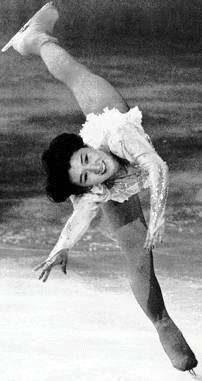
It may not be reproduced without prior written consent. Born August 13, 1969 in Nagoya, Aichi, Japan, Midori Ito took to figure skating at the tender age of 4 and started competing at age 6. Even at that young age, Midori's natural skating ability was prodigious, showing remarkable talent in the area of jumping. While her parents divorced when she was 10, Midori began to live with her coach, Machiko Yamada, a partnership that still survives to this day. 1980 proved to be a successful year with two junior national championship victories, the All Japan Juniors and All Japan Junior Freestyle. At the 1980 NHK Trophy, she was invited to perform an exhibition and her skate was a dazzling display of triple jumps, a flurry of salchows and toe loops, six in all. Said winner and eventual World Champion Denise Biellmann that she was glad she would never have to compete against the likes of Midori.
At age 12, she made waves at Junior Worlds by becoming the first woman in history to execute a triple/triple combination, a triple toe loop/triple toe loop, and became known throughout the skating world as "Tsunami Girl" and "The Japanese Jumping Bean." She made a steady ascent on the junior scene, from 8th at Junior Worlds in 1981 to 6th in 1982 to a bronze medal in 1984, interrupted only by an ankle injury that kept her out of competition for much of the 1982-83 season. She aimed for a berth on the 1984 Winter Olympic team in Sarajevo, and with her stellar record on the junior national and international scene, it seemed likely. An (ironic) fall, however, on the double Axel in the technical program eliminated her chances, but with her silver medal finish, she did qualify for her first Worlds in Ottawa. She made a strong first impression there, landing her trademark triple/triple, and finished 7th. The next season was filled with impressive early season showings with victories (and triple Axel attempts) at Skate Canada and NHK Trophy. Ever courageous, ever daring, after winning what was to be the first of eight consecutive All Japan Championships, Midori reinjured her ankle while she was practicing quadruple jumps (!) in practice, forcing her to withdraw from Worlds. Her next two trips would result in 11th and 8th place finishes, respectively, but they were only warm-ups for 1988: her breakout year. If there was only doubt that Midori Ito had reached the upper echelons of figure skating, this was enough to carry her over the threshold and put her into the spotlight. Despite a 10th place finish in the compulsory figures, Midori brought down the house with dynamic skates in the technical and free programs, finishing fourth and third in those portions, respectively, and fifth overall - a few places lower than what many thought she deserved. Her seven triples added up to the most technically demanding program of the competition. With the crowd producing a deafening roar as she landed her last triple, the Salchow, she leaped into a final double Axel and started pumping her fist in exultation. It was a spontaneous, and completely endearing, gesture, a delightful conclusion to a thrilling performance.
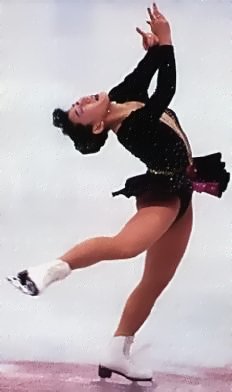
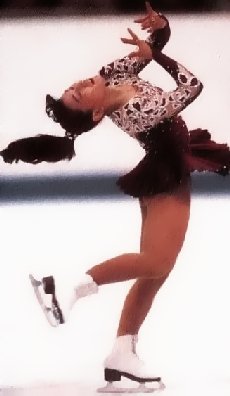
The next season saw Midori at the peak of her career - and making history. In November 1988, she executed her first triple Axel in competition at the Aichi Prefecture Championship and repeated this feat at the NHK Trophy. Her focus was set on Worlds in Paris. Despite a sixth place finish in the compulsories, Midori easily won the technical program with two 6.0s for technical merit and outdid herself by landing a huge, almost overrotated triple Axel in the free program. Said commentator Scott Hamilton: "I think this program is impossible to beat, there's nobody in the world that could skate this kind of technical program. Brilliant performance!" Garnering five more 6.0s, she won her World title, became the first Asian woman to win the gold and the first woman to land a triple Axel in world competition, pushing the technical bar for women's figure skating in the process. To understand just how extraordinary this accomplishment was, the only contemporary of Midori's to land the ever elusive triple Axel was American Tonya Harding - but she lacked Midori's surefire consistency. Since then, two skaters, Ludmilla Nelidina and Yukari Nakano (incidentally, coached by Yamada as well) have had successful, ISU-ratified triple Axels -- but again, neither have demonstrated mastery through competitive consistency. Determined to improve her presentation mark, she added ballet and jazz dance classes to her usual training regimen of 20 hours in the summer, 30 in the winter. And the free program at the 1989 NHK Trophy is probably one of Midori Ito's finest hours, technically, artistically, (arguably) the most complete women's free program ever. Landing seven triples, including a triple Axel and triple/triple, Midori's dynamic power, speed, and much improved artistry were accented to the exquisite strains of Rimsky-Korsakov's ballet music, "Scheherazade." Her marks were without parallel: the Hungarian judge gave her the exceedingly rare perfect 6.0/6.0 for both technical merit and artistic impression. It seemed that a second consecutive world title was within the realm of possibility. Once in Halifax, however, Midori's weakness in the compulsory figures came back to haunt her, with a devastating tenth place finish in that portion. But she charged into the technical program set to a lively medley of swing music, landing a huge triple Lutz/double toe loop combination and winning all first place ordinals. When interviewed, Midori charmingly said, in halting English: "And tomorrow, free skating, I'll be... (makes a thumbs up sign)." The champion was back. In the free program, she landed a triple Axel that was better than the one she landed the year before, and was rewarded with a standing ovation and three 6.0s for technical merit. Although she won both the technical and free programs, she took the silver medal behind American Jill Trenary. In the next two seasons, aside from a fourth place finish at the 1991 Worlds in Munich (where she famously landed in the camera pit after her combination jump), she won nine golds and one silver in the events leading up to the Winter Olympics. The pressure was mounting.
Once in Albertville, she was hounded everywhere by the Japanese media, overwhelmed by the expectations and pressures of winning the first gold medal for Japan in twenty years. Her skating on the Grand Prix had been superlative, seemingly unbeatable, defeating main rival, American Kristi Yamaguchi, at Trophee Lalique and landing the triple Axel/double toe loop at the NHK Trophy: here, she skated with none of her usual spark or spunk. Her nerves were further rattled in practice by the antics of France's Surya Bonaly who landed a backflip in her path (she was later reprimanded by the ISU). In the technical program, Midori decided to replace her triple Axel combination with the triple Lutz, a jump that was usually solid for her - and fell. Mired in fourth place, and with horrible practices all week, her chances of the gold, or even medaling, seemed unlikely. But she bravely came back with a performance that Scott Hamilton called "gutsy." With a fall on her first triple Axel attempt, no one expected that, at three minutes and ten seconds, she would attempt the very same jump and land it, the very first by a woman in Olympic competition. It was as if a thunderbolt struck the arena - and Midori's face lit up with perhaps her first genuine smile of the week. With five triples in all, she won the silver, behind Yamaguchi. Even though team coach, Noriko Shirota, told her it wasn't necessary, she humbly apologized to her country for not winning the gold. For Midori, these Winter Olympics were best described as bittersweet. Retiring from eligible competition, Midori Ito skated three seasons in the professional ranks with great success, her biggest win coming at the 1993 World Pros, where she landed the first triple Axel by a woman in professional competition and defeated Kristi Yamaguchi. Her reinstatement into amateur skating during the 1995-96 season proved to be ill-fated, resulting in a disappointing 7th place finish at Worlds. Originally, Midori was to compete until the Winter Olympics to be held in Nagano, but those who remembered her stressful experience in Albertville feared for her. If the pressure was intense in France, competing in her home country would be next to unbearable. She gracefully bowed out - but was granted the immense honor of lighting the Olympic cauldron in the opening ceremonies of those games. Thing had come full circle. Japan's most dazzling and decorated skating heroine, who didn't win gold but epitomized the very essence of the Olympic spirit, ignited the fire to the glorious strains of Puccini's "Madame Butterfly."
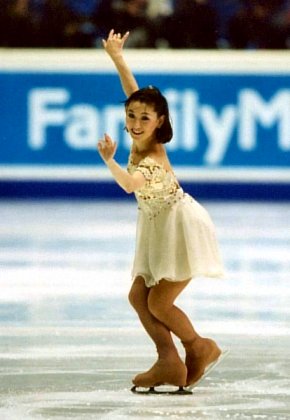
While Midori has kept a low profile in North America, she remains active in Japan, skating eleven months a year in Prince Ice World shows for her longtime sponsor, Prince Hotels. She also provides color commentary for Japanese eligible skating competitions and assistance to her coach, Machiko Yamada, whose students now include promising young skaters like Yukari Nakano and Yoshie Onda. In January of 2001, Midori made a return to professional competition, in the Japan Open, and skated well enough to win a bronze medal. In her interpretive free program, nearly a decade removed from her last eligible competition, she boldly attempted the triple Axel that made her famous. Even with a step-out on the landing, it was an impressive moment. Said Midori: "I thought it be great to compete for the first time in Japan after my long time away." It is said that a talent like Midori Ito only comes along once every fifty years. Her many Firsts speak for themselves. And while Midori lacked the natural elegance or grace of her contemporaries Kristi Yamaguchi or Jill Trenary, it is unfair to call Midori just a jumper. She was a complete skater, with wonderful depth and security in her edging, powerful speed and ice coverage, and artistry that, while not traditional, was wholly organic. Her form of artistry stemmed from the pure, unfettered joy she had for skating. Peggy Fleming once said that "I think she has such a wonderful charisma with this audience. She looks like, you know, she's just loving every moment out here." And this joy, and love, is what has sustained the life, and legacy, of one of skating's most brilliant talents.
|
|
Contact | Transcripts | Profile | Photo Gallery | Home |