Lunatus Ensemble Medieval
RECOVERING THE MUSIC OF THE MIDDLE AGES
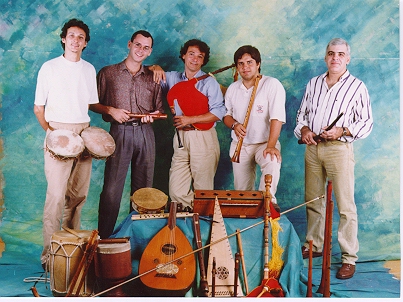
In 1995, the group Lunatus Ensemble Medieval was created by brazilian musicians who aimed to play the music from the Middle Ages. Music from this period was highly influenced by arabian culture and may be classified in two major categories: instrumental dances and songs for voice and accompanying instruments. Besides the search of musical scores, Lunatus researches the medieval period itself. The group tries to reproduce what we may call "the soul of the medieval music".
The musicians of Lunatus utilize copies from medieval instruments found in museums or reconstituted from pictures. Besides playing flutes, lute, vi�le and hurdy-gurdys, the musicians of the group also use instruments of high sound projection as galician pipes, shawns and natural trumpet (a straight trumpet with almost 3 meters). The percussion instruments come mainly from the arabian world (as bendir, derbak, nakers and zarb). Medieval pictures registered the use of these instruments in different occasions.
Lunatus' repertoire includes well-known medieval popular dances (saltarellos, ductias estampies, trottos and rottas), songs from Carmina Burana, religious chants and songs from troubadours and trouv�res. Vocal pieces are performed in their original languages, as Medieval English, Early French, Proven�al and Galaico-portuguese.
In 1998, the group has included in its repertoire some of the 427 Cantigas de Santa Maria - composed in the thirteenth century, in the court of Alfonso X (the Wise). It is known that the king himself composed some of these cantigas, and that he employed musicians from different countries and religions in his court. The lyrics of the Cantigas de Santa Maria tell us about miracles attributed to the Virgin. As they were composed in the galego language, the Cantigas constitute today an importante source of study in the field of the portuguese-galician literature.
In the musical performance, Lunatus utilizes fundamental elements from medieval music such as improvisation. Due to the lack of registers (we believe that all the CDs recorded in that age were destroyed !), Lunatus Ensemble does not present its work as the unique and precise way of playing this music, but as one of the multiple forms of recreating the essence of the medieval minstrels.
Among Lunatus' presentations - which happen in bars, theaters and churches -, the most representative are:
AT THE RADIO - The radio station Cultura FM (SP, Brazil) has retransmitted, from time to time, the two programs recorded by the Lunatus in this station. We thank the audience of the radio for the phone calls and e-mail messages received after each of these presentations.
AT PARATI - In november/1997, Lunatus presented its work at the Santa Rita's Church, in Parati (RJ). The public (more than 200 spectators) was enthusiastic.
AT S�O PAULO - In June/1998, the Lunatus performed at the EUG�NIO KUSNET Arena Theater, a small and nice theater. It was the opening of the project Lat�o Musical, and Lunatus Ensemble showed Cantigas de Santa Maria and medieval dances.
AT THE "CONFRARIA" - At the Confraria da Dan�a (Campinas), Lunatus feels at home: there were 11 presentations there since March/1997, with a total public of 618 spectators. The proximity between the stage and the public is very interesting. At the premi�re of the show "El Sabio Que Fez" (May/1998), for instance, the bis had the direct participation of the public, which danced freely - brazilian people do this quite well !
AT THE CATHEDRAL - The Campinas Cathedral was probably the most beautiful place in which Lunatus has ever performed, as part of the First Early Music Meeting of Campinas (September/1998). On September 6, Lunatus performed for its largest audience (500 spectators), using microphones. The repercution of this event shows that the brazilian public is absolutely receptive to early music. This event was also an opportunity to get in touch with the beautiful work of Marcos Horvat and the Faenza Ensemble.
SANTOS - In May 7, 1999, Lunatus has performed medieval music again in its "homecity" after almost 3 anos. More than 100 spectators - many friends among them - enhanced the show, which received a very favorable critic written by the world-fameous composer Gilberto Mendes.
AT THE TV - In Jan/1999, Lunatus participated in a TV show transmitted by TV Tribuna. The recording was made at the Valongo Church, em Santos (SP). In April/1999, the group appeared in programs transmitted by TV Cultura (S�o Paulo). In May 8, 1999, reporting the return of Lunatus to Santos (after 3 years from the last presentation in that city), TV Tribuna covered the May show and interviewed some spectators.
We are looking for the scores of the 7 Cantigas de Dom Dinis, to prepare them for presentation. If anyone can help us in this subject, please get in touch !
Also, if you want to receive a FREE mp3 archive with a sample of Lunatus' music, please write to "[email protected]".
Members of Lunatus Ensemble Medieval are:
Paulo Barja - Voice, simphony (hurdy-gurdy), bendir, cymbals, tambour, tambourine
Jo�o Carlos Braga - Derbak, tambour, nakers, bendir, tambourine, cymbals
Andr� Victor - Shawm, recorder, galician pipes, tambourine, voice
Francisco Espuny - Vi�le, slide trumpet, galician pipes, recorder, shawm, tambourine, cymbals, voice
Wilson Melo - Lute, shawm, galician pipes, recorder, simphony (hurdy-gurdy), voice
E-mail: [email protected]
Telephone: 55-13-32279673 or 55-11-37513239
VIEW Lunatus' Guestbook (1998-2000) !
VIEW Lunatus' Guestbook (2001) !
Last update: August 21, 2001
 Get your own Free Home Page