| The Monolith | |
|
|
| � Throughout "2001," tools are a mixed blessing. The bone club frees the apes from starvation, but introduces murder and the concept of resources controlled by violence (civilization). All through the movie technology screws up. Pens float away from their owners. Simple conversations are made impractical by space travel. Heated food is just a little too hot to handle. What's point of a phone if Floyd's wife isn't there to answer and he winds up leaving a message with a toddler who will forget anyway? Then there's a bit about a space ship actually killing most of its own crew. We endure these things because our bodies are inadequate. We are big vulnerable bags of water consuming and evacuating vitals like air, water, vitamins, sunlight and waste. Throughout the film we hear the astronauts breathing their precious gases. We see Frank Poole getting a little Vitamin D through a tanning table. All the major characters, from the ape clan to last moment of Bowman at the foot of his deathbed, are shown taking time out to eat. We even get a shot of Floyd reading the instructions on a Zero-G toilet. And of course we see the astronauts exercising, fighting to keep their burdensome bodies from atrophying into mush. At the end of 2001 we see a human transcend the body. With it goes the need for tools - which have always been extensions of our bodies that can do things that we, unaided, can not. |
|
�
� |
And what carries on? Kubrick shows humans completely transforming hunger to ritual, violence to diplomatic face-offs, brutal murder to pulling the plug, and rest to cryogenic preservation. Is there one fundamental human quality that makes us the same as the animals that the first monolith was put down in front of 4 million years ago? With amazing visual eloquence, Kubrick shows what part of the human carries on. Curiosity. Fascination - whether it's primitive fear/worship or a cold, analytical eye with a camera. This is the quality that continues without variation through the movie. |
| There is a lot of room to argue
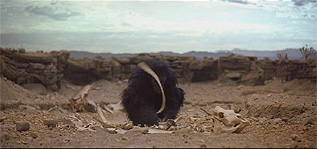
about whether or not the monolith causes or gives the apes the ability to use tools. The
main ape character (I don't think Clarke's "moon watcher" title is very useful)
simply futzes around with some bones for a few minutes. There's a shot of the monolith and
then a light bulb goes on in the monkey's head. A bone spins in the air and the motif of
spinning technology that culminates in HAL begins. This does not necessarily mean that the
monolith did anything. It's enough to just be there, as a suggestion. Just putting the
monolith there causes the birth of the human imagination. The night before the monolith,
we see a close up of the ape's eyes and they are human.� Those eyes are the eyes of
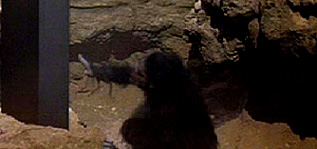
someone thinking. The ape may have simply thought about it and it finally hit him what it was about the monolith that seemed so different from everything else in his life. There's a scene in The Hunt for Red October where a sonar man identifies the Red October's silent drive by analyzing the innocuous cover noise that the submarine's cloak gives it. When he finally gets it, he plays a tape of it for his Captain who doesn't follow him. Then he speeds the tape up several times and a muddy flushing noise becomes a steady, low metal gong. I seriously doubt very many people on this earth who have seen that movie didn't think to themselves something just like what the sonar man said next - "that's got to be man made!" Imagine not having any of the criteria to come to that conclusion. What kind of intuitive leap must have occurred there for the ape to get that raw material had been manipulated... by someone else! There's something about the monolith that completely, literally, floors the apes. At least when they first see it. In the next scene they don't seem all that overwhelmed by it. But the main character has an intuitive flash - "those angles and flat surfaces = what I'm doing with this bone..." or did he? � |
|
|
|
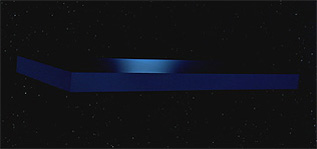
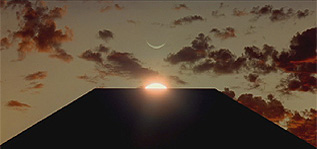
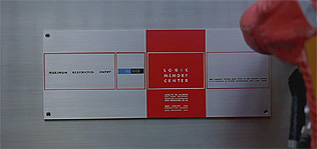
| � The second monolith obviously doesn't give humanity anything. All it did was signal when humans considered extraterrestrial travel hum drum enough that they couldn't stand to have something odd buried on the moon that they didn't know about. The apes' curiosity made the discovery of the buried monolith a certainty (provided they survived 4 million years). It marked a clear point in human history. So did the main ape's first bone tool. Maybe all the monoliths were there for was to see these moments when a life form takes these important steps. Maybe they are just observers. Maybe the monkeys were on the very brink of discovering simple tools and this development is as obvious to the creators of the monolith as the development of space flight to the point of excavating the moon is to us! All the monolith did was hang out to witness it... maybe. The monolith is gone in the scene after the ape discovers the tool. That's all it wanted to see. Then the monkeys start murdering each other. Murder is our invention. Did the monolith give us tools and then we perverted their use? Or did the monolith just hang around long enough to see the invention that really counted? On the side of the monolith greatly effecting, if not causing, the use of tools - the recurring image of the monolith in human technology. HAL's memory core has an exquisite stainless steel monolith on the door. His mind is composed of little translucent monoliths. Is HAL the child of the monolith? Or is he just a reflection? His body is a reflection of our bodies with a head, face, ear and motor half. His mind may be a reflection of what every toolmaker has had in mind since the first main ape started knocking bones around.� The fact that the inside of HAL's mind (a being made in "our" own image) is composed of monoliths, is probably the single best argument that the monolith was put on earth to influence human development. |
|
�
|
|
| Tools
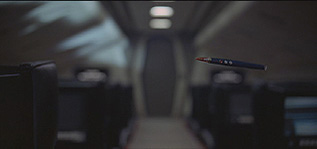
From the Dawn of Man we jump directly into a era when humans are perilously close to losing control of their tools. This is famously expressed with a pen that has floated out of Dr. Floyd's hand and drifts about the cabin at the same time that we are treated to a ballet of technology as the PAN AM flight docks with the space station. There is a joylessness to this tool shrouded life that people lead in the year 2000. |
|
� |
|
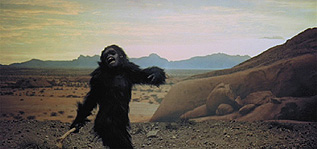
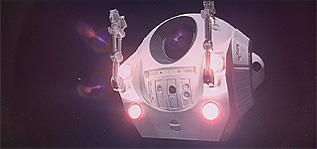
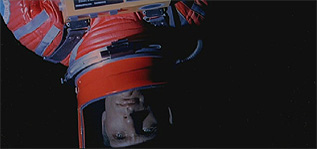
| Compare these two tools below. The ape's body is standing erect and gloriously extended. The bone is a brutally unforgiving extension of his arm. Where his arm moves, his will to shape and kill follows. Now consider the pod. It has completely encapsulated the human. We know that whoever's in there is cramped in something resembling a fetal position. Not only can it's occupant not swing their arms, he must concentrate very hard to work the mechanical claws in front. We see Bowman operate them and it involves the lightest taping of complicated joysticks. � When inside the pod, a human is little more than a head and some hands operating controls... which if you look at the outside of the pod is an ominously redundant situation. | |
� |
|
| �
|
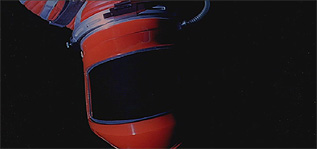
The symbolism is a little obvious here, but it's a nice illustration of how symbol and story telling come together in 2001. Kubrick wanted 2001:ASO to be utterly convincing as a depiction of space travel. This is one of the little details that help that illusion. Before turning to work on the AE35, Bowman presses a button and his visor clouds over to protect his eyes from all the solar radiation that he will be facing into. Thematically, this is chilling because Bowman (with an especially blank look on his face) is fulfilling his role as HAL's tool. He is not a sentient being, he is a device that an entity uses to do things it cannot do for itself. Or as HAL put it "I am putting myself to the fullest possible use..." So his face dissolves into what looks like a TV that's been turned off. |
| � This situation is the bulk of the movie. Humans are making themselves redundant as they refine life into a purely cerebral state. The only problem is that HAL is much much better at being purely cerebral. This is the conflict in the movie's central drama. Bowman overcomes this conflict by reverting back to being a murderous monkey. Lest you miss this point, when Bowman comes out the other side of the stargate, you can hear monkeys howling for a couple seconds. So murder, something the monolith didn't even stick around for in the Dawn of Man, is the thing that allows humans to triumph and meet the third monolith. � |
|
� |
|
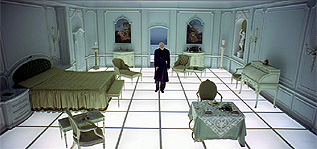
| Does the monkey give murder to the star child or does it just inherit our curiosity? It seems that the white room at the end is there to strip Dave of many things. His body most obviously. He literally watches it wither decay in a manner that makes a lot of sense if you consider that he is now beyond time and space. He loses his tools of course. When the pod arrives the instruments readouts are all errors or malfunctions. But I think Bowman is forced to realize that the confrontation that his species has engaged in for four million years is useless now. | |
|
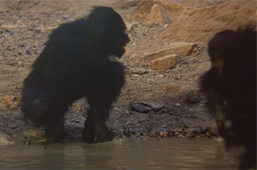
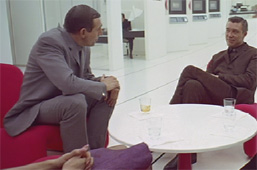
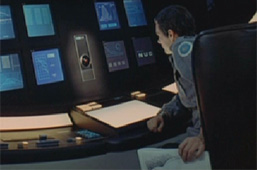
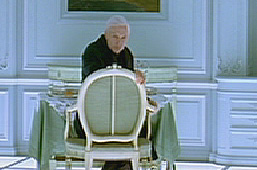
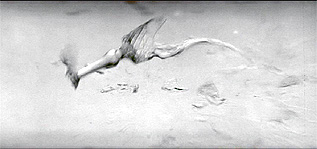
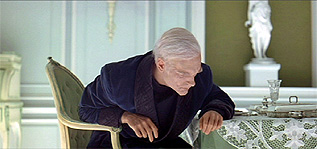
There is a very subtle visual theme that runs
throughout the movie about confrontation. In the four shots to the left you see some of
the movie's most hostile moments. The ape is trying to defend his waterhole. Floyd is
standing his ground against the Soviets. (The cup of brownish liquid is symbolic of the
waterhole and now the whole earth. Floyd is not drawn into the fight because he is no
longer concerned with earth. He ascends to the moon in TMA-1, the Soviets are "on the
way down" to the waterhole.) There is a pane of brownish glass between HAL and Dave.
This is the scene where HAL lies about the AE35, just like Floyd lied by letting the false
rumors about an epidemic on Clavius spread. Notice the nearly identical posture of the men
being lied to. Notice in all three the general curving sweep of the background. They are
all in a cycle of conflict. Now look at the one of Dave beyond the infinite. All straight
lines. The shot is framed by a doorway. There is no more cycle of conflict. Then he turns and brushes a glass full of brownish liquid off the table. He looks at the glass expectantly, as if waiting for someone to lie to him or someone to fight. Again, the same crouching posture. Nothing. After four million years, there is no one to fight. |
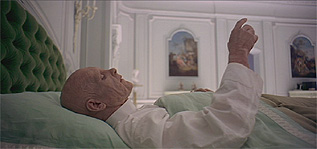
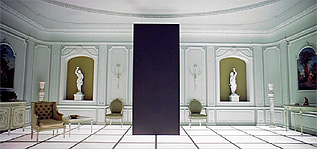
When Bowman becomes aware that he has no need to defend the waterhole, he notices himself near death in the bed near him. The glass was also a metaphor for his body. Now he faces the forth monolith. Bowman has no tools, no appetites, no territory, and now no body. What remains to pass on? Curiosity. |
|
�
� |
|
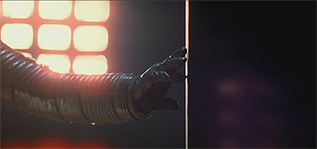
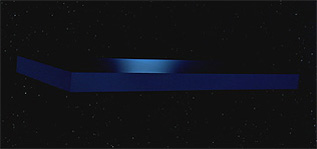
| Look at the straight, symmetrical lines emanating from the monolith. All perspective points meet dead center, beyond it. But above is yet another circle. There is another cycle of life and conflict that can just barely be imagined. The monolith is pointing the way to it. Again, the monolith doesn't tell Bowman to do it or pick him up and toss him through the circle on the ceiling like a scene out of Poltergeist. It simply stands there and lets the ape draw its own conclusions. | |
| � �
|
|
 home
home