�
EAT
Just about everyone in this film eats at some point. It's Kubrick's way of constantly harping on the fact that we have bodies to maintain by spending time each day shoving nutrients in them. There's a brief history of food and civilization here in "2001."
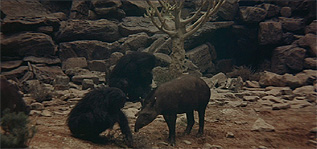
This first shot is of the apes as scavengers. They are picking at the ground for insects and trying out various plants. They have to share this food source with the pigs here, which are just big enough to be a hassle to kill without tools or organization. They are starving to death in this picture. They are at the mercy of a local big cat predator.
�
�
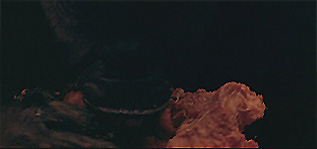
The next shot is a decadent and juicy screen full of fresh, raw meat that comes with the use of tools. The apes have become something deadly - armed predators.
�
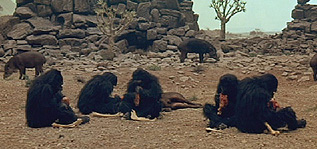
This leads to surplus and the next shot. They have pigs to spare, which is to say they have plenty of food. This scene goes on for quite a while. The apes lay around gorged and the wet sound of their chewing is palpable.
�
�
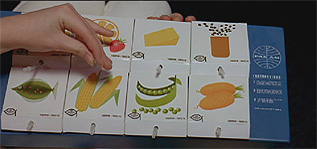
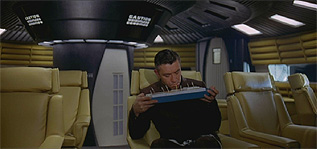
The next time we see someone eat in 2001, humans have learned to deal with surplus. They have preserved and packaged their extra food. Also, agriculture was invented - this is indicated by the vegetable and dairy staples illustrated on the boxes. (This is one of the implied advances that comes with lording over a waterhole.) We have leaped directly from chomping down on a hunk of bloody meat to sipping nourishment out of straws. Not only are our meals no longer walking around next to us, as they do in the previous meal, our food comes in a mass-produced plastic tray. We never actually see what being eaten, people have learned to trust what it says on the label.
�
�
The next shot is the New Man Heywood Floyd enjoying his diner. Compare his posture with that of the apes in the first two shots. There is mention of yet another meal in the space station - a breakfast appointment. Food surplus is so taken for granted by these modern people that eating is now not only a scheduled event, but something that is important as a social engagement, not for feeding.
�
�
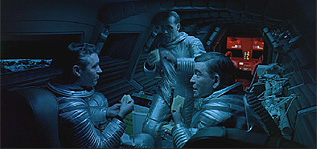
It all tastes the same. Fast food. Surplus is now packaged purely for convenience, irrespective of taste. Now there is no bloody hunk of meat. There aren't even any colorful pictures of food. Just little grey bricks pulled out of a container that might be mistaken for a box holding ammunition or toxic waste. The dialogue here is the astronauts joking about how awful the food is and then munching on it absent mindedly as they talk about Tyco.
�
�
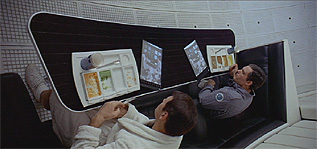
The Discovery dinner. Now humans no longer even speak during meals. Instead they watch recordings of conversations while eating colored paste. We have completely lost taste, the company of others, and any real concern about the reason we feed ourselves. (These two are basically eating TV dinners while watching TV.)
�
�
�
�
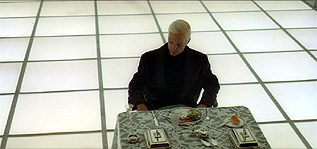
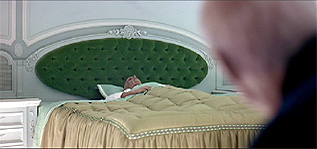
Beyond the Infinite. The only meal in the film a normal person would want. It is a solitary, aesthetic experience. This is the last stage of the body: refinement of experience.
�
�
�
�
SLEEP
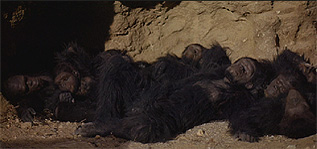
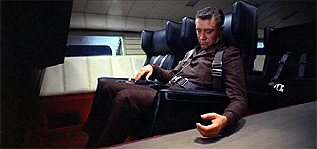
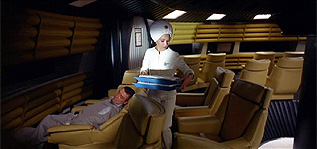
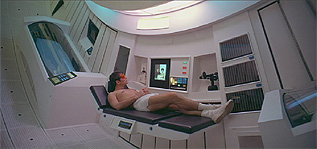
Sleep is a very complex theme in "2001" and I don't think I quite understand it beyond a certain level. Obviously, like all the other bodily functions Kubrick dissects, sleep is something that the body needs that is overcome when the star child is born. We need to rest just as we need to eat, breath and reproduce. At the beginning of the film we see sleep as an exhausted pile of primates. It's a tough life they lead, what with the drought, territorial battles and running from the cat. The next person we see resting is Floyd on the PAM AM flight. Rest is no longer something done when exhaustion overcomes us at night. Humans now live in a world where there is less cause for actual physical exhaustion and travel can make "night" meaningless. Floyd catnaps in "2001" twice, to and from the space station. On the other side of those naps, Floyd is a very animated and alert person. You get the impression that sleep is a utilitarian refueling for Floyd
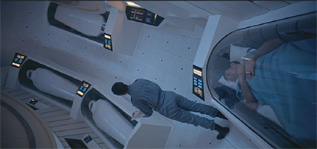
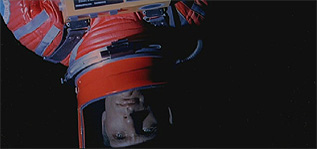
The next time we see someone sleeping, humans have learned to use sleep as a way of casting off their bodies. Poole says that being in hibernation is like being asleep - you don't feel time passing. The three frozen Discovery crew members are to HAL what the employees of the Tyrrel Corporation are to the replicants in Blade Runner (or Frankenstein to the monster) - they are a crippled, inferior version of what they have created. In this state of hibernation, humans can almost travel as pure intellect through space, like HAL. But not quite.
�
�
�
BREATH
Frank Poole jogging in the Discovery may be one of the most famous shots in movie history. On the Discovery we get almost clinically aware of Bowman and Poole's health. We see their diet, know they sleep in shifts, watch them exercise, see Poole soak up some Vit. D and hear them breath. I don't think I've ever seen a sci-fi movie that came close to 2001 in portraying the fact that there just aren't very many breathable gases up in space - well, any at all as far as you and I are concerned. Not even submarine dramas really come close to the sense of confinement that 2001's scenes near Jupiter have. At least in a sub there's the miracle that allows the hero's sub to ascend those deadly hundreds of feet to the surface by movie's end. But in space - I don't think there's a ever a moment of hope in the film that Poole and Bowman can "get away" from HAL. The only movie that comes close to this that I know of is Apollo 13, and that claustrophobia was relieved by the mission control subplot.
�
�
�
POOH
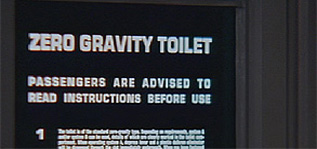
Like actual sex among the apes in the Dawn of Man, Kubrick basically points to the existence of it and then moves on. In this case, Heywood excretes waste. It's the other half of the food theme. Add up all the time you spend eating, sleeping, doing things for your health and excreting waste, and you have a goodly fraction of your life there. Also, this works with the theme that humans in space are infants. Here, Floyd is being potty trained.
�
�
�
 home
home