|
THE PROCESS
 We select for you
top-of-the-range composite materials such as resins, gel coat and
multidirectional fabrics, all of them certified by considered
organizations such as Lloydds, Norwegian Nordsk office, or the
Bureau Veritas, an international certification office. This endows
all our catamarans with excellent resistance to ageing and is
responsible for their exceptional mechanical characteristics. For
example, a P465 structure weighs 7.5 to 10 kg/m2 according to the
sampling plans ! The Bureau Véritas certification, which awards,
on your request, an individual construction certificate, is one of
the GROUPE ALLIAURA MARINE yard's major assets. This involves
intensive supervision and regular inspections which are carried
out by Véritas experts for the entire construction process of
each catamaran. these inspections entail mechanical, traction,
bending, physico-chemical shearing tests and representative
test-pieces of hull planking. Beyond these inspections, we insure
our structures for 3 years. We select for you
top-of-the-range composite materials such as resins, gel coat and
multidirectional fabrics, all of them certified by considered
organizations such as Lloydds, Norwegian Nordsk office, or the
Bureau Veritas, an international certification office. This endows
all our catamarans with excellent resistance to ageing and is
responsible for their exceptional mechanical characteristics. For
example, a P465 structure weighs 7.5 to 10 kg/m2 according to the
sampling plans ! The Bureau Véritas certification, which awards,
on your request, an individual construction certificate, is one of
the GROUPE ALLIAURA MARINE yard's major assets. This involves
intensive supervision and regular inspections which are carried
out by Véritas experts for the entire construction process of
each catamaran. these inspections entail mechanical, traction,
bending, physico-chemical shearing tests and representative
test-pieces of hull planking. Beyond these inspections, we insure
our structures for 3 years.
STRUCTURE
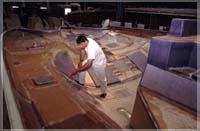
The structures of our catamarans are guaranteed 10 years !
It is the fruit of controlled and resolutely hi-tech technology,
implemented by extremely qualified labour.
Moreover, our fidelity with the Marc Lombard office, in perfect
symbiosis with our own design office is a guarantee of stability
and also common research into technological evolutions born out of
ocean racing.We have been using the technique of vacuum bagging
for many years, allowing us to apply this technique to all the
structural parts of the boat, hull, deck and bulkheads.
This technique associated with the use of high quality polyester
resin and "aviation" quality glass cloth very precisely
selected according to their use, gives us a weight per m_ among
the lightest in the marine business.Thus in matters of cloths, the
choice includes very complementary varieties throughout the range,
going from unidirectional, to bi, tri and quadridirectional.
All of these techniques and processes are reinforced by the
scrupulous choice of our supplies of which, resins, cloths and
foams are approved by world renowned organisations, such as
Lloyd's and Bureau Véritas.
The latter issues on demand an " Individual Construction
Monitoring Certificate" !
Hulls
Glass polyester sandwich on PVC foam applied under vacuum.
Solid laminate keel lines reinforced in the beaching zones and
contact points.
Bulkheads
Glass polyester sandwich on PVC foam applied under vacuum.
Deck
Glass polyester sandwich on PVC foam applied under vacuum.
Implemented on contact in a female mould in one single piece with
chainplate and beam reinforcements.
Anti-skid incorporated in the moulding.
 APPENDAGES APPENDAGES
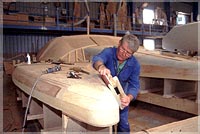
The hung rudders on stainless steel stocks and self-aligning
bearings, are linked together by a crossbar which can take the
emergency tiller (supplied).
They are made from multiaxial cloths, including unidirectional and
bidirectional, impregnated with polyester resin and entirely epoxy
foam filled.
Depending on the versions we
use different keel systems, fixed fins or daggerboards.
The fixed fin keels are made in the same way as the rudders,
completed with numerous bulkheads and foam filled along the entire
bottom 1/3, to ensure perfect watertightness in the event of a
violent shock.
They are also designed to function as sumps being able to recover
any water ingress at a much lower level than the soles.
As for the daggerboards and board casings, they are made with
epoxy impregnated glass cloth.
The daggerboards are made
buoyant, for safety and practical reasons through the choice of
low density foam.
The daggerboard casings also use uni and bidirectional cloths, to
ensure perfect stiffness of the assembly, and to increase their
rigidity in the event of violent shock, the daggerboards have a
sheering role thereby avoiding damage to the boat's structure.
They are extremely reinforced and interdependent with the hull
through dense bulkheading from one end to the other of the casing
over all its height.
------------------------------------------------------------ |