The comparison of evolutionary psychology and feng shui reveals many interesting similarities. A linkage of the modern Darwinian synthesis and 3,000 year old Chinese science would appear to be an arduous, if not ridiculous undertaking. Yet the author firmly believes after reading this paper the reader will feel that indeed, there are some very interesting parallels between these two fields. The first area to be discussed will be a brief summary of what comprises feng shui. This will help the reader better understand the different ideas covered in this paper. After the summary, I’ll argue that the feng shui practices involved in the bagua map, habitat selection, phobias, and physical attractiveness are similar to some of the ideas in evolutionary psychology.
As a caveat, I must say feng shui is not mutually inclusive to evolutionary psychology. Instead, I am arguing that the two ways of thinking are not mutually exclusive. There are many ideas in feng shui that are “way out there.” The following quote highlights a bizarre guideline. “Since most of the world is right-handed, the right hand is often used to express friendship and greeting, as in shaking hands. Consequently the right side of a room should have a closer connection to emotions.” (Wydra, 1996, p. 49) The author would like to express, as a left-handed person, that this quotation is not legitimate. Another book about feng shui insinuated that the staircases in the last Czar’s summer palace in St. Petersburg were negatively positioned, and as a possible result, the bloody Russian revolution happened!
Before the reader becomes too discouraged about this paper’s lack of coherent information, there’s a quote that highlights how feng shui and evolutionary psychology are similar. This following quote explains the symbolism of fish in feng shui.
A picture of a child with a fish means ‘may you have an abundance of high-ranking sons’; goldfish in a bowl or pond mean “may gold and jewels fill your house to overflowing’; a fish with a lotus blossom means ‘year after year may you live in affluence (Thompson, 1996, p. 139).
This quote’s parallels with evolutionary psychology are quite apparent. High social status, good financial prospects and preference for economic resources were discussed. Anyone who has read Buss’ “Evolutionary Psychology” can notice these analogous ideas. This paper’s author hopes the reader will notice these parallels in some other areas of feng shui herein discussed. Even though these two areas are quite different in theoretical approach, they often discuss the same subject matter.
Feng shui (pronounced fung shway) was originally practiced in China starting around 3,000 years ago. The first practitioners were actually in the armies of ancient China. These military personnel studied the physical environment to help with defending and fighting enemies. They understood that knowing one’s environment is critical to successful warfare. These military personnel and their armies, controlled by the ruling family, were forbidden to divulge this crucial information. “At one time, Feng Shui masters who shared the secrets of Feng Shui with people outside the imperial family could be put to death.”(Lawler & Ziegler, 2004, p.22) It’s not known exactly when other people started to practice it, but more than the imperial military of China eventually practiced it.
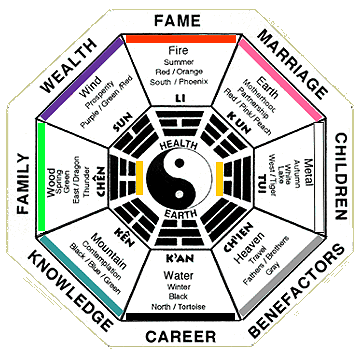
These practitioners came to realize that understanding the environment is beneficial not only for military related pursuits. Over hundreds, if not thousands of years, they studied the environment and came up with many ideas and two major ideas. One is the idea of chi, a life force that will flow freely, bringing health, love, peace, and even prosperity to those who have a harmonious environment. The opposite of chi is char chi, a negative life force that hinders a prosperous life. “Having good chi-flow through your space makes you feel more comfortable and even happier. It brings positive energy to you, making you feel more upbeat and positive. Negative energy, on the other hand, can make you feel stuck and depressed.” (Lawler & Ziegler, 2004, p. 42) Only environments that fit with feng shui teachings have chi and are suitable to live and prosper in. The other main idea is the “bagua” map. This chart shows were different areas of an environment correspond to different areas of life.
The bagua map fittingly parallels many ideas in evolutionary psychology. As you can see from figures one and two, it’s divided into eight areas. These areas correspond to the most essentially important and vital aspects of life. Feng shui indicates these areas are the most central areas of life to keep in order.
Since this paper is about analyzing feng shui from an evolutionary viewpoint, I will do that with the bagua map. These eight areas would then be separated into two applicable areas. The first one would be about evolved mate preferences. Evolutionary psychology books often deal with what people find attractive people because it translates into reproductive fitness. In other words, if someone is more attractive in certain areas that the other sex prefers, then they will have more reproductive success. These certain preferred areas are very common in feng shui. Firstly, there is the section of the bagua map concerning “wealth”. Even though females value it much more than men, both still find it helpful in a mate, especially for long term relationships (Kenrick, Sadalla, Groth, & Trost, 1990). The second is the “fame” section. The word fame and status are usually related. Women throughout the world have been shown to have a preference for men of high status, such as in the United States (Buss & Barnes, 1986). Even in hunter-gatherer societies there are status hierarchies with the men on the top receiving the most assets including increased sexual access to women. (Betzig, 1986; Brown & Chia-yun, n.d.). The third mate preference of the bagua map is the “career” section. This is quite similar to the fame and wealth sections because if someone has a good career, it usually translates into higher status and financial prospects. This is especially true for males. It is in this way of thinking the “knowledge” section of the bagua map makes sense. Finding mate preference information on knowledge was very difficult probably because the proposal of ranking people’s intelligence is not outright done in academia. However, I can ascertain that a knowledgeable person would have served a very valuable role in the EEA. For example, knowledge of the surrounding areas in terms of edible plants and animals would have been very important. These different areas of the bagua map are interrelated with themselves and evolved mate preferences.
The other section of the bagua map is related with the inclusive fitness theory. This theory states that not only are one’s own genes important, but others who are related to him or her. Similar reasoning reveals why the “children” area of the bagua map makes sense. Evolutionarily speaking, children are the vehicles that pass on one’s genetic legacy. Along these lines of thought is the next area of the bagua map, the “family” area. Whereas it is not exactly known why humans form families, it’s most likely because it carries a tremendous reproductive benefit (Buss, 1999, p. 244). Similar reasoning attempts to explain the existence of families, which is fittingly another area of the bagua map. The existence of families is quite an anomaly in the animal kingdom, but the norm in homo sapiens. Taken together, the fame, career, knowledge and wealth components of the bagua map have similarities to evolved mate preferences.
The last section of the bagua map related to the inclusive fitness theory is “benefactors.” This area is also called “helpful people” in some bagua maps. If you look at this section in terms of reciprocity and friendship it makes sense. The feng shui literature has examples of reciprocity. “Giving some of your blessings away brings more to you. So don’t forget to give your garden produce away to friends and family throughout the summer and fall.” (Lawler & Ziegler, 2004, p. 214) “Look to the compassion corner when entering a home to determine how your needs will be met. In a similar way, be sure to provide assistance to those who enter your world. Both the provider and the recipient will benefit.” (Wydra, 1999, p. 53) Evolutionary literature also points out the possible adaptive importance of having friends (Tooby & Cosmides, 1996). Both the feng shui literature and evolutionary literature reveal that the receiver will be better off in a reciprocal friendship.
The bagua map outlines the basic tenets of feng shui. When viewed from an evolutionary viewpoint, these tenets look less mystical and spiritual as some books on the subject point out, but more like justifiable Darwinian thinking.
Habitat selection is also very similar in both areas. Finding the correct environment to sustain life would have been a fundamental adaptation in human evolution. “Given the supreme importance for survival of selecting a place to live…it would be astonishing if evolution left our environmental preferences untouched.” (Buss, 1999, p. 85) It comes as no surprise to an evolutionary psychologist to unearth data revealing an evolved desire for a sustainable environment. To live, humans need an environment where there is an abundance of life; both in game and vegetation. The research aptly shows humans find these types of environments the most appealing. Trees and other vegetation is higher rated than similar environments that lack trees of vegetation (Ulrich, 1993) The same idea of desiring plant life is expressed in feng shui literature: “Plants bring additional living energy into a space and help to keep the chi flowing smoothly and freely.” (Butler-Biggs, 1999, p. 63)
On the northern side there should be, ideally, hills at the back as protective elements. There should be flowing streams and low hills to the east as symbols of wealth, ponds or lakes to the south also for wealth, and low hills and roads to the west as protective and functional elements. (Lip, 1989, p. 9)
Both ways of thinking seem to select for a similar environment. It is in this way that gardens provide an interesting offshoot of habitat selection. First I should say that I highly doubt humans have a specific mechanism specifically for gardens. But I would be willing to argue gardens satisfy other evolved mechanisms for food selection. As previously noted, humans have a strong interest for environments that can sustain life, as does feng shui literature. “Living plants…create life energy that can raise the chi in your garden.” (Lawler & Ziegler, 2004, p. 146) This quotation is from a book entirely dedicated to combining feng shui and gardening. Throughout the book there are many tips on maintenance, pest and disease control and growing. The importance of having a healthy garden is stressed in the majority of books on the subject. “Your natural preferences are often good feng shui. A home surrounded by plants and pleasant views will give its inhabitants a feeling of tranquility and lead to improved well being.” (Butler-Biggs, 1999, p. 11) This quote seems to allude to the idea humans have “natural preferences” for gardens. An evolutionary psychologist might read the last quote and add the word “evolved” instead of the word “natural.” Nonetheless, both fields are talking about the same idea. Interestingly enough, a feng shui author wrote about evolutionary psychology in terms of gardening.
Evolutionary psychologists now believe that humans are genetically programmed to engage in behavior that will advance their gene pool into the next generation. Because our offspring require a longer period of care than those of any other mammal, we need to have a natural predisposition toward long-term caregiving. We are connected to our natural biology when given an opportunity to care for living things, so caring for plants satisfies an important instinct. (Wydra, 1996, p. 104)
Whereas I believe the author was wrong on several different levels, she was correct that humans are satisfied on an instinctual level when caring for gardens. I believe this because gardens represent easily accessible food. There is evolutionary literature that points out habitat selection would have been a very important issue. “The most pressing general problem in food selection is how to obtain adequate amounts of calories and specific nutrients such as sodium, calcium, and zinc without at the same time consuming dangerous levels of toxins that could rapidly lead to death (Rozin & Schull, 1988). It would only make sense to have adaptive modules satisfied by gardens because they solve this important adaptive problem of providing food and nutrients in a close, accessible manner. A garden can signify to humans a place of accessible nutrients. Overall, feng shui seems to help people become better aware of what type of environments they should live in: the type that served an adaptive function.
Contrary to this, humans should therefore find environments unappealing if they are not conducive to life. Again, the literature supports this conclusion. There are suggestions in feng shui for not living in environments such as deserts or tundra or on the tops of mountain ranges. All these environments are not hospitable to life. There are also suggestions to not live where there is not enough water or if the water is not clean. “In feng shui, water is synonymous with money, and good, clean water equals money or the ability to attract money and resources. All environments containing water are superior to those without water.” (Thompson, 1996, p. 48) It almost goes without saying an environment without water cannot support life. A lot of this habitat selection and feng shui literature might strike some people as rather obvious. Yet what is obvious to one person, in this case habitat selection, is another persons fundamental adaptation.
The commonalities are also found regarding human fears. These phobias can be looked at as clues in figuring out human’s evolutionary history. Whereas we still don’t live in the EEA, in many ways we still act like we do. An example of this behavior is how we avoid certain animals. Darwin seemed to predict quite well that scientific experiments would reveal these clues to our past when he wrote: “May we not suspect that the…fears of children, which are quite independent of experience, are the inherited effects of real dangers…during ancient savage time?” (Darwin, 1877, pp.285-294) Feng shui practitioners seemed also to know about these fears. Here is a quote from a much read book on the subject: “Only domesticated animals should be kept. Snakes, tarantulas, mice, insects, monkeys, and other wild animals belong in nature.” (Thompson, 1996, p. 139) It looks as if feng shui practitioners figured out humans had phobias of certain animals and accordingly advised against having them around. Yet these animals are not just any animal, but particular animals that would have been dangerous to humans in their ancestral environment. In Africa, where humans evolved for the longest period of time, snakes, spiders and wild animals are quite hazardous to humans. It makes evolutionary sense to have evolved a desire to stay away from such dangerous animals. An interesting study revealed that even modern day schoolchildren in Chicago, the fears of tigers, snakes and lions were rated as what the kids were the most afraid of. (Maurer, 1965). This study reveals that even in a modern environment where there are a lot more dangerous things (such as smoking and cars); humans are still the most afraid of the type of things found in the EEA. The feng shui way of explaining phobias of certain animals is that they produce char chi and an inauspicious environment. Evolutionary psychologists explain the same phenomenon by taking into account our EEA. In their own respective ways, these areas discuss the same subject matter.
So far I’ve discussed the parallels between these two fields regarding the bagua map and the external environment. Yet I also believe feng shui has some related insights regarding the internal environment.
Both fields discuss the significance of physical attractiveness. Feng shui offers ways to change your internal environment to facilitate physical attractiveness. An excellent example of this is the use of mirrors. They serve the important function of giving feedback to how we are looking. “Seeing a full, clear image of yourself tends to enhance your self-esteem, whereas mirrors that cut your image off or into pieces…have the opposite effect.”(Collins, 1999, p. 85) Or “It is important to choose mirrors that reflect whole images. Clear, bright mirrors reflect clear, bright Ch’i. Therefore, mirrors that are one big, clear piece of glass are best.” (Collins, 1999, p. 84) By recommending mirrors that reflect a clean clear and in-focus image, feng shui helps people receive positive feedback about themselves. This in turn would lead the person to think they are more attractive. A dirty mirror or individual mirrors combined in one amalgamation would give a distorted view of a person. The vertical position of mirrors follows this reasoning. “Seeing a full, clear image of yourself tends to enhance your self-esteem, whereas mirrors that cut your image off or into pieces…have the opposite effect.”(Collins, 1999, p. 85) Feng shui recommends placing the mirror so you can also see yourself as tall as you are, and not any shorter. It makes sense for people to see their entire head and thus see themselves as taller.
Yet can this type of thinking be reconciled with evolutionary psychology? Definitely. Humans seem to have an evolved mate preference for tallness. Many studies indicate this type of relationship. Tall men are seen as more attractive rather than short men just because of their above average height. (Ellis, 1992) Furthermore, in a real world setting, taller men received more responses by women when they placed personal ads than shorter men (Lynn & Shurgot, 1984). A glance at the personal ads shows that women do want taller men (Kenrick & Keefe, 1992). Another finding suggests that in a noncontracepting environment taller men would have had more children (Nettle, 2002). This finding is significant because it puts forward that human’s could have an evolved adaptation for wanting tall partners. But do different cultures around the world favor tallness? An important benchmark for evolutionary psychology is if the trait is found around the world. The findings do suggest preference for height to be found cross-culturally. For example, in an Andalusian town in rural southern Spain the inhabitants use spatial metaphors along these lines. Tallness, regardless of gender, is associated with wealth, power, and control. Shortness, regardless of gender, had such negative values associated with it like poverty, weakness and submission (Brandes, 1993). Another example was found in Canada, eh. After an election for prime minister in 1988, the winner was seen as taller and the losers seen as shorter. This implies human’s have an unconscious mechanism for associating tallness with higher status which has been linked to Cleary, the benefits to being taller have many benefits. Physical appearance is also desired in both sexes as a long-term mate (Buss & Schmitt, 1993). One possible reason for feng shui’s allure is that it highlights certain things people can do to have themselves look more attractive in terms of evolved preferences in physical characteristics.
Overall, I hope the reader is persuaded that these two areas have much in common. The similarities regarding the feng shui practices involved in the bagua map, habitat selection, physical attractiveness, and phobias are similar to some of the ideas in evolutionary psychology. Taken as a whole, feng shui is a more proximate and supernatural way of explaining humans and their environment. While evolutionary psychology is a more ultimate and scientific way at explaining these same phenomena.
References
Betzig, L.L. (1986). Despotism and differential reproduction: A Darwinian view of history. Hawthorne, NY: Aldine.
Brandes, S. (1993). Spatial Symbolism in southern Spain. The psychoanalytic study of society. Hillsdale, NJ, England: Analytic Press.
Brown, D.E., & Chia-yun, Y. (n.d.). “Big man” as a statistical universal. Department of Anthropology, University of California, Santa Barbara.
Buss, D. M. (1995). Evolutionary Psychology: A new paradigm for psychological science. Needham Heights, MA: Allyn & Bacon.
Buss, D.M. & Schmitt, D. P. (1993). Sexual strategies theory: An evolutionary perspective on human mating. Psychological Review, 100, 204-232.
Buss, D.M., & Barnes, M.F. (1986). Preferences in human mate selection. Journal of Personality and Social Psychology, 21, 559-570.
Butler-Biggs, J. (1999). Feng Shui in 10 Simple Lessons. New York, NY: Watson-Guptill.
Collins, T. K. (1999). The Western Guide to Feng Shui: Room by Room. Carlsbad, CA: Hay House.
Cosmides, L., & Tooby, J. (1996). Are humans good intuitive statisticians after all? Rethinking some conclusions from the literature on judgment under uncertainty. Cognition, 58, 1-73.
Darwin, C. (1859). On the origin of species. London: Murray.
Ellis, B. J., (1992). The evolution of sexual attractive: Evaluative mechanisms for women. In J. Barkow, L. Cosmides, & J. Tooby (Eds.), The adapted mind (pp. 267-288). New York: Oxford.
Kenrick, D. T., & Keefe, R. C. (1992). Age preferences in mates reflect sex differences in reproductive strategies. Behavioral and Brain Sciences, 15, 75-133.
Lip, E. (1989). Feng Shui for Business. Singapore: Times Books International.
Lynn, M., & Shurgot, B. A. (1984). Responses to lonely hearts advertisements: Effects of reported physical attractiveness, physique, and coloration. Personality and Social Psychology Bulletin, 10, 349-357.
Maurer, A. (1965). What children fear. Journal of Genetic Psychology, 106, 265-277.
Nettle, D. (2002). Height and reproductive success in a cohort of British men. Human Nature, Vol 13(4), 473-491.
Rozin, P., & Schull, J. (1988). The adaptive-evolutionary point of view in experimental psychology. In R. C. Atkinson, R. J. Herrnstein, G. Lindzey, & R. D. Luce (Eds.), Stevens’ handbook of experimental psychology: Vol 1. Perception and motivation (2nd ed., pp. 503-546). New York: Wiley.
Thompson, A. (1996). Feng Shui: How to Achieve the Most Harmonious Arrangement of Your Home and Office. New York, NY: St. Martin’s Press.
Ulrich, R. (1983). Aesthetic and affective response to natural environment. In I. Altman & J. F. Wohlwill (Eds.), Behavior and the natural environment (pp. 85-125). New York: Plenum.
Wydra, N. (1996). Feng Shui: The Book of Cures. Lincolnwood, IL: Contemporary Books.
Ziegler, H. & Lawler, J. (2004). Feng Shui Your Garden For Dummies. Indianapolis, IN: Wiley.
Figure 1.
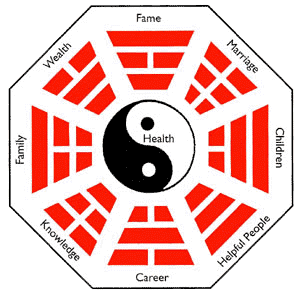
Figure 2.