Discovering
next generation tourism information systems: A tour on TIScover
Journal of Travel Research;
Boulder; Nov 2000; Birgit Proll; Werner Retschitzegger;
|
Volume: |
39 |
|
Issue: |
2 |
|
Start Page: |
182-191 |
|
ISSN: |
00472875 |
|
Geographic Names: |
Austria |
Abstract:
Information
technology has been playing a fundamental role in the tourism industry for a
long time. The Internet particularly is increasingly emerging as a perfect
platform to bring tourism products direct to the customer. Web-based tourism
information systems, however, are required not only to offer online brochures
but also to provide both value and service. The Austrian tourism information
system, TIScover, meets this challenge by focusing on three crucial points.
First, high-quality access is provided. Second, the content is of high quality
that is achieved by enabling tourism information providers to maintain their
products directly, as well as by integrating external tourism information
sources. Finally, the system is designed in such a way that is easy to
customize.
|
Full Text: |
|
Copyright
University of Colorado, Business Research Division Nov 2000 |
[Headnote]
Information
technology has been playing a fundamental role in the tourism industry for a
long time. The Internet particularly is increasingly emerging as a perfect
platform to bring tourism products direct to the customer. Web-based tourism
information systems, however, are required not only to offer online brochures
but also to provide both value and service. The Austrian tourism information
system, TIScover, meets this challenge by focusing on three crucial points.
First, high-quality access is provided, both by supporting e-- commerce
transactions and by allowing access to the system via the World Wide Web, info
kiosks, and cellular phones. Second, the content is ofa high quality that is
achieved by enabling tourism information providers to maintain their products
directly, as well as by integrating external tourism information sources.
Finally, the system is designed in such a way that it is easy to customize. This
facilitates employment of the system by the various kinds of tourism information
providers, as well as by different regions and even countries.
The tourism industry can be seen as one of the first areas to do business electronically. In the 1960s, airline reservation systems, which can be regarded as the forerunners of today's e-commerce systems (Copeland and McKenney 1988; Kappel et al. 1996; Kapsammer, Retschitzegger, and Wagner 1998; Schulz 1996), were already being employed. Today, tourism information systems are one of the most important areas of application for e-commerce. The number of tourists who use Web-based tourism information systems for pretrip planning jumped from 3.1 million in 1996 to 33.8 million in 1998, a 1,000% increase in 2 years (Travel Industry Association of America [TIA] 1999b). Furthermore, it is predicted that within the next 10 years, 30% of the whole tourism business will be done via the Internet (Schuster 1998). According to a recent report from Gartner Group, the global Internet travel market will increase sixfold by the end of 2001, rising from U.S.$5 billion spent at Web sites in 1999 to U.S.$30 billion (Gartner Group Inc. 2000).
There are two major factors, among others, in these promising figures. First, the special properties of tourism products-- heterogeneity, intangibility, and perishability-make them very information intensive and thus especially suited for offering and selling electronically (Sheldon 1997; Werthner and Klein 1999). Second, information technology (IT) will always be able to cope with the changing demand of tourists toward more frequent, but shorter travel, last-minute reservations, quality of information and service, market transparency, and tailored holidays (Karcher 1997; Werthner and Klein 1999). Despite this fundamental role of IT in the tourism industry, when developing tourism information systems today, one has to keep in mind that only publishing online brochures is by no means enough. Gartner analysts commented that travel companies that do not have competitive and easy-to-use Internet sites established by Q2 2000 will be forced to close operations or be acquired by stronger online travel firms (Gartner Group Inc. 2000). Three crucial aspects can be identified that seem to be essential for the success of tourism information systems; these are quality of access, quality of content, and ability to customize the whole system.
First, the acceptance of a tourism information system particularly depends on comfortable and powerful access capabilities. To succeed in this, one prerequisite is that the system supports all phases of an e-commerce transaction, from the information phase via the negotiation phase to the settlement phase (Kappel, Retschitzegger, and Schroder 1998; Malone, Yates, and Benjamin 1987; Schmid and Lindemann 1998). The information phase especially requires detailed consideration to provide the tourist with powerful navigation and search capabilities so the desired tourism information or product can be found conveniently and efficiently. Another prerequisite is that access to the system should not only be possible in advance of a trip by means of the traditional World Wide Web (WWW). Rather, additional media should be provided to allow the tourists to access tourism information and products on arrival at the destination or to provide mobile access, that is, access independent of location and need for a laptop.
Second, since information has been identified as one of the most important quality parameters for efficient service (Schertler 1994), a tourism information system has to focus on the content aspect by providing comprehensive, detailed, accurate, and topical tourism information. The dynamic nature of some tourism information, for example, rates, schedules, events, opening hours, and weather forecasts changing with the days, weeks, months and seasons, makes this a challenging task. One possibility to achieve a high-quality content is to allow its maintenance directly by the tourism information providers. However, it is not feasible to store all the information a tourist might be interested in at one Web site, neither in terms of storage costs nor, more important, in terms of maintenance overheads. Another way to provide comprehensive contents is to use the broad spectrum of tourism information already distributed over various Web sites by supporting interoperability. Integrating this information automatically would enable the tourist to collect all tourism information at one place, no matter what is desired, be it information about weather and traffic conditions, schedules of trains, planes and buses, or current events.
The third crucial point is that a tourism information system should represent a generic platform allowing the presentation of arbitrary destinations, as well as integrating different kinds of tourism information providers. One problem in this respect is the complexity and heterogeneity of tourism information and products depending on both the kind of provider and the destination being presented (Malone, Yates, and Benjamin 1987). Another problem is that tourism information providers, regions, and countries should differ from each other, since especially in the tourism industry, uniqueness is the main attraction. Consequently, the system should be easy to customize with respect to different tourism information providers, regions, and countries while preserving the individuality of their presentation.
A system that has faced these crucial points is the Austrian tourism information system, TIScover. The aim of TIScover is twofold (Prop, Retschitzegger, Wagner, and Ebner 1998; Pr6ll, Retschitzegger, and Wagner 1998c): first, tourists should be supplied with comprehensive, accurate, and up-to-date tourism information on countries, regions, villages, and all destination facilities they offer, such as hotels, museums, or other sights. Second, it aims to attract the tourist to buy certain tourism products either offline or, if possible, online. TIScover was developed in 1996 based on the experiences of the pioneering systems TIS (Ebner 1994) and TIS@WEB (Burger et al. 1997). Originally, TIScover was developed to market the facilities of just one region of Austria, namely, Tyrol. Since then, six other Austrian regions have joined TIScover MS GmbH 2000a). Moreover, TIScover has been employed in Asia, presenting tourism information about Thailand (GoThailand 1998)1; it is used by the German company START Media Plus, a major player in the area of online reservation systems, to present tourism information about Germany (START Media Plus 2000); and it is online in Switzerland (TIS GmbH 2000c). Regarding the top 100 most frequently accessed travel sites, TIScover Austria was already ranked in the top 10, above international companies such as American Airlines, Hyatt, Hertz, or American Express (100hot Travel 1999).
This article focuses on the aforementioned crucial aspects of tourism information systems as they are implemented in TIScover. For this, first, an overview of the whole architecture of TIScover, including a short description of the manner in which the system may be customized, is given. E-commerce transactions in the context of TIScover are discussed, and different access paradigms supporting the information phase are emphasized. Afterward, the article deals with mobile access to TIScover by means of cellular phones and presents mechanisms used in TIScover to achieve interoperability. The article concludes with the outlook for future work.
AN OVERVIEW OF TISCOVER
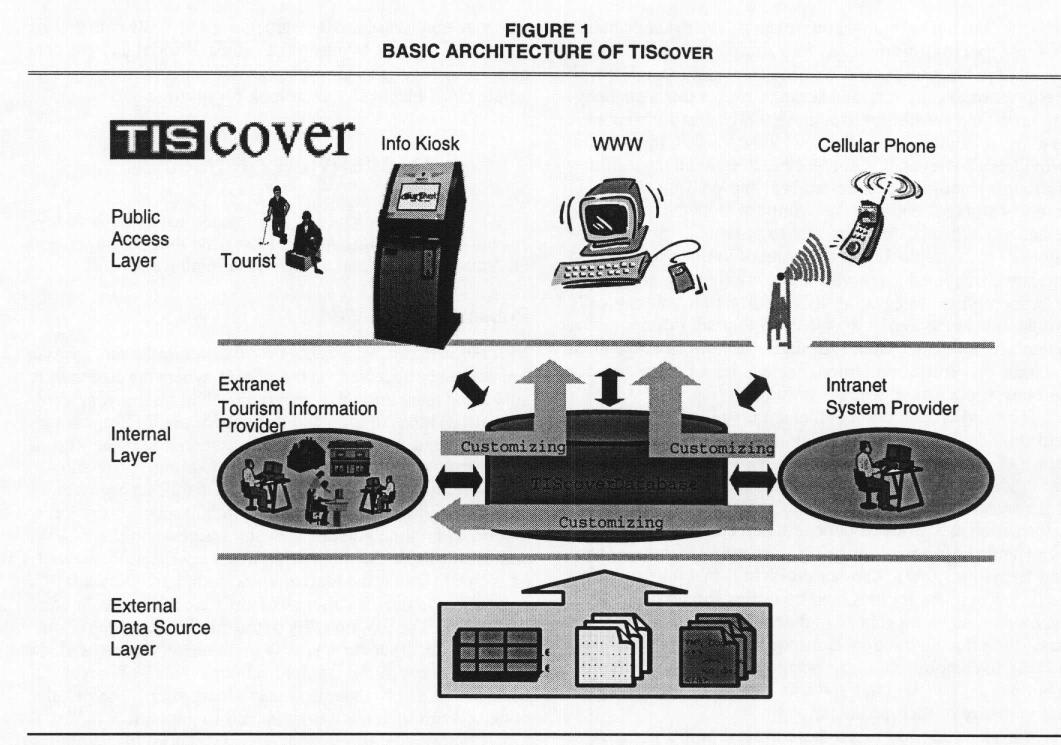
The basic architecture of TIScover consists of three layers, namely, the Public Access Layer, the Internal Layer, and the External Data Source Layer (see Figure 1).
Public Access Layer
TIScover can be accessed by the public in three ways. First, it can be accessed via the WWW, where the customer is able to navigate through a geographical hierarchy, representing various kinds of tourism information; use different search facilities; and even book tourism products online (Proll, Retschitzegger, KroiB, et al. 1998). Currently, per month, TIScover Austria has to handle up to 11.5 million pageviews,2 2.6 million visits,3 and as many as 40,000 requests for information and online bookings. Besides access via the YAW, which is discussed in more detail in the next section, the tourist is able to access the tourism information and products of a certain destination by means of info kiosks at the holiday destination. The functionality of the info kiosk, which is sim ilar to that of TIScover's WIM component, can be used via touchscreen or speech input. Last but not least, TIScover can be accessed at any time, from anywhere, simply via cellular phones. With this, the tourist is able to get topical information about weather forecasts, avalanche conditions, and snow reports.
Internal Layer
The Internal Layer is situated beneath the Public Access Layer. Its core component is represented by the TIScover database. The database schema of TIScover Austria consists of approximately 300 database tables and has been constructed on the basis of a domain data model. This incorporates all conceptual entities gathered during the process of requirement definition from numerous tourism information providers and from the experiences with the predecessor systems TIS (Ebner 1994) and TIS@WEB (Burger et al. 1997). Currently, the database of Mover Austria comprises approximately two gigabytes of data covering 2,000 towns and villages and nearly 40,000 lodgings. To facilitate efficient and reliable access, Web pages are automatically generated from the database every time the underlying data changes. As a result, more than 400,000 Web pages are stored in some million files (Proll et al. 1999). On average, TIScover has to generate 24,000 Web pages per day, representing more than 5% of the whole TIScover Web site. There are three main reasons for this high workload: first there are a lot of tourism information providers that are able to maintain their data by means of the extranet; second, a huge amount of data is already managed by TIScover; and third and probably most important, the nature of some tourism information is extremely dynamic.
Two other system components placed on top of the TIScover database, namely, the extranet and the intranet, provide the basis for a generic platform, allowing the system to be customized (Droll, Retschitzegger, and Wagner 1998a, 1998b). The extranet provides authorized tourism information providers, offering all manner of concerns, from small guesthouses to large local tourist offices direct access to their tourism information and products (Droll, Retschitzegger, and Wagner 1998a). A particular benefit of tourism information providers is that they are allowed to maintain their tourism information and products decentrally and customize them in various ways. For example, a tourism information provider is able to decide the number and complexity of the products presented, ranging from single products to whole packages (Karcher 1997; Droll, Retschitzegger, and Wagner 1999) and to customize their presentation, for example, by choosing between different layout templates, thus coping with the demand for individuality. At this time, the extranet of TIScover Austria is accessible to 7,000 tourism information providers. In contrast to the extranet, the intranet component of TIScover is accessible to the system provider only and allows the whole system to be customized. It is, for example, possible to extend the geographical hierarchy to integrate new countries or villages into the system, to define default language and currency for all system components, and to construct layout templates that can then be selected by the tourism information provider via the extranet. The various possibilities to customize the system as offered by the extranet and the intranet have proven to be very powerful. No programming effort was needed to customize the system for Thailand, Germany, and Switzerland, three significantly different countries where the nature of their tourism facilities is concerned.
External Data Source Layer
Although TIScover manages a huge amount of tourism information, it is of course far from being complete. The External Data Source Layer ensures interoperability to other Web sites going beyond simple links, to satisfy requests for certain information that is not part of the TIScover database but is already available at other Web sites. The External Data Source Layer has been prototypically realized in the course of the ESPRIT project MIRO-Web to federate multiple structured and semistructured tourism information sources on the Web (Haller et al. 2000).
E-COMMERCE TRANSACTIONS IN TISCOVER
Today's tourism information systems are required to fully support an e-commerce transaction. The interaction processes between the participants of an e-commerce transaction can be grouped into three phases: the information phase, the negotiation phase, and the settlement phase (Schmid and Lindemann 1998). In the following section, the concepts and mechanism employed by TIScover to support these phases are described in more detail.
The Information Phase
In the information phase, customers, that is, tourists, acquire a market overview by gathering information about potential market partners: tourism information providers, as well as their products and services (Froschl and Werthner 1997). To provide a comfortable information access, TIScover supports three paradigms for finding tourism information and products (see Figure 2).
* First is the hypertext paradigm (Conklin 1997) for navigating through information by using hypertext links. This is realized by means of the Atlas module.
* Second, the database query paradigm for a precisely structured search (Domenig and Dittrich 1999) on the basis of a common database schema is provided by the Scout module.
* Third is the classical information retrieval paradigm (Salton and McGill 1983), providing a full text search as it is done by most search engines on the Web.
The Atlas module allows the customer to browse through all kinds of tourism information by navigating through a geographical hierarchy ranging from world via continent, state, and country to a village. Each geographical level offers those pieces of tourism information and products that are important at this level. For example, a tourist may get information about duty free regulations or highlights of a state at state level, whereas at the village level, information about skiing facilities is available. Both the kind of information and the content gets more detailed the deeper one navigates into the hierarchy. Accommodations-for example, hotels-are placed at the village level and represent the starting point for online booking (cf. Section 3.3). To prevent tourists from following links with products that cannot be booked online, the booking button is only visible if there are products within a village and at least one of them is available for online booking. Furthermore, the Atlas does not have to access the database during navigation but can work fully on Web pages, which as already mentioned, are generated from the database every time the underlying data changes (Prop et al. 1999).
The Scout module represents the second way offered by TIScover to find tourism information and products. In contrast to Atlas, Scout makes navigation completely superfluous in that it realizes a precisely structured search within the TIScover database by allowing the specification of various search criteria, which are represented by attributes of the common database schema. These criteria include location, name, and facilities of the accommodation, type of room, type of board, price limits, and arrival and departure dates. In general, the Scout module is especially appropriate for the single-minded tourist who already has a clear idea of what he or she wants. A major benefit of Scout is that products, which can be booked online, can be searched at any geographical level and the system supplies only those products available at the required time. Note that this is different from Atlas, where the tourist has to navigate down to the lowest geographical level, namely, villages, before there is any possibility to check the availability of products.
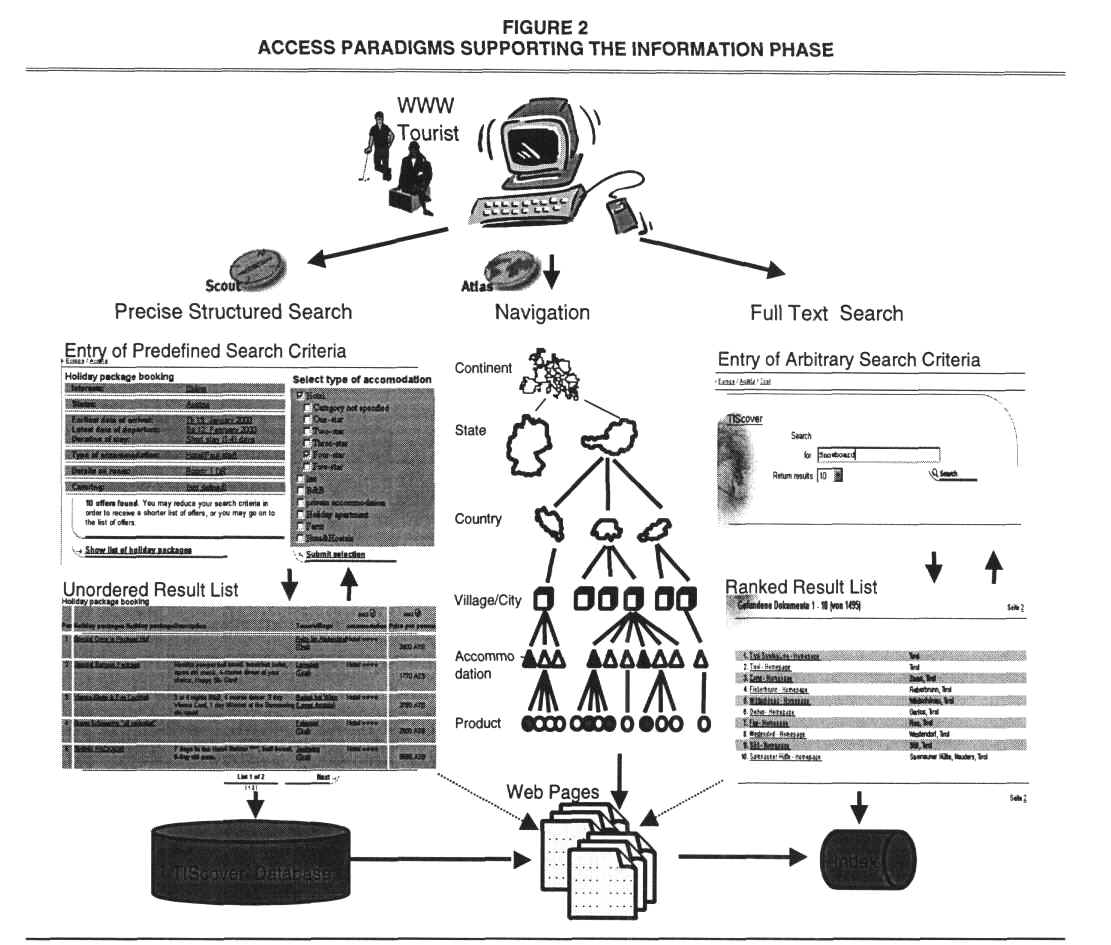
Finally, TIScover allows a tourist to start a full text search, at any geographical level, to find all Web pages containing an arbitrary keyword, for example, all pages containing the keyword "carving" starting at the level of Tyrol. The system matches the keyword against an index built by a robot. The robot is started from time to time to index Web pages. This approach is comparable to well-known Internet search engines, stemming from traditional information retrieval (Salton and McGill 1983). One advantage of this approach is that the customer is free to choose the search keywords. This is in contrast to a structured search in which the customer is restricted to those keywords that are predefined by the system provider and are, thus, part of the common database schema. Another advantage is that unlike the structured search, in which the result set of a query can only be empty or non-empty, the results of a full text search are ranked (Salton and McGill 1983). However, there are also some limitations. First, the tourist has no guidance in using the right keywords; thus, it is quite hard to find words matching the index of the Web pages. For example, one will obviously not succeed by using synonyms that are not part of the index. Second, there is a considerable system overhead every time the robot is started to index the pages again. And third, the less often the robot is started, the higher the probability that the search is processed on an index that is outdated.
It is important to note that the three access paradigms implemented by TIScover are not isolated from each other. Instead, they are seamlessly integrated so that a tourist can arbitrarily switch in-between and the system automatically preserves all necessary context information. When, for example, browsing on the Tyrolean level of Atlas, a switch to Scout or to full text search implies that the following search is done automatically in the context of Tyrol only. If the tourist navigates from the result list of a search for products on Atlas, the context for browsing is automatically the village the product is related to.
The Negotiation Phase
In the negotiation phase, the conditions of the e-commerce transaction are negotiated, The conditions for tourism products are, for example, facilities at the accommodation, type of board, duration of stay, price, and terms of payment. In the simplest case, these conditions are predefined in full, and the customer cannot tailor a certain product to his or her individual needs. A more sophisticated negotiation phase would be based on some negotiation protocol, in which one or both participant(s) are able to negotiate the final terms.
In TIScover, the tourism information provider is responsible for defining the negotiation protocol for tourism products in that he or she specifies the conditions according to which he or she is willing to sell them. There can be products that are fully predefined (e.g., a last-minute offer) but also products where the tourism information provider specifies the product's conditions but the customer is able to tailor the product to his individual needs. TIScover allows the same tourism product to be offered with different conditions. For example, different types of board or different seasons imply a price reduction or increase. With time conditions, it can be specified that a tourism product is only available during a certain season and valid on weekdays only. Finally, it can be ascertained whether credit cards are accepted and which ones, and whether payment by bank transfer is possible.
If a customer searches for a tourism product via the Scout module, the information phase and the negotiation phase overlap, since to carry out a search, the customer has to define the criteria according to which he is willing to book a product. Depending on how precisely these criteria have been specified and whether the product has been fully predefined by the tourism information provider, the results list contains products that allow no further customization and can be booked directly or products that can be further adapted to individual needs, for example, by choosing the type of board (see Figure 3). It has to be emphasized that each modification of the conditions implies an immediate recalculation of the price.
The Settlement Phase
In the settlement phase, both parties fulfil the terms agreed in the negotiation phase. As is the case with many products sold electronically, only part of the settlement phase can be supported by the system for tourism products since there is a difference between the time of booking and the time of consuming. Existing tourism information systems often do not really support the settlement phase. Some offer only a telephone number, others offer only an e-mail address, without checking availability or dealing with a proper actualization of the inventory.
To book products in TIScover, tourists have to enter their personal data; their credit card numbers, if payment by credit card has been chosen; and confirmation that they accept the booking conditions. If tourists decide to pay by bank transfer, they get an automatically generated e-mail with the request to confirm the booking by forwarding this e-mail to the provider.
The internal booking process comprises several steps. First, the personal data of the tourist and all the data concerning the product booked are stored in the database. Second, the inventory of the product is actualized. Third, the tourism information provider is notified of the booking by an automatically sent fax and e-mail. Finally, the tourist is sent a voucher confirming his or her booking. All data transferred during the booking process are encoded via the Secure Sockets Layer protocol (Netscape Inc. 1999).
MOBILE ACCESS TO TISCOVER
With the rapid growth of wireless telecommunication on one hand and the exponential expansion of the Internet on the other hand, the convergence of these two mainstreams is predictable. Mobile access to Internet content and services by means of mobile devices, such as cellular phones, is indeed becoming an interesting possibility, both for the tourism information provider to reach new customers and for tourists on the move. Mobile services are not replacing pure Web applications or interactive television services (Rose et al. 1999), but they complement them in that for example, topical information is accessible both at home and wherever is most convenient for the tourist. The market for this new application area seems to be ready since according to the latest TIA travel poll of 1,200 U.S. adults, 51 % of the 39.8 million business travelers and 46% of the pleasure travelers over the past year said they took their cellular phone with them on a trip (TIA 1999a). Furthermore, according to the Strategis Group (1999), there will be more than 530 million owners of cellular phones by the year 2001, and a substantial proportion of the phones will allow Internet access.
To stay abreast of these promising changes, TIScover already provides three different mobile services, namely, weather forecasts, avalanche conditions, and snow reports (TIS GmbH 2000b). This kind of tourism information is also available via the traditional Web, but it is especially well suited to mobile access. This is because it represents a hot spot within the TIScover database, being subject to a particularly high update frequency. At the same time, the value of this information depends on its topicality and, therefore, on the ability of the tourist to access this information at any time, independent of location. In the following section, the basic technology for realizing mobile access and its usage in TIScover is described in more detail.
W@P-The Basic Technology for Realizing Mobile Access
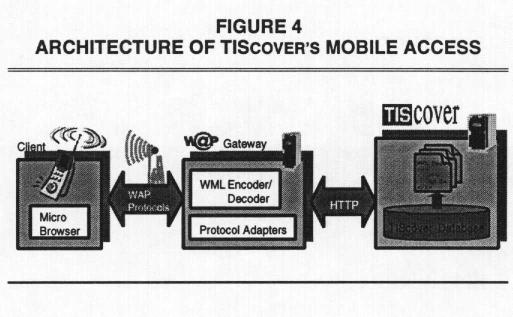
The basic technology for enabling mobile access and realizing mobile services is the Wireless Application Protocol (W@P) (Wireless Application Forum Ltd. 1999). W@P is the de facto world standard for the presentation and delivery of information and telephone services on cellular phones and other mobile devices. W@P belongs to an industry consortium of approximately 200 members, including 75% of the mobile operators and nearly all phone manufacturers. The specification of W@P includes three basic building blocks (see Figure 4).
First, the Wireless Markup Language (WML), a subset of the Extensible Markup Language (XML) (World Wide Web Consortium [W3C] 2000) and the Hypertext Markup Language (HTML) (W3C 2000), is used to describe the content, which should be displayed on the mobile device and is especially designed to cope with the limited screen size and input capabilities of mobile devices. Second, a microbrowser in the mobile device controls the user interface, that is, defines how WML should be interpreted, and is analogous to a standard Web browser so the user can navigate back and forth between several WML pages. Finally, to take into account the specific characteristics of wireless networks, a W@P Gateway, which is usually provided by mobile operator companies, is responsible for mediating between the mobile device and the server offering the WML pages. Protocol Adapters transform special W@P protocols to standard Hypertext Transfer Protocol (HTTP) requests (W3C 2000) and vice versa. The protocols are defined for use with the low-bandwidth and high-latency conditions often found in wireless networks. Encoders and Decoders translate textual WML pages into a more compact binary format and vice versa, to reduce the size and number of packets traveling over the wireless network.
A Typical Scenario: Mobile Access to Snow Reports
Based on the technologies described above, the architecture used for enabling mobile access to TIScover is illustrated in Figure 4. Since W@P is based on standards for Web application development such as HTTP and XML/HTML, mobile access to TIScover can be enabled with minimal additional effort and without changing any existing component. On the server side, WML documents are generated from the TIScover database and are offered by the TIScover standard Web server, in the same way as HTML pages used for access via WWW.
To use the mobile services provided by TIScover, the tourist has to connect to TIScover by simply entering the respective unified resource locator (URL) into his or her cellular phone. After the connection has been established, the TIScover logo is shown, and the tourist can select one of the services displayed, that is, snow reports, weather forecasts, or avalanche conditions (see Figure 5). After selecting the service "snow reports," a list of all Austrian regions is shown, and the tourist has to select one option. Now, the tourist is able to enter the first letter, but preferably the full name, of the village or skiing area desired. If the name is misspelled, TIScover uses a phonetic search to find names within the database that sound similar. If the results list contains more than one entry, the tourist can scroll up and down and select one of the entries or can navigate back and start another search. As soon as an entry has been selected, the snow report is displayed, comprising name of the village/skiing area, date, snow level, and snow quality for mountain, valley, and village. Furthermore, direct links to both weather forecasts and avalanche conditions of this geographical area are provided.
INTEROPERABILITY OF TISCOVER
Although quality of access is a major prerequisite for a successful tourism information system, as already mentioned, quality of content is equally, if not more, important. To fulfill this requirement, it is of course infeasible to store all information a tourist might be interested in at one Web site, both in terms of storage costs and, more important, in terms of maintenance overhead. A more promising idea would be to take advantage of the huge amount of other relevant tourism information that is already distributed throughout the Web. However, most of current Web sites do not allow for the integration of multiple data sources beyond simple links between them.
In the course of the ESPRIT project MIRO-Web (Fankhauser et al. 1998), which was started at the end of 1997, TIScover has been extended with an External Data Source Layer to federate multiple structured and semistructured tourism information sources on the Web. These sources comprise different in-house databases employed in the various tourism offices, Excel files used for managerial purposes, and finally, HTML pages of other Web sites. In the following section, the concepts and technology employed in MIRO-- Web are discussed along with a typical usage scenario.
Basic Concepts and Technology of MIRO-Web
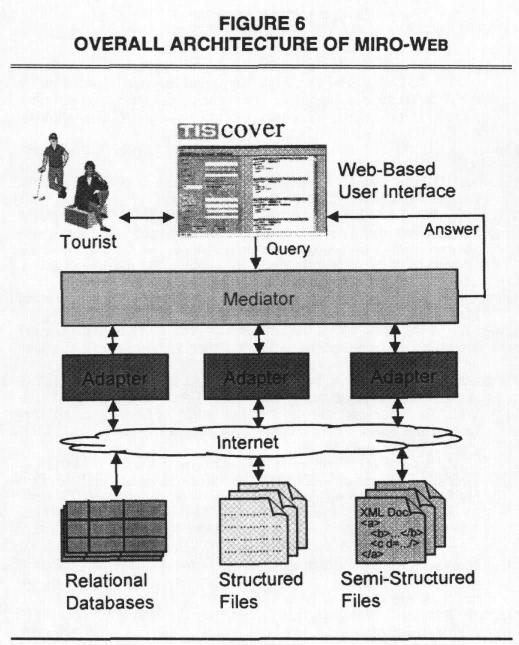
MIRO-Web builds on the technology already developed and the knowledge acquired in the course of the EU ESPRIT project IRO-DB aiming at the integration of heterogeneous databases (Kapsammer, Retschitzegger, and Wagner 1998). In the spirit of IRO-DB, MIRO-Web is based on a three-tier architecture, consisting of a Data Source Adapter Layer, a Mediation Layer, and a Client Layer (see Figure 6).
The Data Source Adapter Layer consists of a number of adapters, also known as wrappers, which are needed to mask the heterogeneity of data sources and to transform source data into a structured format (Huck et al. 1998). Data source adapters have two main functions: first, they translate a query to the underlying query system used by the source, and then, they translate the results sent back. MIRO-Web adapters can be used in conjunction with a mediator (cf. below) or independently by an application. MIRO-Web supports several kinds of adapters, relational adapters, structured, and semistructured file adapters, depending on the nature of the data source. To facilitate both building and maintenance of data source adapters, a Java toolkit called "Adapter Development Kit" has been developed.
According to (Wiederhold 1992), mediators "simplify, abstract, reduce, merge and explain data." The Mediation Layer of MIRO-Web provides the means to combine and integrate these heterogeneous sources into a homogeneous view and supports queries about this view in terms of a single point of access. MIRO-Web supports a materialized approach to mediation as well as a virtual approach, whereby it is the responsibility of the database administrator to decide which approach is suitable for a certain data source. In the former case, data from multiple Web sources are stored within an Oracle8 database (Oracle Corporation 2000); whereas, in the latter case, external data are not accessed before the user issues a query. Virtual mediation is performed by DISCO (Distributed Information Search COmponents), a distributed extensible query engine that provides a uniform query language and data model for declarative access to a heterogeneous collection of data sources (Tomasic, Raschid, and Valduriez 1996).
The Client Layer provides Web-based user interfaces, allowing both the expression of queries to the underlying heterogeneous sources and the uniform presentation of their results.
A Typical Scenario: The Event Agent
To demonstrate the suitability of MIRO-Web to TIScover, an exemplary scenario will now be presented, in which some kind of agent assists the tourist in querying heterogeneous tourism information sources in a transparent way. A common case is that a tourist wants to find a hotel near some event location, such as an exhibition, a sporting event, or a cultural event. Furthermore, the weather forecast should be good and the hotel should cost less than a certain amount of money, issued in an arbitrary currency. To specify such a request, the Event Agent provides a uniform graphical interface in terms of a Java applet (see Figure 7).
The Adapter Layer of MIRO-Web extracts the answer for this request from different heterogeneous data sources. First, information about hotels is extracted directly from the TIScover database. Second, information about current events can be found at different Web sites that already exist (cf., e.g., www.austria-tourism.at or www.film.at or www.events.at). Third, the weather information is gathered via file transfer protocol in the form of a structured file. And finally, the exchange rate for calculating the currency requested is available in a semistructured format, namely, as an e-mail.
The basic join criteria for the query, which is used by the Mediation Layer to satisfy an information request, is the name of the location. On the basis of this join attribute, information about the events can be joined with weather information and hotel information. The price can be calculated and converted by means of the exchange rates and joined with the hotel information. Finally, the Client Layer, that is, the Java applet, presents the result of the information request in a uniform way on the right side of the panel (see Figure 7).
OUTLOOK
Future work is planned with respect to all three areas described in this article, that is, e-commerce transaction support, mobile access, and interoperability.
Where the support of e-commerce transactions is concerned, a visionary approach would be to allow the tourist not just to book accommodation by means of TIScover and contact Web sites, for example, of car rental companies or airlines individually, but rather to allow the tourist to assemble a whole holiday package and to book the package at once (Kappel et al. 1996; Proll, Retschitzegger, and Wagner 1999). Two scenarios of varying complexity can be distinguished. First, the Web sites, whose products can be selected to assemble the package, could be predefined. This is similar to electronic shopping malls where the shops participating are known in advance. Second and more visionary would be for the user to navigate from TIScover to arbitrary Web sites offering products, and some runtime engine checks whether the Web site is capable of participating in a global booking process (Kappel, Rausch-Schott, and Retschitzegger 1999).
Mobile access poses several interesting possibilities for future developments. With respect to e-commerce transactions, W@P provides the proper technology to allow secure online transactions. This means that it will be possible in the near future for a tourist to book tourism products anywhere via cellular phones. Furthermore, W@P will define a "push mechanism," enabling any Web server to send information to the client, that is, the cellular phone, without having to wait for information requests. This function would alert subscribers when time-sensitive information changes. For example, immediate information about a predicted fall in temperature would be of great value for an alpinist. Finally, W@P also provides location information, meaning that the mobile services can vary depending on where one uses them. An interesting application scenario would be a location-dependent tourist guide for city visitors, where the visitors are provided with context-sensitive information, such as where to find the best restaurant, when the next bus leaves from that bus stop, or what the current waiting times at local attractions are (Davies et al. 1998; Hartl et al. 2000).
Concerning interoperability, future work will be done primarily in the course of the follow-up EU ESPRIT project of MIRO-Web, called XML-KM (XML-based Mediator for Knowledge Extraction and Brokering). The goal of XML-- KM, which is strongly based on XML, is to enhance the components and tools developed in the course of MIRO-Web to be able to collect and disseminate knowledge instead of just data. Through a rule-based XML-wrapper, tourism information from corporate databases, HTML files, and office applications will be collected in data warehouses (Gardarin, Sha, and Ngoc 1999). Using classical data mining tools, knowledge will be extracted from the warehouses in the form of derived tourism information and rules. Through XML-based query tools, users will be able to subscribe and receive personalized tourism information in an appropriate format on various devices including computers, cellular phones, and faxes.
[Footnote]
NOTES
[Footnote]
1. Note that due
to the economic crisis in Asia, TIScoverasia is currently not operating.
2. Pageviews depict the number of "real" documents
transmitted by a Web server without counting access to images, CGI scripts, or
Java applets.
3. Visits count the number of users accessing one or more
pages of a Web server.
[Reference]
REFERENCES
[Reference]
Burger, F., P.
KroiB, B. Prell, R. Richtsfeld, H. Sighart, and H. Starck (1997).
"TIS@WEB-Database Supported Tourist Information on the Web." In
Proceedings of the International Conference on Information and Communication
Technologies in Tourism (ENTER), edited by A. Min Tjoa. Edinburgh, Scotland:
Springer, pp. 180-89.
Conklin, J. (1997). "Hypertext: An Introduction and
Survey." IEEE Computer, 20 (9): 17-41.
Copeland, D., and J. L. McKenney (1988). "Airline
Reservation Systems: Lessons from History." MIS Quarterly, 353-70.
[Reference]
Davies, N., K.
Mitchell, K. Cheverst, and G. Blair (1998). "Developing a Context Sensitive
Tourist Guide." In Proceedings of the First Workshop on Human Computer
Interaction with Mobile Devices [Online]. University of Glasgow, Scotland.
Domenig, R., and K. R. Dittrich (1999). "An Overview and
Classification of Mediated Query Systems." SIGMOD Record, 28 (3): 63-72.
Ebner, A. (1994). "TS-Tirol Informations System: Die
Konsequenz einer Idee." In Tourismus, edited by W. Schertler, Ueberreuter.
In German, pp. 307-45.
[Reference]
Fankhauser, P.,
G. Gardarin, M. Lopez, J. Munoz, and A. Tomasic (1998). "Experiences in
Federating Databases: From IRO-DB to MIRO-- Web." In Proceedings of the
24th International Conference on Very Large Data Bases (VLDB), edited by A.
Gupta et al. New York: Morgan Kaufmann, pp. 655-58.
Froschl, K. A., and H. Werthner (1997). "Informed
Decision Making in Tourism Management-Closing the Information Circuit." In
Proceedings of the International Conference on Information and Communication
Technologies in Tourism (ENTER), edited by A. Min Tjoa. Edinburgh, Scotland:
Springer, pp. 75-84.
Gardarin, G., F. Sha, and T. D. Ngoc (1999). "XML-based
Components for Federating Multiple Heterogeneous Data Sources." In
Proceedings of the 18th International Conference on Conceptual Modeling (ER),
edited by J. Akoka et al., LNCS 1728. Paris: Springer, pp. 506-19.
Gartner Group Inc. (2000). GartnerGroup's Online Travel
Forecast: $30 Billion by 2001 [Online]. Available: http://www.gartner12.gartnerweb.com/ public/static/aboutgg/pressrel/prI0600.html
GoThailand (1998). TIScover ASIA [Online]. Available: www.tiscoverasia.com
[Reference]
Haller, M., B.
Proll, W. Retschitzegger, A. M. Tjoa, and R. R. Wagner (2000). "Integrating
Heterogeneous Tourism Information in TIScoverThe MIRO-Web Approach." In
Proceedings of the International Conference on Information and Communication
Technologies in Tourism (ENTER), edited by D. R. Fesenmaier et al. Barcelona,
Spain: Springer, pp. 71-80.
Hard, A., G. Austaller, G. Kappel, C. Lechleitner, M.
Muhlhauser, S. Reich, and R. Rudisch (2000). "Gulliver-A Development
Environment for WAP Based Applications." In Poster Proceedings of the 9th
International World Wide Web Conference, Amsterdam, the Netherlands, pp. 26-7.
Huck, G., P. Fankhauser, K. Aberer, and E. Neuhold (1998).
"Jedi: Extracting and Synthesizing Information from the Web." In
Proceedings of the 3rd IFCIS International Conference on Cooperative Information
Systems (CoopIS), IEEE Computer Society Press, pp. 32-43.
Kappel G., S. Rausch-Schott, and W. Retschitzegger (1999).
"Transaction Support for DataWeb Applications-A Requirement's
Perspective." In Proceedings of the Fifth Americas Conference on
Information Systems (AMCIS), Milwaukee, WI, pp. 877-79.
Kappel, G., S. Rausch-Schott, W. Retschitzegger, and M.
Sakkinen (1996). "A Transaction Model for Handling Composite Events."
In Proceedings of the 3rd International Workshop of the Moscow ACM SIGMOD
Chapter on Advances in Databases and Information Systems (ADBIS), Moscow,
Russia, pp. 116-25.
[Reference]
Kappel, G., W.
Retschitzegger, and B. Schroder(1998). "Enabling Technologies for
Electronic Commerce." In Proceedings of the XV. IFIP World Computer
Congress, Vienna, Austria/Budapest, Hungary, pp. 396-400.
Kapsammer, E., W. Retschitzegger, and R. R. Wagner (1998).
"Meta Data-Based Middleware for Integrating Information Systems: A Case
Study." In Proceedings of the 4th International Conference on Information
Systems Analysis and Synthesis (ISAS), Orlando, FL, pp. 177-83.
Karcher, K. (1997). Reinventing the Package Holiday Business.
Wiesbaden, Germany: DUV.
Malone, T. W., J. Yates, and R. I. Benjamin (1987).
"Electronic Markets and Electronic Hierarchies." Communications of the
ACM (CACM), 30 (6): 484-97.
Netscape Inc. (1999). SSL 3.0 Specification [Online].
Available: www.netscape.com/eng/ssl3findex.html
100hot Travel (1999). The Web's Most Popular Travel Sites
[Online]. Available: www.100hot.com/travel/
[Reference]
Oracle
Corporation (2000). www.oracle.com]
Proll, B., W. Retschitzegger, P. KroiB, and R. R. Wagner
(1998). "Online Booking on the Net-Problems, Issues and Solutions." In
Proceedings of the Sth International Conference on Information Technology in
Tourism (ENTER), edited by D. Buhalis et al. New York: Springer, pp. 268-77.
Proll, B., W. Retschitzegger, H. Sighart, and H. Starck
(1999). "Ready for Prime Time-Pre-Generation of Web Pages in
TIScover." In Proceedings of the 8th International ACM Conference on
Information and Knowledge Management (CIKM), Kansas City, MI, pp. 63-8.
[Reference]
Proll, B., W.
Retschitzegger, and R. R. Wagner (1998a). "Extranet-Based Maintenance and
Customisation of Tourism Information," Technologies for the Informaton
Society: Developments and Opportunities, edited by Roger, J. - Y. et al. Burke,
VA: IOS Press, pp.331-38. (1998b). "TIScover--A Tourism Information System
Based on Extranet and Intranet Technology." In Proceedings of the 4th
Americas Conference on Information Systems (AIS), Baltimore, pp. 1014-16.
(1998c). "TIScover--A Web-Based Tourist Information System." In
Proceedings of the EURO-MED NET Conference, Nicosia, Cyprus, Greece, pp. 93-4.
(1999). "Holiday Packages on the Web." In Proceedings of the
International Conference on Information and Communication Technologies in
Tourism (ENTER), edited by D. Buhalis et al. Innsbruck, Austria: Springer, pp.
108-18.
Proll, B., W. Retschitzegger, R. R. Wagner, and A. Ebner
(1998). "Beyond Traditional Tourism Information Systems-TIScover."
Journal of Information Technology in Tourism (FIT), Inaugural Volume, Cognizant
Corp., USA, pp. 15-31.
[Reference]
Rose, M., C.
Dormann, H. Olesen, B. Beute, and J. F. Jensen (1999). "White Paper on
Interactive TV." Interim report of the Intermedia project of the Danish
National Center for IT-Research [Online]. Denmark. Available: www.cti.dtu.dlk/personal/berco/html/cti/ITV%20white% 20paper.html.
Salton, G. and M. McGill (1983). Introduction to Modern
Information Retrieval. New York: McGraw-Hill.
Schertler, W. (1994). "Tourism 2000--An Information
Business." In Proceedings of the Intrnational Conference on Information and
Communication Tecnologies in Tourism (ENTER), edited by W. Schertler et al.
Vienna/New York: Springer, pp. 20-6.
Schmid, B. F., and M. A. Lindemann (1998). "Elements of
a Reference Model for Electronic Markets." In Proceedings of the 31st
Annual Hawaii International Conference on Systems Science (HICSS), vol. IV. Los
Alamitos, CA: IEEE Computer Society Press, pp. 193-201.
[Reference]
Schulz, A.
(1996). "The Role of Global Computer Reservation Systems in the Travel
Industry Today and in the Future." Newsletter Competence Center Electronic
Markets [Online], 6 (2). University of St. Gallen. Available: www.businessmedia.net/netacademy/publications.nsf/ all_pk/77
Schuster, A. G. (1998). "A Delphi Survey on Electronic
Distribution Channels for Intermediaries in the Tourism Industry: The Situation
in German Speaking Countries." In Proceedings of the International
Conference on Information and Communication Technologies in Tourism (ENTER),
edited by D. Buhalis et al. Vienna/New York: Springer, pp. 224-34.
Sheldon, P. J. (1997). Tourism Information Technology. New
York: Cab International.
START Media Plus (2000). TIScover Germany [Online].
Available: www.deutschlandreis,de
[Reference]
Strategis Group
(1999). CellTRAC: Cellular and PCS Consumer Trends: 1999-(Latest Update)
[Online]. Available: www.strategis group.con/
TIS GmbH (2000a). TIScover Austria [Online]. Available:
http:/www. tiscover.com (2000b). TIScover Austria WOP Service [Online].
Available: www.wap.tiscover.com (2000c). TIScover Switzerland [Online].
Available: www. tiscover.ch
Tomasic, A., L. Raschid, and P. Valduriez (1996).
"Scaling Heterogeneous Databases and the Design of DISCO." In
Proceedings of the 16th International Conference on Distributed Computing
Systems. Hong Kong: IEEE Computer Society, pp. 449-57.
[Reference]
Travel Industry
Association of America (1999a). Americans Are "Staying Wired" While
Traveling [Online]. Available: www.tia.org/ press/091999poll.stm (1999b).
New Travel and Technology Report: 6.7 Million Adults Use the Internet For Travel
Reservations [Online]. Available: www.tia.org/press/010899tech.stm
Werthner, H., and S. Klein (1999). Information Technology and
Tourism-A Challenging Relationship. Vienna, Austria/New York: Springer.
Wiederhold, G. (1992). "Mediators in the Architecture of
Future Information Systems." Computer, 25 (3): 38-49.
Wireless Application