 |


 KRT |
 KRT |
A heavier load provides greater acceleration; in the doubles competition, the heavier of the two racers lies in front.
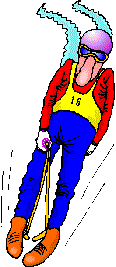
Lugers use their gloves (pictured), which have small spikes in the palms, to move forward after the push-off.
History: Although the sport of luge is sometimes thought of as being relatively new, sled racing is actually one of the oldest of all winter sports. The word "luge" comes from the French word for "sled." In Germany it is known as "rodel," and it is in the alpine countries of Europe that the sport began.
References to sled racing first appeared in chronicles from Norway in 1480 and the Erz Mountain area in 1552. The first international luge race took place in 1883 with 21 competitors representing seven nations, including the United States. The race was organized by hotels in the Swiss resort of Davos and took place over the 2½-mile road from St. Wolfgang to Klosters.
At the turn of the century, luge was actually governed by the International Bobsled Federation which administered all the ice-track racking sports. In 1953, the sport gained its own International Governing Body with the formation of the Federation Internationale de Luge de course (FIL), and in 1964 it was inaugurated as an Olympic sport at the Winter Games in Innsbruck.
Having no formal luge program at the time, the first U.S. team was made up of American soldiers who were stationed in Europe. Back in the United States, luge attracted a small number of athletes who were relegated to training on the 1932 Olympic bobsled run in Lake Placid, N.Y. With no formal national organization to support and develop, American sliders remained in relative obscurity for the next couple of decades.
The nation's first refrigerated luge run was built in 1979 for the 1980 Games in Lake Placid. The same year, the
U.S. Luge Association was formed to govern the sport in the United States.
Trivia: 1. What does the the word "luge" mean?
2. How fast can luge sleds go?
3. How many medals has the United States won in luge?
Answers