COMP572
Neural Networks
Ludovic Hilde
Email:
[email protected]
Summer 2008
07/30/08
Assignment 6
NETWORK ARCHITECTURE
The Kohonen neural network
is used to solve the Traveling Salesman Problem (TSP), which consists of creating
the shortest tour possible by traversing each city exactly once, starting at
any city, and ending at the same city.
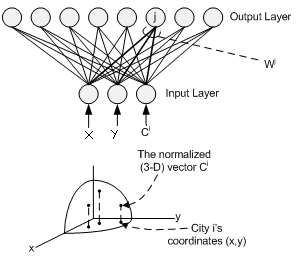
The network contains 3 input
neurons and N output neurons, where N stands for the number of cities in the
network. In my implementation, two of
the input neurons represent the xy Cartesian coordinates of a city in the unit
square, and the third input neuron represent the normalization component of
that city, which is calculated as 1 / √(x^2 + y^2).
All input neurons are
connected to all output neurons.
The network’s architecture
is shown in the picture below:
SIMULATION
The simulation first trains
the network by mapping each city presented at the input layer to one of the
image neuron at the output layer. It
then prints the results.
The source was written in
Java.
Click on the link below to
access the source code of the simulation:
Kohonen Self-Organizing Networks
MAPPING PROCESS
Initialization
The alpha gain is
initialized to 2.
The interaction distance is
initialized to 0.1N, which equals 3 for 30 cities.
The weights are initialized
to values between 0 and 1. these values are uniformly distributed when using the nextDouble function of the Java Random Class
All cities are located
within the unit square.
The number of cycles is set
to 1000
Algorithm
One city is chosen from the
training set and is presented at the input neurons, that is ai0 = x, ai1 = y, ai2 = c.
The activation values of the
Ith output neuron are computed as follows, aoi = C(x, y, c) * W(w1i, w2i, w3i) = x* w1i + y* w2i + c* w3i = ai0 * w1i + ai1 * w2i + ai2 * w3i.
The city image is set to the
output neuron with the highest activation value. The city image is stored in a double array to
account for duplicate.
The weights between output
and input neurons are updated as follows:
1-
Select the city image output neuron
2- Compute W(t) + C alpha(t)
-> ( w1i + alpha * C1x, w2i + alpha * C2x, w3i + alpha * C3x)
3- Normalize W(t) + C alpha(t)
-> √( (w1i + alpha * C1x)^2 + (w2i + alpha * C2x)^2 + (w3i + alpha * C3x)^2)
4- Update weights W(t+1) = W(t)
+ C alpha(t) / || W(t) + C alpha(t) || ->
( w1i + alpha * C1x / √( (w1i + alpha * C1x)^2 + (w2i + alpha * C2x)^2 + (w3i + alpha * C3x)^2),
w2i + alpha * C2x / √( (w1i + alpha * C1x)^2 + (w2i + alpha * C2x)^2 + (w3i + alpha * C3x)^2,
w3i + alpha * C3x / √( (w1i + alpha * C1x)^2 + (w2i + alpha * C2x)^2 + (w3i + alpha * C3x)^2
)
5- Repeat steps 2 to 4 for neurons within interaction
distance located left of the city image (accounting wrap around)
6- Repeat steps 2 to 4 for neurons within interaction
distance located right of the city image (accounting wrap around)
Decrease the interaction
distance linearly if it is greater than one and the number of cycles is within
the first 10%.
Decrease alpha linearly to
10% of its initial value if the number of cycles is within the first 10%. (In this simulation, alpha decreases by 0.2 -
2/100 = -0.018 at each cycle.)
Decrease alpha linearly to 0
if the number of cycles is past the first 10%.
(In this simulation, alpha decreases by - 0.2/900 = -0.000222 at each
cycle.)
RESULTS
The following depicts
several runs of a Kohonen network with 30 cities, 1000 cycles, and the
initialization parameters described in the MAPPING PROCESS section.
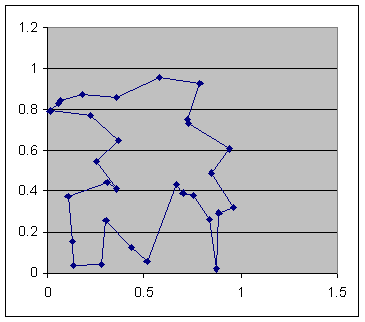
The
shortest length is: 4.6750
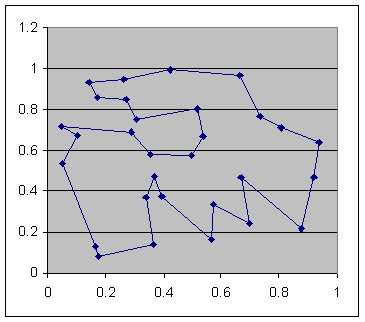
The
shortest length is: 4.9169
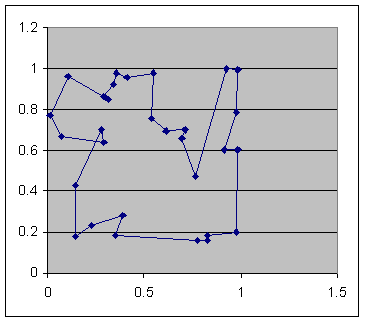
The
shortest length is: 4.7193
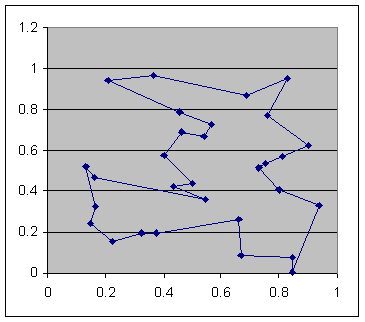
The
shortest length is: 4.5051
Path lengths for a 30-city
problem are shown in the table below.
|
Cycles |
Average Path |
Best Path |
|
1000 |
4.61711 |
4.0069 |
|
2000 |
4.8811 |
4.0935 |
|
5000 |
4.83974 |
4.2102 |
The path lengths generated
by my simulation are consistent with the results described by Favata and Walker for a 30-city problem. The increase in the number of cycles does not
have an impact for such small problem set because near optimum solutions are
found with 1000 cycles.