

Six hundred years ago, the Khmer civilization was one of the world's most sophisticated societies. While my ancesters were in northern France languishing in the Middle Ages, the Khmers were producing great art, literature, and architecture. The Khmer Empire was a diverse kingdom encompasing Khmer and Lao, Cham and Mon, and other ethnic groups lived in relative peace within its borders.
Sadly, Cambodia in recent decades has been a very sad place indeed. Anyone who has seen the movie "The Killing Fields" has an idea of what happened. The French granted Cambodia independence in the 1950s. During the Viet Nam war, the Viet Cong were smuggling weapons south on the Cambodian side of the border. The Americans began bombing, getting the Cambodians in the war and destabilizing Phnom Penh and its government. Before long, the United States is pulling out and the Khmer Rouge (Red Cambodians) surrounded the capital. It wasn't long after that that the Khmer Rouge depopulated the cities. Everyone was brought to the countryside where the young, supposedly pure, ruled, often arbitrarily and with great cruelty. Unfortunately, it resulted in the death of up to one-third of all the people in the country. This was only stopped by the Vietnamese invasion in 1979, which in and of itself created a whole new set of problems. At least the slaughter ended however.
Finally, after twenty-five years, Pol Pot is dead and the fighting is about over. The Killing Fields are a horrible memory. Cambodia can return to trying to build itself up as a nation. Fortunately, Cambodia has a strong national identity, and a wealth of resources. With hard work and the support of the international community, Cambodia will climb out. We in the West, especially the United States and France, have a moral obligation to help in any way possible.
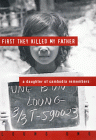
Loung Ung. "First They Killed My Father: A Daughter of Cambodia Remembers".
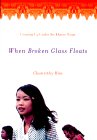
Cohanrithy Him. "When Broken Glass Floats: Growing Up Under the Khmer Rouge".
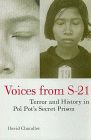
David Candler. "Voices From S-21: Terror and History in Pol Pot's Secret Prison".
Elizabeth Becker. "When the War Was Over: Cambodia and the Khmer Rouge Revolution".
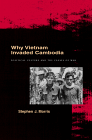
Stephen J. Morris. "Why Vietnam Invaded: Political Culture and the Causes of War".
Vann Nath. "A Cambodian Prison Portrait: One Year in the Khmer Rouges' S-21".
David Chandler. "Brother Number One: A Political Biography of Pol Pot".

 Click on the rabbit to tell me what you think.