Time Frame
1910, Boac, Marinduque
|
 |
Marcial, Kasilag Sr.
a native of Rosario Batangas who was born in 1881 married Asuncion Reyes,
a ballet teacher and a Solfegio violin player. Marcial Kasilag graduated
from Purdue University in 1908 with a Civil Engineering Degree. A loving
father who brings home books for his children to read was the First Filipino
head of the Bureau of Public works and Chief National Power Corporation.
|
|
|
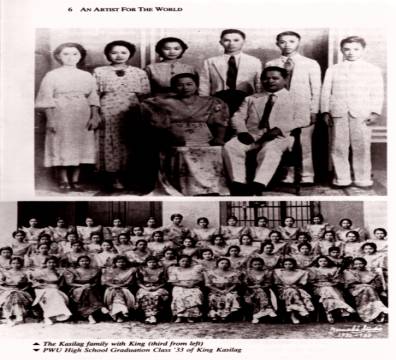
The couple had their
first offspring in Manila. He was Ocatavio, the next child, Natividad was
nicknamed "Nati". The third child was Lucresia or "King" which she was
more likely to be called. With a loving and very caring mother and a busy,
strict, firm but supervising father. Specially with the children's education
the Kasilag Family hither and tittered to San Fernando, La Union, Legazpi
Albay and finally the family heritage house in Perdigon, Manila. Inside,
Marcial and Asuncion now had 6 wonderful children. The Kasilag Family lived
in a so-called "white house' for it was the tallest & whitest in the
area.
|
|
Aug.31,1918
|
|
Birth of the talented
Ms. Lucresia "King" Kasilag.
|
|
1924, Kasilag Residence
|
|
King's first musical
inclement started when she was six. Her mother tutored her first Solfeggio
and violin lessons. Thus the start of the family's RONDALLA GROUP.Ok and
King's mom on the violin and Mina, Marcialito and Pedring blew the New
Year's horn of "torotot".
|
|
|
King, as a child wanted
to be a doctor. She didn't like to play with dolls. She's very athletic
and squirmy.
|
|
|
King and OK (Octavio)
learned to play Hawaiian guitars from her Papa's barber. Another barber
taught them to play other Rondalla instruments by oral note tradition.
|
|
|
King and her siblings
were very close. They played together and played music together.
|
|
|
The brood of six had
names to call each other. OK was name "Palakol" because of his big teeth,
Nati as "Bulati", King as "Bakoko" because she was so gat, Mina as "Kulata"
for she was delicate and pretty, Marcialito as "Tapa" because he loved
beef jerky.
|
|
1925, Piano Lessons
|
 |
King's next instrument
was the piano. She was 7 years old, her teacher was a Spanish woman named
Donya Concha Cuerro. Her teacher always noted that she was excellent in
her lessons and always remarked "Sobre Saliente".
|
1930, Paco Elementary
School
|
|
King graduated valedictorian
at the Paco Elementary School for she possessed such intelligence.
|
|
|
King's first recital;
she played May Breeze's song with out words by Mendelssohns in which she
learned from her piano lessons with Donya Pura Lacson Villanueva.
|
|
|
Funny medication;
King was diagnosed with an inverted heart and was advised by her doctor
to jump a number of times.
|
|
1930-1933, Philippine
Women's University
|
|
King went to Secondary
School in the Philippine Women's University, a efficient and meticulous
student proven by Ms. Laura Zalamen her Biology teacher, she only took
high school for 3 years, King and friends were called OSG's or Ostracized
Sophomore Group, In her senior year, she became the student council president.
|
|
1933; College
|
|
Engineering College
was started really tough for her, She was to enroll in U.P. as pre-Med
student but in the process, she found the registration procedures daunting
with OSG friends to help so she gave up.
|
|
PWU
|
|
King graduated B.A.
Major in English cum Laude. She always had very high grades. One's were
her grade through except in Swimming which she got a "5". She also became
Editor-in-Chief of the Maroon and White Association, editor of the PWU
Magazine, President of Liberal Arts Students Organization and Secretary
of the Collegiate Student Council.
|
|
|
King also joined the
dramatic guild, varsity cheering squad, senior track and field team and
the College Editor's guild as a member.
|
|
St. Scholastica's
College
|
|
A music degree |
|
1939;Japan
|
|
King, after a recital
for the music's teacher diploma in St. Scholastica's College was sent to
Japan by her full of pride father. King, the piano soloist was accompanied
by a group of musicians. When she went back to her native land she taught
piano and music theory in St. Scholastica's College. |
|
1946-1947: University
Of the Philippines
|
|
King taught at the
Conservatory of Music for more than a year and she also became secretary
registrar for a time. |
|
1949-1950: Chicago
Musical College and Eastman School of Music
|
|
She took up Master
of Music Degree Major in Theory with Minor in Composition as graduate scholar.
After she graduated, she worked with the head of the Theory Department
and Acting Admissions Officer of Eastman. |
|
1953: Philippine
Women's University
|
|
King was appointed
Dean of The PWU College of Music and the Fine Arts but continued composing
using the modernism she acquired abroad. |
|
1953: Brussels,
Belgium
|
|
The UNESCO International
Conference was held in Belgium and King was one of the delegates. She was
also elected Board of Directors in the prestigious International Society
for Music Organization. |
|
1954: Philippine
Women's University
|
|
The PWU Alumni Association
and College Easters Guild awarded King her very first award for her outstanding
work for music. |
|
1955-1957: National
Music Organization in the Philippines
|
|
Under her belt she
held are Director, Bayanihan Folk Arts Theater, PWU; Organizer and Charter
member, Philippine Music Educator's Organization; Technical Adviser, Manila
Symphony Society; and Secretary, Music Promotion Foundation of the Philippines
and Presidential Appointee to the Board of Trustees. |
|
1956-1957; 1960:
Other Awards
|
|
In 1956, the Manila
Symphony Society honored her for her compositions, from the PWU president
came the "Distinguished Service Award" and from St. Scholastica's College,
"Golden Jubilee Award for Notable service to Music Education". In 1957,
the Business and Professional Woman's Club named King its presidential
awardee as "Woman Composer of 1956". In 1960, King obtained four more awards
namely, Civic Assembly of Women of the Philippines' National Award as Presidential
Awardee in Music and the Arts, St. Scholastica's College Alumnae Association's
Special Plaque for Achievement in Music, The Battig Music Circle Award,
and the most important award for that year, her First Republic Cultural
Heritage Award in Music for her Toccata for Percussions and Winds. |
|
1963: Honolulu,
Hawaii
|
|
King was the only
Asian featured in the "Festival of Music and Art of this Century" sponsored
by the University of Hawaii and the East-West Center's Advanced Projects
in Honolulu. |
|
1965 February 9:
Gala Concert
|
|
The PWU sponsored
a gala concert featuring King's major compositions to celebrate her jubilee
year in music and recognition for all her national and international awards
given to her through the years. |
|
1966: Another Republic
Cultural Heritage Award in Music
|
|
King received this
award six years later from her first Republic Cultural Heritage Award in
Music for her composition, Misang Pilipino. |
|
1977: New Appointments
|
|
King retired as dean
and was named Dean Emeritus of the PWU College of music and the Fine Arts.
This retirement was because of her new appointment as the president of
the Cultural Center of the Philippines |
|
1970's
- Gained
22
merits of acknowledgment and appreciation.
(Note:
Only the most important ones are to be cited)
March
18, 1975
- Centro Escolar University
|
|
first
honoring doctorate in music |
|
March
27, 1976
- Cultural Center of the Philippines (CCP) Complex
|
|
She
was authorized as the President of the said organization |
|
|
|
Developments:
establishment of the Folk Arts Theatre, Philippine Center of Industrial
and trade Exhibits and Philippine Plaza Hotel. |
|
1980
|
|
Doctor
of Laws - Received from the Philippine women's University |
|
|
Outstanding
Alumnae for achievement in music award (St. Scholastica's College) |
|
June
11, 1981
|
|
Doctor
of Fine Arts - St. John's University (New York) |
|
April
24, 1982
|
|
Outstanding
classical instrumental recording (Philippine music industry) |
|
|
Gen.
Romulo Peace Award ( UN Association of the Philippines) |
|
June
24, 1984
|
|
Diwa
ng Lahi Award |
|
September
1984
|
|
Avicenna
prize (Novisti press Agency) |
|
1985
|
|
Chinese
Musicians Association, board member (October) |
|
|
Commandeur
dans l'Ordre des Artes et d Lettres (November, by French gov't) |
|
Involvements
|
|
National
Music Council of the Philippines (President) |
|
|
International
Music council in Paris (Board member) |
|
|
Philippine
Board on Books for Young People (Chairman) |
|
|
Federation
of Asian Cultural Promotion (Chairman) |
|
|
National
Commission on the Role of Filipino women (Chairman) |
|
|
Manila
Cathedral Cultural Foundation, Inc. (President) |
|
|
Committee
on Culture (Chairman) |
|
|
UNESCO
National Commission of the Philippines (Chairman) |
|
|
Filipino
Society of composers, Authors and Publishers (President) |
|
|
Music
promotion foundation of the Philippines (Board secretary) |
|
|
La
Salle Young Artists Foundation (Board member) |
|
|
Philippine
Music Educator's Group (charter member)Philippine Fulbright Scholars Association
(Charter member) |
|
|
International
Society for Music and Education (Charter board member) |
|
|
Philippines
Field Chapter of Pi Samba Theta (member) |
Home Pictures Works
Bibliography About
Us Things About Her