| HISTORY |
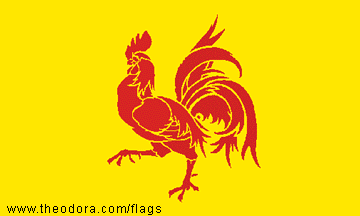
| HISTORY:Belgium became independent from the Netherlands in 1830 and was occupied by Germany during World Wars I and II. It has prospered in the past half century as a modern, technologically advanced European state and member of NATO and the EU. Tensions between the Dutch-speaking Flemings of the north and the French-speaking Walloons of the south have led in recent years to constitutional amendments granting these regions formal recognition and autonomy. |
| B E L G I U M- What'sthatallabout? |
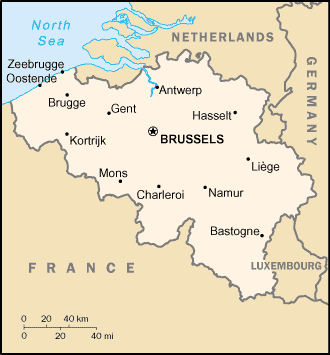 |
| RIGHT, this is a little "get-to-know-your-belgium" page so that none of you can have the excuse of saying "so where in Portugal is Belgium again?" or "Is it hard to speak Belginian?". The stats are courtesy of the CIA website which you can visit at... http://www.cia.gov/cia/publications/factbook/index.html if you feel the need to find more info on any country you so desire. So here we go..... |
| i live here |
 |
| GEOGRAPHICALSTUFF |
| GEOGRAPHICAL STUFF: Location: Western Europe, bordering the North Sea, between France and the Netherlands Area: total: 30,510 sq km land: 30,230 sq km water: 280 sq km Land boundaries: total: 1,385 km border countries: France 620 km, Germany 167 km, Luxembourg 148 km, Netherlands 450 km Coastline: 66 km Climate: temperate; mild winters, cool summers; rainy, humid, cloudy Terrain: flat coastal plains in northwest, central rolling hills, rugged mountains of Ardennes Forest in southeast Elevation extremes: lowest point: North Sea 0 m highest point: Signal de Botrange 694 m Natural resources: coal, natural gas Natural hazards: flooding is a threat in areas of reclaimed coastal land, protected from the sea by concrete dikes Environment - current issues: the environment is exposed to intense pressures from human activities: urbanization, dense transportation network, industry, intense animal breeding and crop cultivation; air and water pollution also have repercussions for neighboring countries; uncertainties regarding federal and regional responsibilities (now resolved) have slowed progress in tackling environmental challenges Geography - note: crossroads of Western Europe; majority of West European capitals within 1,000 km of Brussels, the seat of both the European Union and NATO |
| PEOPLE |
| PEOPLE: Population: 10,274,595 (July 2002 est.) Age structure: 0-14 years: 17.3% (male 911,729; female 871,470) 15-64 years: 65.6% (male 3,395,885; female 3,341,536) 65 years and over: 17.1% (male 716,673; female 1,037,302) (2002 est.) Sex ratio: at birth: 1.05 male(s)/female under 15 years: 1.05 male(s)/female 15-64 years: 1.02 male(s)/female 65 years and over: 0.69 male(s)/female total population: 0.96 male(s)/female (2002 est.) Life expectancy at birth: total population: 78.13 years female: 81.62 years (2002 est.) male: 74.8 years Nationality: noun: Belgian(s) adjective: Belgian Ethnic groups: Fleming 58%, Walloon 31%, mixed or other 11% Religions: Roman Catholic 75%, Protestant or other 25% Languages: Dutch 60%, French 40%, German less than 1%, legally bilingual (Dutch and French) |
 |
 |
| Before we get started on the lesson children, this here is in fact a page of facts which is very useful for general knowledge-type stuff but not so crash hot on the THINGS there are in Belgium. There are of course many interesting things to see and do and eat and drink, and you'll find that they are often mentuioned in my journal/updates page. SO, hope you enjoy learning a little more about a new country, there will be a quiz on wednesday - be sure to be prepared.... MUAHAHAHAHA |