NAHHASH
Are We Afraid of the Bible?
WE WANT the psychological security of a protecting deity, whereas we can become as gods, knowing good and evil (GEN. III, 5), just as the serpent said. This statement, which really means that we can be the whole process "Elohim", is confirmed by YHWH-Elohim: the man is become as one of us (Gen. III, 22). Rabbi Yhshwh, better known as Jesus, is supposed to have quoted that assertion; but, of course, he who referred to himself as Ben-Adam (mistranslated as "Son of man") knew the meaning of the letter-numbers. Not even his disciples understood that sacred language, as they themselves said. This understanding is not easy, but it is one thing to make a serious attempt to understand a somewhat difficult code, and it is quite another to run away from it and to dream that the mystery of life-death and existence can reveal itself by means of a few legends.
The fact (which one can verify for oneself)) is that the copyists, priests, rabbis and theologians have systematically discarded every statement in the Bible that destroys man's sense of security in a steady contunuity of existence. But the Bible is a Revalation only in so far as it includes death in life, thereby disrupting every psychological certainty. Vested authority throughtout the ages, however, has reversed and betrayed this biblical message of life-including-death and has promised existence-after-death, which is not the same thing at all. Death is actually here, as a vital aspect of our everyday life, at every moment. When we come to see that we are constantly waging a battle (psychologically) for the continuity of our existence against the life-death within us, and when we come to learn (from the Book of Genesis) that combat mujst cease by our becoming that very life-death, a disruption occurs in our thought process and in our psychical armour, which liberates us into life. And this is precisely the thing, the life-stimulating thing, that we are araid of.
It is important to learn that our urge toward static permanence goes very deep. Constantly, we shy away from something that might upset us. This we automatically classify as "harmful". For instance, look again at the tree which, so the translations state, is "the tree of knowledge of good and evil". This schema Tov, translated as "good", expresses the static, materializing, carnal action of the primitive female (symbolically considered under all its aspects). That action nourishes and strengthens the Bayt, the "house", the shell.
The schema Raa ("evil") leads all structured energy towards the indertermination of 70; it cannot therefore but tend to destroy all that is static, determinant, conditioning.
Any static factor in our minds eventually jeopardizes the flow of newness, of freshness, which is the specific quality of human genesis. The cause of fear is easy to see: one does not want to be disturbed; therefore one calls good anything which is the mind's container, and calls evil everything which will endanger the maintenance of one's armour of certainties. And the translators, by supporting this reversal, have seen to it that we should be conditioned to a view of life that mocks all true values. When one reflects that Tov (translated "good") really means limitied in its material proliferation and that the process Raa (translated "evil") is really a loosening of our bonds, a thawing out, an awakening or quickening of the life force, one can understand that the action of Raa, far from being in any sense evil, is something designed to save our life.
The misunderstandings with which we have grown up are too numerous to be dealt with in one small volume. Here, however, is another vital example. We have seen with the episode of Jacob wrestling with Elohim that the process of evolution in time is satisfied only when overcome and "conquered". Thus Esha, in plucking the apple, understands and integrates the Elohimic process and it is satisfied. An extraordinary thing happens to Esha. When she is questioned concerning the event, she does not--as the translations assert--reply, The serpent beguiled me (Gen. III, 13). What the true reading gives is far more significant. The Hebrew phrase, Hanahhash Hashayiny, as is so often true in the most beautiful passages, is impossible to translate in two or three words. It has to do with the action of the letter Sheen (300), it is remembered, stands for the cosmic breath of life, and we have seen that the true meaning is not that they were "naked" and "not-ashamed" (which has nothing to do with the letter-numbers of the text), but they were left without the Sheen. Now Hanahhash Hashayiny simply means that Nahhash, the serpent, "Sheens" her; that is, he blends his earthly fire with her lost heavenly fire, which thus comes to life again. Some traditions have identified this Sheen (300) with the mythical "Spirit of God".
But we are afraid to pluck the fruit; and because we wish to rationalize our "sins" of omission, we invent a prohibition and carefully project the allegory into the past, when in fact the fruit is ready for us to harvest here and now. Esha did not live centuries ago, and we wonder if she is even born yet.
The psychological process by which a revalatory and profoundly challenging book is consistently and forever misread is, after all, quite easy to understand. The reason that the tale of the talking serpent and the magic apple outlives every other fairy story is that we are afraid of it.
--Suares, "The Cipher of Genesis" pp. 117-20.
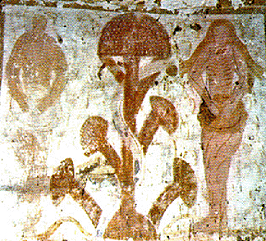
Serpent
.i.