It was a cold ride to Barrineau. You could not really call it rain, but if you crossed your eyes you could see fine beads like dew standing on the end of your nose. Several times the rig bogged down in the muddy slop that filled the road. Baptiste was forced to cut brush and shove it up under the front wheels while I coaxed the mules forward. Despite these miserable conditions we got to Barrineau before noon.
I found a spot that was covered and out of the wind near the loading platform. I pulled in there. The train was not due till after one, so we had ourselves each a couple of boiled eggs and a few slices of ham and called it lunch.
By and by Baptiste began to fidget. I expect that nickel was burning a hole in his pocket, for the last time I saw him he was headed in the direction of the firehouse. He had of late fallen in with a fast crowd that hung around there: card sharps, stove huggers, and the like. He ran errands for them. Every once in a while they let him sit in on a hand of bourré. You may wonder how a deaf boy could master such a game as bourré. Simple: he cheated.
I decided it was best to stay with the wagon and spent the time observing the comings and going at the depot. For a small town the railroad station did a brisk business. In a span of thirty minutes, I counted ten men, five women, an infant in a carriage, two coffins, and a half dozen dogs pass through its front doors. The dogs were quickly turned out. Which brings to mind a similar situation I was witness to first hand in a place called Purgatory, Kansas. Only it involved cats.
One winter a few stray cats took up residence in the town's one livery stable. They went unchecked, wandering the streets and fraternizing with the local cats, till by summer a body could scarcely put one foot in front of the other without one of those flea-bitten felines wrapping itself around your ankle. Now Purgatory was a town you did not have to go through to get to anywhere. So there was no chance of them slipping into a passing freight car or wagon. A town meeting was called and several proposals were put forth, including one by a lesser frequented eating establishment. After several hours of heated debate a peaceful solution was agreed upon. Over the course of a week all the stray cats were rounded up, then one night under the cover of darkness, they were loaded into the town funeral wagon and transported across state lines to White Horse, making them Colorado's problem. What became of them after that I cannot say. It is a shame the same could not have been done with my uncle.
After thirty minutes or more went by with no sign of the train or Baptiste, I swung myself off the wagon seat and went around to the front of the depot. The water run-off made little gullies around the building. I had to jump several and still managed to get my feet wet. I would have to dry my shoes by the fire when I got home. They would be stiff for sure in the morning.
The depot building was newly built and still smelled of green wood and fresh paint. The inside was not much bigger than a good size smoke house. On either side of the room were two rows of wooden benches. Most of them were filled with the people I had seen earlier. Against the back wall was the ticket counter. The ticket agent was a friend of the family's, Theo Duhon. He was a widower. His wife had died three years earlier because of heart trouble. Theo was sweet on my mama. He had called on her once or twice, but she would have nothing to do with him. I liked Monsieur Duhon. He was a kind man who would have been good to Mama. But the need for male companionship did not abide in her.
Monsieur Duhon was also a musician. He played the fiddle. I liked to watch him near as much as I liked to hear him. That is because he had three fingers on his bowing hand missing. He lost them to a Yankee saber in the war. It was said he slept with a CSA pistol under his pillow just in case the sorry bastard ever came back looking for the rest of him.
He did not seem busy, so I walked right up to say hey.
I said, “Bonjour, Monsieur Duhon.”
He said, “Lucie, cher, comment ça va?”
“Pretty good,” I said. “And you?”
“Well, me, I can't complain. And your mama? She still as pretty as ever?”
“Mama is fine.”
“And speaking of pretty women, how about that sister of yours? Alyce has sure made a beautiful girl, hasn't she? I was just telling my son Dewey the other day, that Alyce Trosclair has sure made a pretty girl. I hope your uncle keeps on letting her come to our little dances on Saturday nights. There will be a lot of broken hearts if he don't, yeah.”
“Well,” I said, “it is hard to tell with Uncle Neg.”
Monsieur Duhon pushed his eye shade back a bit and leaned over the counter so as to get closer. He said to me in a low and confidential manner, “Your mama, she's not seeing anybody, is she?”
“Oh, no, Monsieur,” I said. “She mostly stays home. The children keep her pretty busy.”
He nodded. “I know what you mean, cher. It was not that long ago my own were little. And look now. Lizette married and with a baby of her own. And that Dewey! Tell me the truth, what do you think of his fiddle playing?”
“Dewey is very good,” I said. “But he still cannot hold a candle to you.”
Monsieur Duhon took my hand and patted. “Well, thank you, cher. You know I tried to teach him all I know. But children now days, it looks like they got a mind of their own. I don't know. Maybe the rest comes with age. What do you think, you?”
“I reckon so.”
He said, “What brings you here? Your uncle expecting some freight?”
I told him, “I am here to get Monsieur Gaspard's son Charles. He is coming from New Orleans on the train.”
“Monsieur Gaspard's son you say? Philippe Gaspard?” He pulled off his visor and scratched his head. “Well, well. I did not know old man Gaspard had him a son, no. Where has he been? Locked up somewhere, if he's anything like his papa.”
“You don't know how close you are to the truth,” I said.
Monsieur Duhon took his watch from his pocket and looked at it closely. “Well, the train ought to be in anytime now. She's running late on account of the weather. Some trouble with a bridge a ways up the line. Just have a seat over there. It should not be long. Are you here by yourself, cher?”
“No,” I said. “Baptiste came with me.”
Monsieur Duhon began to laugh. “That Baptiste sure has a great capacity for making mischief, don't he? Where is he now, down to the firehouse?”
“More than likely,” said I.
“Well, you go right ahead and make yourself at home, cher. The train ought to be here soon.”
“Merci, monsieur.”
“And listen. The next time Alyce comes to the fais-dodo, you come go, too. I bet we can find you a fine young man to dance with, yeah.”
My eyes went straight to my shoes. I remembered what my uncle had said to me just that very morning concerning my looks. I felt my face go red, and I said nothing.
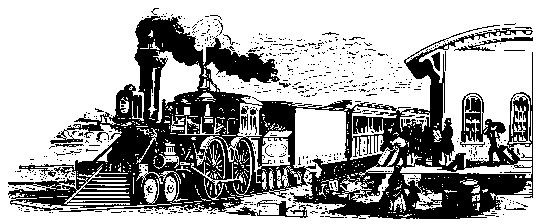
No sooner had I found a seat than Baptiste came strolling through the door. It was none too soon for the train was rolling in. She had a shiny new engine and was coughing up clouds of black smoke for all she was worth. The engineer was quite taken with her low mournful whistle, as he laid on it every chance he got and made it cry like a dog. You should have seen the look on Baptiste's face when he saw her round the turn into the yard. There is nothing like a steam engine to make a boy's eyes light up. You can say what you will about those new contraptions they are calling airplanes, but I do not believe they will ever take hold like trains. If the Good Lord had wanted us to fly, would He not have given us feathers?
We huddled together in the cold while the passengers got off. Amongst them were several well dressed young men. But none of them was who we had come for. The first car emptied, and then the next, and still there was no Charles Gaspard. I noticed that the last car---which was a private car---appeared to have a party going on inside. Every now and then you could catch a glimpse of the revelry. People were laughing and carrying on, arms flung around one another in joyful jubilee. There was also evidence of wine and strong spirits. Some appeared to be drinking it straight from the bottle! A red-haired man commenced to shout and catcall through an open window of the car. It was hard to make out what he was saying. I was just beginning to get the gist of it when he was struck on the head with a chunk of wood and fell from my line of vision.
That was when I spotted Monsieur Philippe's valet, Louis. He was standing on the back steps of that same car. Louis was an elderly colored gentleman. When I say he was a gentleman, I mean he was a real gentleman. He could both read and write. He was well versed in the customs of high society and knew the proper way to behave at all times. I envied him those skills. Louis had been in Monsieur Gaspard's service since slavery days. When he was in residence at Amelie, he took over the job of running the house from poor old Madame Chauvin. He made it run with crackerjack efficiency. He was as good natured as could be, and why he stayed on with that no-account Philippe Gaspard is beyond me. Call it misguided loyalty and let it go at that.
I waved my arms till Louis saw me. I must confess, Louis' polite and courtly manner made me nervous. I always felt as if I had a piece of mustard greens stuck between my teeth whenever I talked to him. I stood ramrod straight when I saw him coming my way and did my best to push my straggly hair beneath my bonnet. I punched Baptiste with a sharp elbow and motioned for him to do the same.
“Bonjour, Mademoiselle Lucie,” Louis said to me. “I take it your uncle is here to fetch Monsieur Charles?”
I said, “Uncle Neg had some unexpected business at Amelie. He asked me to come in his stead.”
It was clear this did not meet with Louis' approval. He hesitated and looked around. “Is there someone here to help with the luggage? I am afraid I will not be able to manage alone.”
“I have Baptiste.” I motioned to my brother, but Louis still seemed worried, so I told him, “We are quite strong for our size. I am sure we can do the job, even if we have to make two trips.”
“No, no,” he said. “That is not the problem. It is . . . well . . . Monsieur Charles. He is rather indisposed. But I suppose you and I can manage. Here is his baggage ticket. Have your brother take it to that man over there. He will see to it that it is brought to the carriage.”
“We do not have the carriage,” I said.
“No? Then how are we to get home?”
I told him, “We brought the wagon.”
The rain began to seep down his collar, but he paid it little mind, such was his concern for his charge. He said, “Very well then, follow me, s'il vous plait.”
When we got inside the train car the smoke was so thick I could not see my hand before my face. My thought was this: What? Is the car on fire? It was not. It was only cigar smoke. Thick enough to choke a horse. After my eyes adjusted to the light I saw the car was packed tight tight with people. They were mostly women, but there were also a few men. A number of folks were dressed in costumes of such extreme that their genders were uncertain. My pulse quickened at the sight of so much unbridled lechery crammed into so small a space. There was even an organ grinder with a blind man on a leash who went from seat to seat soliciting funds. Louis had to shout to be heard over the din and clammer. He said something I did not quite catch and then pointed to the rear of the car. I nodded and followed his lead.
The walls of the car were paneled in dark walnut. The windows were draped in black and gold brocade. Brass lamps with little gas jets of fire lit the way, and everywhere you looked amongst the writhing sea of bodies were baskets of roses and empty bottles of champagne.
I put my fingers to my ears and walked through the people up the aisle behind Louis. A noisy boy in a flannel shirt offered to sell me a hot tamale. I declined. Too many of your tamales peddled in such a way are made with cat. That is what Madame Rémy always told us. Way at the very back of the coach was a young woman sitting quietly by herself. I could not help but notice how she looked like a striped peppermint candy dressed the way she was in her red and white silk frock. She was quite handsome and did not appear the least put out by all the raucous noise. She was content to sit and pet the small dark object she had on her lap. From where I was standing it looked to be a small dog of some kind.
“Who is that?,” I shouted, nodding my head toward the pretty lady at the back of the train.
“That is Mademoiselle Adriana Durandville, the famous stage actress. She and Monsieur Charles are very close friends. It is through her benevolence our trip was arranged. This is Mademoiselle Durandville's private car. As you can see, she is a very generous woman. Mind you don't step on the Lieutenant Governor.” And Louis continued down the aisle.
I thought to myself, Monsieur Charles certainly cut a wide loop amongst the rich and powerful. If Uncle Neg truly planned to rob him of his birthright, he had his work cut out for him.
“Which one of these fellows is Monsieur Charles?” said I, for none of the drunken fools I saw looked to be offspring of Philippe Gaspard.
“This one.” And Louis pointed to the reclining figure whose head I had mistaken for a lap dog.
I stepped back in horror. “Mon Dieu! What has happened to him?,” I cried, fearing that on the trip from New Orleans he had met with an untimely end. All I could see was the look on Philippe's face when I came home carrying his dead boy up the drive in the back of a feed wagon. Charles Gaspard may have been a pearl of great price to some, but he was fast becoming an almighty trial to me.
“There is no need to worry, child,” spoke the famous stage actress on seeing my distress. “In the morning he will be as good as new.”
“Are you sure?” I said. “Philippe is a pitiless man, double-tough and used to having things his way. He will beat me with a strap if any harm has come to his son.”
“Hush, child. Don't carry on so. Charles simply has had too much champagne. The prospect of exile weighs heavy on him.”
I looked at the young man asleep on her lap. He needed a bath and a shave, but you could tell he was very nice to look at beneath it all. And he surely had a nice smile, for it slowly turned up the corners of his mouth for all to see.
“My oh my,” I said, as I gazed down at him, “he sure is pretty.”
“Yes,” the mademoiselle agreed. “He is very pretty indeed.” She smiled as she twisted one of his dark curls around her finger, then bending down, she whispered something in his ear. He seemed to have not only have heard her but understood whatever it was she said, for his face broke into a wide grin and he commenced to kiss her fingers---all her fingers . . . one digit at a time . . . up and down . . . from tip to junction, from tip to junction . . . till each . . . slender . . . digit . . . was done. Lord! I am here to tell you, you would be hard pressed to find a more wanton display than the show those two put on. Decorum keeps me from going into it any further, but I will say this: it was clear that more than just a handshake had passed between them!
Louis was not shocked in the least, so long had he lived in the camp of the Philistine. He waited for the young monsieur to stop his nuzzling and together we stood him up, each taking an arm, and we loaded him into the wagon. Baptiste had already seen to the luggage and was pulled up near the steps so we did not have to lug Monsieur Charles very far. We laid him out in the back. He was way beyond sitting. Then we left without delay.
Baptiste took the reins. Louis rode shotgun. I sat in the back with the “freight.” It had begun to rain hard, so I took an old blanket Uncle Neg kept behind the seat and made a little tent to cover me and the young monsieur as best I could.
We traveled that way for some time, jostling back and forth in the wagon. It was almost as if Baptiste tried to hit every rut and pothole he could find. Pretty soon I forgot I had Philippe's boy's head resting in my lap, and what with the steady drip of the rain, and the constant rocking of the wagon, I expect I began to doze. It did not last long, for presently I was aroused by the feel of a warm hand upon my cheek, stroking me gentle-like, the way you would a baby.
“Cheri, why are you shivering?”
I woke all the way up, startled by the nearness of this stranger and the newness of just such a situation. “I beg your pardon, monsieur.”
“Shhh,” he whispered. “Look at me. That's it . . . no . . . do not talk . . . just look at me. I want you to remember.”
That was when I got my first good look at his eyes. They were big and brown, the color of hot coffee, fringed all around with long black lashes. In those I eyes I saw things I had never imagined. And it was as tempting as seven kinds of mortal sin.
“Angel of mercy,” he said to me, “I have lived a poor life. The water is too deep. Hold me up, for I fear I will surely drown.”
You may well imagine the level of shock that was registered upon hearing this man speak, let alone at knowing the feel of his hand upon my innocent person! Up till then I do not think I had ever been touched in any way by a man except in anger. Papa had been dead too long for me to remember much about him. Paw Paw sometimes would pat our heads, but even that was hard to recall. The only other man I knew was Uncle Neg, and I am not sure you would call a good pop across the jaws a touch. Now all of a sudden, here I was, in the rain, in a wagon with a strange man who had not yet called me by my rightful name, and yet he was feeling my cheek and talking pretty words! I sat transfixed, a statue to be shattered by one more soft blow of his words, till finally I recovered my tongue long enough to prevent it. “Don't worry, monsieur,” I told him. “I will take good care of you. No harm will come. I promise. I will not let you drown.”
He put his hand in mine and with a sigh, closed his eyes and fell back into his drunken sleep.
My eyes were glued to that hand. I dared not breath for fear I would wake and find it all to have been a dream. How rough and coarse my hand must have felt against his. His hand was long, almost bony, with smooth slender fingers that curled and twitched ever so softly against my palm. His fingernails were clean, trimmed smooth as a woman's. I had never known a man with fingernails so clean. And his breath, for all that he had drunk, was as clean as his nails. The rain rolled off the brim of my bonnet right onto him, so I pulled the blanket over his face, as you would a dead body, without saying another word. It was a good thing we had rain, for I cried great big crocodile tears all the way home. I felt sick to my stomach and my head hurt. It hurt to think. It hurt to breath. I believe I may have been running a fever. Like the story of the blind man in the Bible, I had suddenly been given the gift of sight. Fate had dealt me its cruelest blow. I now knew Uncle Neg's prophecy would come to pass for I had seen the rabbit.
The Narrow Journey - Chapter One "Lucie"
