
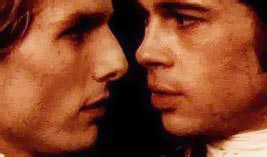
Several representations abound in the homoerotic depiction of male vampires. In my analysis, I found the homoerotic desire between male vampires is much more apparent in later films of the last twenty years or so. In these films, the male vampire with his homoerotic tendencies is portrayed as always appearing well dressed. He is often slim and very attractive with an almost androgynous or effeminate appearance. In contrast to some of the earlier depictions of male vampires, particularly that of Dracula, the male vampire of today�s films is never outwardly muscular or masculine. In addition, he is always refined in his taste and regards aesthetic beauty of great importance. This representation is clearly highlighted by Anne Rice�s vampires, in particular Vampire Lestat and his companion the vampire Louis. In addition, the male vampire relies more heavily on his social grace and charm and his supernatural powers to seduce and over take his victims. This is in great contrast to lesbian vampires who use their overt sexuality to seduce and kill. As such, the male vampire�s victims are most often men. In their feedings off these men, homoerotic desire becomes apparent, despite any visual or physical desire happening. An intimacy is present allowing the male vampire to connect with the most desired and hidden aspect of his male victim: his blood. This can clearly be regarded as allowing homosexual desire to exist within the �safe� sphere of heteronormative social boundaries. As one author notably claims, �the life-or-death risk, the trading of fluids, the fact that it�s always at night�.it�s a little risky, and that�s what vampires offer us� (as quoted by Jones, 11/6/01: 48). In viewing this quote, when you take the word �vampire� out of the sentence, one can mistake the quote as talking about homosexual men and the danger they live with in a heterosexualized society.
Garber, Eric. �The Sons of Lestat: Vampire Love for the Nineties�. In the Lambda Book Report Journal. 6/30/1991. V.2; N.10; p.22.
Jones, Wenzel. �Vamping it Up: The Outfits? The Sex? The Age Defiance? Just What is the Appeal of Vampires to Gay and Lesbian Audiences?� In The Advocate. 11/16/2001. N.850 p.48.