Granular Materials
Properties of matter have been studied for long time using the atomic concept: 'everything is formed by atoms that move and interact.' However, granular materials show some peculiarities. Some times they behave as solids but other times as liquids. The clue is in the grains. They are not real atoms and their interaction is very different.
When two atoms collide the total energy (unless they break up in electrons, protons and neutron) is conserved. However, when two grains collide most of the energy is lost in friction and deformation.
Arches
We have numerically simulated 2200 inelastic, rough spheres vertically shaken in a box. In the figure below two different arches are displayed after the removal of all the surrounding spheres from the virtual box. An arch is a multi-particle, self-stable structure. The blue spheres are fully stable whereas the green ones are mutually stabilised. The green ‘grains’ form the actual arch supported by the blue ones.
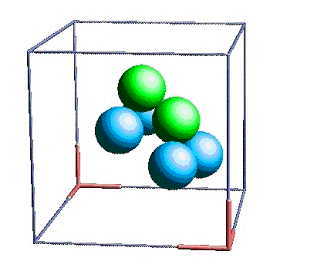
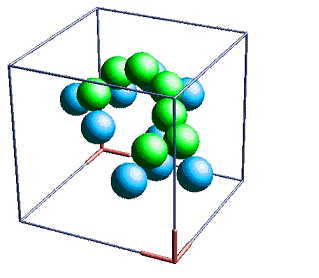
One of the surprising discoveries about arches is that most of them look like ‘centipedes’. The arch is like a chain of spheres supported by ‘legs.’
The jamming of a saltcellar
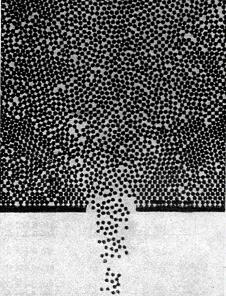
We have conducted experiments on the jamming of an orifice when granular material is poured through it. The jamming probability and avalanche size distribution was obtained by measuring the number of glass beads that came out from a small hole at the bottom of a silo. Since the outlet gets jammed, we use a jet of compresed air to trigger the avalanches. The experimental results can be partially explained by using a very simple probabilistic theory which implies that the fall of each glass bead is independet from the fall of other glass beads.