Computer Simulation of Food Colloids
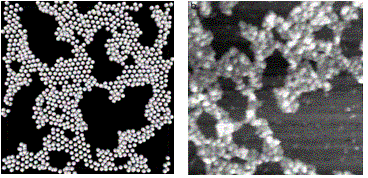
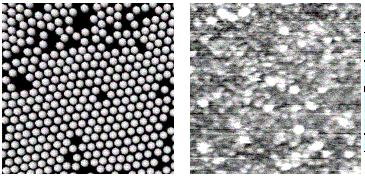
Globular proteins, like milk beta-loctoglobulin, can be modeled as colloidal spheres --spheres much bigger than the solvent molecules. These proteins have a high preference to lie in the air-water or oil-water interface. This contributes to the stability of foams and emulsions. In addition, these proteins form gels by association through chemical and/or physical bonds. In the left hand panel of the figure below a two-dimensional gelled structure is shown. The spheres are connected through elastic bonds (not displayed) and are adsorbed to an interface. The structure was generated by Brownian Dynamics Simulation. On the right hand side, the structure of an adsorbed beta-lactoglobulin film obtained by using an atomic force microscope (AFM) is shown for comparison.
Although these structures are very stable, they can be displaced from the interface by other surface-active particles. Below, we have introduced a new specie of particles in the system (the small red spheres) that can be adsorbed competitively at the interface.
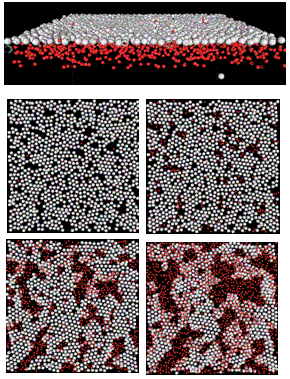
Because the small red spheres are more surface-active, they adsorb at the interface displacing the gel-forming particles (white spheres). The lower four panels show the interface as the competitive absorption progresses. Unlike the white spheres, the red ones do not form bonds. In the figure below we compare the resulting structure of the protein network with the structure of a beta-lactoglobulin film partially displaced by a smaller surface-active molecule (Tween20). The image on the left is from our computer simulation and the one on the right is from a AFM experimet. The dark areas correspond to the small molecules that have been washed away before imaging.