Aggregation and Continuum Percolation
Many problems in chemical physics are related to the association of elementary entities that form complex structures called clusters. For example, atoms associate to form molecules and these associate to form more complex clusters. Percolation -the development of a macroscopic cluster- is essential in the description of some sharp behavior changes in associating entities.
Clusters near a container wall
The figure shows a cluster (dark spheres) of atoms linked to a fixed one (black sphere). This was obtained by Monte Carlo simulation of 500 hard spheres in a box. The box has walls at the right and left sides and periodic boundaries in the other directions.
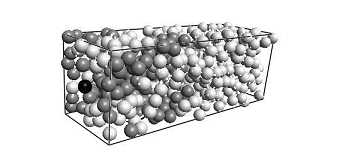
In order to decide which particles belong to the cluster we used the Stillinger's criterion: two particles are directly connected if they are separated by a distance shorter than d (d = 0.25 times the sphere diameter in this case).
Time-dependent connectivity criteria
The Stillinger's criterion can be very simplistic. We have proposed two more elaborated criteria. The first includes a time residence restriction, in addition to the distance restriction, to decide whether two particles are or not directly connected. The resulting clusters are called 'chemical clusters.'
The second connectivity criterion we have developed consists in tracking the fragmentation of a Stillinger's cluster during its time evolution. We consider the fragments as more 'real' clusters because they 'survived' in one piece during a given time. These are called 'physical clusters.' PowerPoint example.