BCU - Fire
Contact B.Howe
Wire Plant Names
Quickie-ProjectThe first time I made these, my wife flipped out, dug out my garden journal from last year, and started listing off words to make. They are very easy to do, cost next to nothing per name, and can be as fancy or plain as you desire. I usually spend an hour doing a name, but that includes actually watching the TV a little, drinking coffee, putting kids to bed, etc. So if you are interested in a quick and easy project for late at night, or those rainy spring days, just read on.
First things first, what the heck am I talking about? Name tags made out of twisted wire, of course.

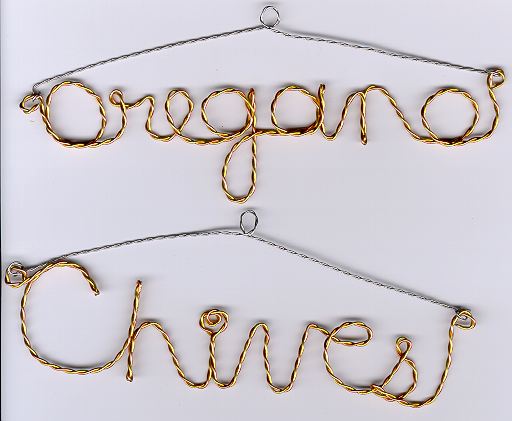
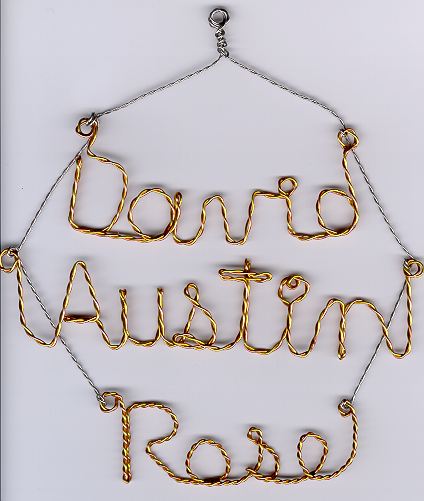
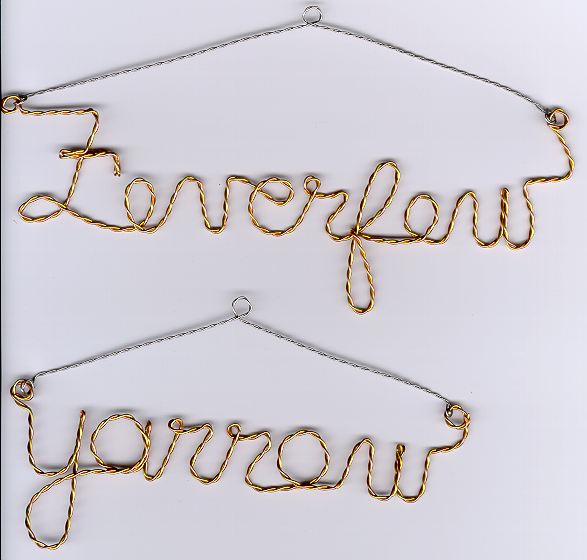
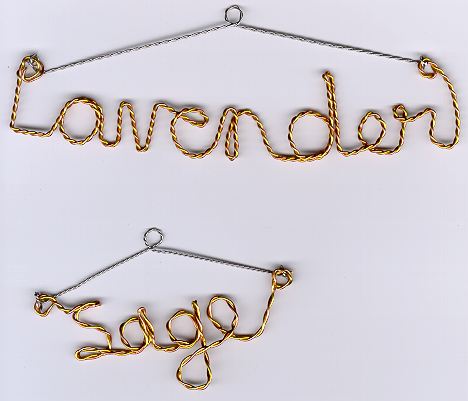
There they are. Nothing fancy admittedly, but if you're anything like me when it comes to gardens, plants will be moved, tags will be lost, and if you spent any real money on them you'll be upset. If you lose these ones it won't hurt so much, hey you may even be happy about it.
How to make these things:
1) Start with two pieces of wire (I used 1 copper and 1 brass in the photos) around 20 ga. or whatever weight your comfortable working with, and about 3 feet long. wrap one end of both wires securely around a chair leg, a nail in the wall, a door handle (anything fixed in place).
2) Stick the other ends of both wires into the chuck of a hand drill so that it is gripped firmly. Here's the tricky part - ready? - spin the drill. The wire will spiral itself evenly and tightly, the longer you spin it the closer the spirals will get to each other. I use a small, unpowered hand-drill (the kind that looks like an old eggbeater) for most of this work, but if your using a very stiff wire (14 guage) I'd suggest a power drill.
3) Figure out what word you want to make. Then write it out a few times on a piece of paper, until you get the right look. Remember that your pen cannot leave the paper. This sounds like an easy step to skip, but you'd be surprised how many weird situations you can find yourself in trying to bend wire this way. I used a small slate chalkboard from the kids toybox to work the writing out on. Also if you have problems with keeping the size just right, then you can make a template on paper to match the wire to.
4) Grab your wire, some pliers, and start bending. Following the writing on the paper for connecting the letters together and starting/ending the words. Notice the d's, o's, and a's in the above pictures. I found that by going around in a full circle made a more stable letter than trying to backtrack like I would if writing normally.
That's all there is to it, no tricks. One tip I can give you though, keep them small. The more compact - the better. I made a really nice 'Lavender' about 7" long, to go in a large patch. When I actually put it outside (in the snow) it disappeared. The surrounding scenery is busy enough (snow and a few twigs) to completely hide the letters. The more compact ones, like the Sage shown above, hold their own better against the background.
Also, the squiggly white line on the left of the images is the pattern I use for my hanging hooks. I use stainless steel wire on the names to make the loops, and 14 ga, galvanized steel for the hooks (coat hanger would work). In case it isn't clear, the bumps about 1/4 of the way up the hook is a horizontal circle of wire which acts as a stabilizer for the stick. Sort of an 'insert to here' mark for whoever has to stick the thing into the garden. It also helps keep it from sinking or falling over sideways to some degree. Leave quite a bit of wire below this point, or double it into sort of a 'U' to give the stand the stability it'll need.
Lastly, remember that metals change when exposed to the great outdoors, so you may only get a couple years out of them. Iron wire will turn oranges and reds as it rusts, copper - greens, galvanized steel will change with the sky, stainless steel will get very dark, brass changes in many ways. The wire may be coated, uncoated, electroplated, filled, square, round, or oval lending to some truly unexpected reactions with the environment.
Experiments:
...different kinds of wire (material, weights, combinations);
...add to a flat background (tin, steel, aluminum foil);
...make peoples names as gift tags;
...You get the idea :-)
Brett