BCU - Air
Contact B.Howe
Aeolean Harp
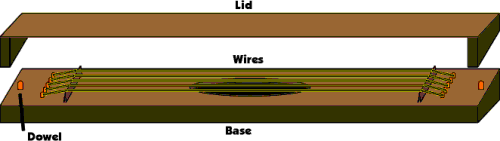
I made this harp last summer as a test. I found the design online at The Little Aeolian Harp Page. The principal of using the harp isn't too difficult to grasp. Place the harp with it's lid on in an open window, then close the window until it rests on the lid. This way, all of the air movement through the window has to blow across the wires. Sounds easy doesn't it - just wait until you make one and three months goes by before you can test it out :-)
I'm not a harmonics/resonance expert, but I can tell you that some property of the harp requires a specific flavour of wind. It has to be blowing in a specific way to fire up the wires and give you an audible tone. One aspect that the wind needs is a certain consistency. Try to imagine the feeling of a spring breeze versus a gusty fall wind - the harp sounds off better in the spring. It also makes better sound in the morning, rather than evening.
The first time I got tone from my harp I was ecstatic. The thing had been sitting in the kitchen window for a solid couple months (I made mine in June, toned off near the end of August). I was near ready to scrap it, when a strong late afternoon breeze drifted through and gave me a crystal clear tone which sounded similar (but not the same) as the sound you'll get by running a finger around the rim of a crystal goblet. The sound begins inside your skull, you don't suddenly realize that you can hear it, so much as suddenly realize that you've been hearing it for a little while it's just gotten louder. It is a sound that I have tried to describe to many people and have failed utterly each time. It must be experienced.
It toned off again for witnesses during a small thunderstorm during the fall. The wind had picked up enough that it was slamming doors and blowing things off of the counters, when all of a sudden this torturously loud mischord rattled out of the harp. Not unlike airy nails on a blackboard, it quickly settled back down to more tolerable levels. That night we were audience to the full range of tones and harmonies that the harp can produce. It also sealed it's place in the kitchen window as long as the weather is warm enough.
I plan on making a couple more for my parents and such. Before I give them away though, I'm going to try stacking two together (turn one over as the lid) to see what the harmonics are like. I've seen pictures of set-ups like this and would like to experience it.
This is a great weekend project to pull together out of scrap wood and bits of wire (mine are 24 guage stainless steel, 28 guage brass, and fishing line held in with part of a drawer-pull. Make it to fit a window in your house that gets a good breeze (blowing in or out). Put the harp in the window and forget about it.
It will sound off when it wants to, probably not when anyone is nearby. A great thing to surprise people with when it is heard. Very mystical quality to the sound, eerie and settling at the same time. It can also carry a fair ways outside, or at least my neighbour says it does.
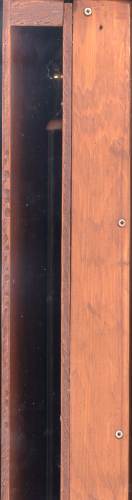
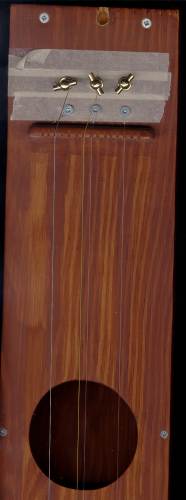 At left are scans of my harp. Bear in mind that I have no technical woodworking ability (and it shows), but while it may not be pretty - it works. The box is made out of some 1/4 plywood that I had laying around, screwed and glued onto some small blocks of spruce that were in the scrap bin. I gave it some stain just for the heck of it. The wire is attached with little screws at one end, and the threaded shaft from a small 'ring-style' drawer pull (with the ring removed, obviously). From start to finish this is a work-with-what-you've-got project,and I'm proud of it. If you don't try to get fancy, it won't get expensive. On the other hand, if you have the skill your can produce a beautiful instrument to show off.
BIG HINT: Keeping the wires tight can be a problem, the tuning screws will tend to slip due to changes in heat, humidity, and vibrations. When your wiring the box, tighten the tuning screws as far as the will go before attaching the wire. Attach your wire to it as tight as you can by hand, then 'unscrew' the tuning screw in order to tighten/tune the wire. This way as the wire pulls on the screw, it will be fighting the ever tightening thread of the tuning screw rather than loosening the screw and stripping the hole. I applaud you if that makes sense.
Links:
The Little Aeolian Harp Page - this is the only place to start. You will be able to find technical information on the construction and the accoustics behind these little marvels. There are also a number of links to others who are making/selling/studying the harps.
Brett