BCU - Air
The Bat Box
Contact B.Howe
 Bats are amazing and often mis-understood creatures. They are seen as dark shadows in the evening twilight, or briefly glimpsed in the glare of a streetlight or patio light. They have been the source of endless nightmares, and the subject of numerous horror stories.
 The number of myths revolving around bats makes finding hard information very difficult. Hopefully, I have been able to gleen a little useful data to present here for you. If you should find information on this page that you don't believe to be accurate, I urge you to contact me with reliable sources. I am more than willing to review the information for myself and make whatever changes should be required.
My Bat box:
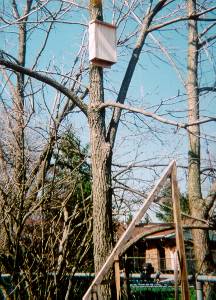
Before I get into details about the bats, I'd like to tell you about the little bat house I have stuck up in this Black Walnut tree in the summer of 2000. It is made of untreated cedar, and has been mounted facing south to grab the sun. I put it up thinking of attracting bats as a form of mosquito control. I know there are bats in the area because we see them regularly and my hope is that they will start roosting here. They haven't this year, but I have been told, and have read, that it can take several years for the bats to take up residence in a box. So, I'll wait.
Bats as Mosquito Control:
Here's a cute little tidbit I just ran across:
"Insectivorous Bats Every so often, a well-meaning conservation group promotes bats to eliminate mosquitoes from areas where nuisance has become intolerable. This undoubtedly leads to rediscovery of research conducted in the 1950s indicating that bats released in a room filled with mosquitoes could catch up to 10 mosquitoes per minute. The research was conducted to measure the effectiveness of echolocation in insectivorous bat species. The results have been extrapolated to suggest that wild bats can consume 600 mosquitoes per hour. Using that figure, a colony of 500 bats will remove 250,000 mosquitoes each hour and theoretically afford mosquito control for an entire neighborhood. Research since that time has shown that insectivorous bats are opportunistic feeders and that mosquitoes make up a very small percentage of their natural diet. Bats' behavior when locked in a room with nothing to feed upon but mosquitoes has no bearing on their behavior in the wild. Bats feed on the same insects that turn up in bug zappers and are no more effective for controlling mosquitoes than their electronic equivalent. Providing habitat to enhance bat populations is an admirable activity for conservation purposes. Using mosquito control as the reason to initiate public interest is misleading at best." - Wayne J. Crans, Associate Research Professor in Entomology
The full article, entitled "Products and Promotions That Have Limited Value for Mosquito Control" can be viewed at http://www-rci.rutgers.edu/~insects/proprom.htm
Calling Bats:
Some part of the sound produce by shaking a ring of keys is attractive to bats. Simply take a walk outside just after sunset and jingle your keys. If there are bats in the area they may be drawn to the sound. I didn't really believe this when I first read about it but I tried it with my kids and a couple of their friends (in reality I thought I was giving them a pointless task to just get them out from under foot for a few minutes). After about five minutes, I realized we had two small bats diving and dodging around the kids. The kids had clumped into a bit of a group, but relaxed when I got out there with them, and we spent about 30 minutes watching the bats dart between and around us. It was a truly up-close experience that we will not soon forget. The kids now frequently ask for my keys just before bed so that they can try to call the bats again. Some nights it works, some it doesn't, but the kids always have fun with it.
Bat Info:
� In Southern Ontario (as far as I know) the only bats you're likely to see are the Little Brown Bat or the Big Brown Bat (Am I the only one who laughs at these names?) but there are several other kinds around.
� The Little/Big Brown Bats do not make a screech that humans can hear.
� They catch flying insects by swooping down on them, scooping them up with their feet, and popping them into their mouths.
� They are warm-blooded mammals.
� They are not blind, their daylight vision is as good as any other mammals, but as you probably now that doesn't count for much at night, hence the sonar adaptation.
� Bats do not dive bomb and get entangled in your hair - think about it, they dodge tree branches and catch tiny insects, what are the chances that they are going to miss your head on their internal sonar screens.
� Because they feed partly on the blood sucking mosquitoes and flies, there is a slight risk of transmittable diseases (ie. rabies) showing up in bats. This is not usually a direct risk to humans unless your pets find a sick bat to play with or another larger animal contracts it and bites someone.
Links:
Bats of Windsor & Essex County, Ontario - an excellent place to start researching the bats of Southern Ontario and the rest of Canada. Royal Ontario Museum - The Bat Cave Exhibit - A good site for information on the worlds bats, myths and facts.
The Norfolk Bat Group - in England has presented a fair bit of info regarding the numerous varieties experienced there. There is also an excellent bat box design to be found on this site.
There is a lot of information online regarding bats. Many of the sites I've visited in the past were based in the United Kingdom. It appears that bats are stricty protected there, and it seems that an attempt is being made at providing real information on them. As I rediscover my old links, I'll post them to share with everyone else.
Brett