
|
Archaeological Cape Sounion Delphi Olympia Epidaurus Corinth Knossós Delos
More
|
 reece (Hellas): officially the Greek Republic, its name comes from the God Elio (God of the Sun), is the country of mythology and history, the mother country of the idea of the Olympic Games.
Greece is, generally, characterized by its diversity of forms. On the one hand, high
mountains, mountain chains and the mounts that every here and there are
interrupted by few plains that feed relatively small rivers. On the other hand
interminable surprises in the fragmented coasts of the main land. The great fragmentation of the coasts is what gives an unusual beauty to Greece, unique in the Mediterranean.
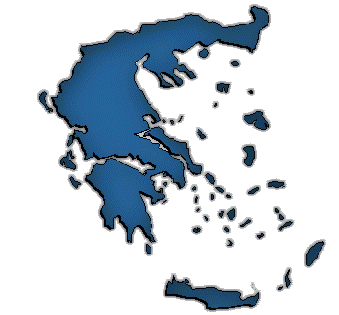
The Greek peninsula is positioned to the Southeastern part of Europe. It has a surface of 131,944 km2 and a population of about 10,300,000 inhabitants. It is formed by continental Greece (Attica, Peloponnisos, Sterea, Epiro, Thessalia, Macedonia, Thrace) and by the islands of the Aegean and Jonico seas and the Island of Crete (greatest of Greece); each one with its own characteristics and particularities.
By its geographical position in the Mediterranean, the climate is characterized by
mild winters and exotic warm summers that are refreshed by a wind system that the
Greeks call " meltemia ". It is not exaggerated to say that there are more than
3,000 hours of sun per year.
The Greek adventure began more than 4,000 years ago, thus marking the future
of the new civilizations; several archaeological sites have been left to testify its long evolution, between the most famous and better preserved we have:
|
Its capital, Athens (Athina), took its name from the Athenian goddess (Goddess of the knowledge and wisdom). She is one of the most glorious cities of the world, cradles of the western culture and Democracy. Here it was created the masterpiece of the architecture The Parthenon.
The present Athens is a cosmopolitan and wild city, this megalopolis looks like a jungle of concrete, animated mainly by a chaotic traffic, as a result of uncontrolled growth started after 2nd world war and where approximately 50% of the population of Greece has chosen to live; perhaps, to feel protected under the shade of the Acropolis.
A modern and alive city, but also romantic, where people always live on emotions. With squares and streets full of life, but also with peaceful side streets and calm and isolated districts, like in the Plaka: the characteristic popular zone, oldest of Athens, where innumerable small street markets, tourist taverns and shops are located.
The Acropolis (Akropolis: city on the height): For thousands of years the Acropolis has been the symbol of Athens, the Sacred Rock, magnificent natural fortress, that rises about 100m.on Athens. On this Sacred Rock , among others, there are important monuments like:
The Parthenon (Greek for "Virgin's Place);the most known among the masterpieces of the Greek architecture, it is raised solemn and majestic in the central and higher point of the Acropolis, splendid representation of Doric temple, built in 447-432 B.C., during the Golden Age of Perikles, utilizing marble from Penteli and dedicated to the Athenian Goddess Polis (protector of the City).
It was originally painted in vivid reds and blues, but the marble pillars gradually lost their paint and faded to white.
The Erechtheion; . it takes its name from Eretteo one of the mythical kings of Athens, It mainly derives its fame from its precious Cariatidis (statues of women, used as columns).
The Propylaea; monumental entrance, entirely made utilizing white marble.
The temple of Athena Nike (Victorious Athena); it is a temple of Ionic style, made to protect The statue of the Victorious Athena.The Acropolis with its monuments, its history and the myths that are connected to it correctly represent the pride and the glory of this city.
Among the other important cities of Greece we have:
Piraeus: main Port of Athens (the biggest in Greece) since ancient times. The present city, located in the same place where the old one used to be, is a great commercial and naval center. From this port all the boats that unite the Capital with all the Greek islands and the foreign nations weigh anchor.
The Piraeus is located to the southwest of Athens, about 10 km from the center. By the great urban growth in the recent past of both Athens and the Piraeus, it is practically difficult to identify the borders between these two.
Thesalonike : Second city and port of Greece, big commercial and industrial center of great importance, located to the north in the Macedonian region. Many Roman and bizantin monuments five splendor to this city. Among then, the famous White Tower (In the past called "blood tower", since during the Ottoman empire, came executed the sentences from death). It was founded on the 315 B.C., by the Macedenian general Cassandro, Who gave it the name of his wife Thessalonica, sister of Alexander the Great (King of Macedonia during 336-323 B.C., he was one of the most important military strategist and conqueror of history).
Patra: Third City of Greece in terms of size and importance, located to the northwest of the Peloponesso, with an important port that colleague Greece with Italy. It has a population of about 150,000 inhabitants. It was very important during bizantinun and venetian times.
.gif)
Archaeological
Sites:
[ The Acropolis| Cape Sounion| Delphi| Olympia| Epidaurus| Corinth| Knossós| Delos ]More
Information:
[ Language y religion| The Greek Cuisine| Music ]