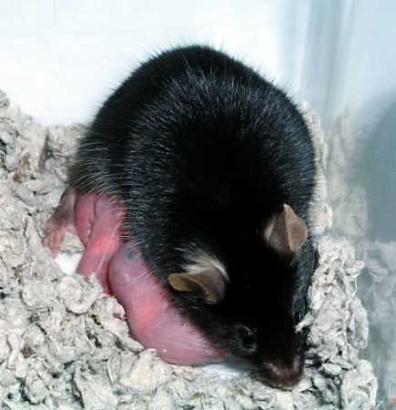
兩 雌 鼠 單 性 繁 殖 下 一 代
母 親 節 快 到 了 , 但 全 世 界 首 次 有 哺 乳 類 動 物 不 要 爸 爸 了 。 繼 複 製 (cloning) 後 , 科 學 家 創 出 另 一 種 革 命 性 的 生 殖 技 術 ─ ─ 單 性 繁 殖 (parthenogenesis) 。 日 本 和 南 韓 科 學 家 將 兩 隻 雌 鼠 的 卵 子 結 合 , 成 功 培 育 出 幼 鼠 , 過 程 中 不 需 要 精 子 , 幼 鼠 沒 有 父 親 , 只 有 兩 個 母 親 。
其 實 這 種 「 處 女 產 子 」 的 單 性 繁 殖 在 動 物 界 一 直 存 在 , 蜜 蜂 、 螞 蟻 、 蚜 蟲 、 火 雞 與 多 種 魚 類 和 爬 蟲 類 動 物 , 都 可 以 單 性 繁 殖 , 或 種 孤 雌 繁 殖 , 即 雌 性 蛋 卵 不 用 受 精 也 能 生 長 成 下 一 代 , 但 這 是 首 次 在 哺 乳 類 動 物 上 實 現 。
克 服 遺 傳 標 記 障 礙
哺 乳 類 動 物 繁 殖 下 一 代 , 本 來 需 要 結 合 雄 性 和 雌 性 的 染 色 體 。 因 為 兩 性 部 份 基 因 各 有 不
同 的 「 遺 傳 標 記 」 , 若 胚 胎 感 應 不 到 兩 套 遺 傳 標 記 並 存 , 就 極 難 正 常 發 育 。
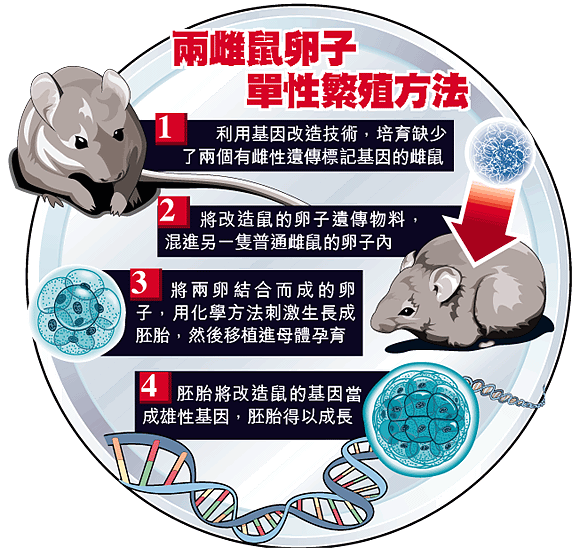
日 本 東 京 農 業 大 學 與 南 韓 漢 城 國 立 大 學 的 科 學 家 , 卻 想 出 方 法 克 服 遺 傳 標 記 障 礙 。 他 們
先 用 基 因 改 造 技 術 培 育 一 隻 雌 鼠 , 令 雌 鼠 缺 少 了 兩 個 帶 有 雌 性 遺 傳 標 記 的 基 因 , 然 後 把
牠 的 卵 子 遺 傳 物 料 , 混 進 另 一 隻 普 通 雌 鼠 的 卵 子 內 。
兩 卵 結 合 而 成 的 卵 子 , 被 化 學 方 法 刺 激 生 長 成 胚 胎 , 然 後 移 植 進 母 體 內 孕 育 。 胚 胎 果 然
被 改 造 鼠 沒 雌 性 遺 傳 標 記 的 基 因 「 騙 倒 」 , 以 為 是 雄 性 基 因 , 胚 胎 得 以 成 長 。
研 究 員 用 這 方 法 培 育 出 兩 隻 雌 性 幼 鼠 , 一 隻 拿 來 測 試 , 另 一 隻 則 養 到 成 年 , 並 讓 牠 跟 普
通 雄 鼠 交 配 , 生 育 下 一 代 , 至 今 仍 然 健 康 。 牠 被 命 名 為 「 輝 夜 」 , 即 日 本 童 話 《 竹 取 物
語 》 中 那 個 破 竹 取 出 來 的 女 孩 。 研 究 結 果 刊 登 在 新 一 期 英 國 《 自 然 》 科 學 雜 誌 。
依 此 研 究 結 果 , 理 論 上 兩 個 女 人 是 有 可 能 用 類 似 技 術 生 育 下 一 代 。 但 東 京 農 業 大 學 研 究
員 河 野 友 宏 說 , 他 的 研 究 目 的 只 是 想 更 深 入 了 解 遺 傳 標 記 和 胚 胎 異 常 成 因 : 「 昆 蟲 能 單
性 繁 殖 , 就 算 雞 也 能 改 造 到 可 以 單 性 繁 殖 , 我 想 找 出 哺 乳 類 動 物 為 何 不 同 。 」
理 論 上 可 兩 女 生 子
河 野 說 , 研 究 結 果 印 證 了 是 遺 傳 標 記 阻 止 哺 乳 類 動 物 單 性 繁 殖 , 確 保 繁 殖 不 能 少 了 雄 性
。
澳 洲 悉 尼 大 學 的 專 家 勘 貝 爾 和 帕 特 里 克 . 譚 也 表 示 : 「 在 我 們 充 份 了 解 基 因 遺 傳 標 記 在
發 育 中 的 角 色 和 規 律 前 , 父 親 看 來 仍 有 需 要 參 與 繁 殖 。 」
路 透 社 / 美 聯 社 / 英 國 廣 播 公 司 / 美 國 廣 播 公 司
Fatherless Mice Created Without Sperm
By Patricia Reaney
LONDON (Reuters) - Japanese and Korean scientists have created a fatherless mouse without using sperm in a reproductive feat akin to the birth of Dolly the sheep, the world's first cloned mammal.
Bees, ants, aphids and some fish and reptiles reproduce without having sex in a process called parthenogenesis. But creating a living mammal from same-sex parents was thought to be impossible.
Until now.
The birth of Kaguya, the daughter of two female mice, which is reported in the science journal Nature Wednesday by Tomohiro Kono of Tokyo University of Agriculture, shows that a healthy mammal known as a parthenote can be created without any male help.
"The parthenote developed to adulthood with the ability to reproduce offspring," Kono and his colleagues said in the Nature report.
Mammals inherit one set of chromosomes from their mothers and another from their fathers. Embryos containing only female chromosomes usually die early in the womb and those with only male genetic material are abnormal.
IMPRINTING IS THE KEY
Kono and his team overcame the problem and created Kaguya by fusing two female eggs after knocking out a key gene in the donor egg. The gene is involved in imprinting, a mechanism which controls the activity of genes inherited from the father and mother.
The fused eggs were chemically activated to produce embryos that were implanted into the wombs of mice.
"The paper shows that, like cloning, another asexual form of reproduction is possible in mice and may be possible in some other mammals," said Simon Best of the Biotechnology Industry Organization.
"However, this was achieved with even lower efficiency than the cloning process used to make Dolly and therefore it is even more unacceptable and unsafe to consider using this for humans," he added.
Only 0.6 percent of the embryos Kono and his colleagues created survived. It took hundreds of fused eggs to produce 28 offspring but Kaguya was the only mouse to survive. Others were stillborn or abnormal.
"This is an incredible achievement, the process of creating these mice required perseverance and patience: From around 600 eggs only two mice were created. As a result, this technique is far too complicated to be used in humans," said Professor Azim Surani of the University of Cambridge in England.
But the research could improve understanding of genetic imprinting and what causes abnormalities in embryos, as well as knowledge about the beginning of life.
Kono said his results suggest that paternal imprinting prevents parthenogenesis in mammals and ensures a male role in reproduction.
"Until we fully understand the role and regulation of imprinted genes in development, it seems that the participation of the father in reproduction will remain necessary," David Loebel and Patrick Tam, of the University of Sydney in Australia, said in a commentary in the journal.
Mice Created With 2 Genetic Moms, No Dad
By MALCOLM RITTER, AP Science Writer
Just ahead of Mother's Day, scientists have found a way to cut dads out of the picture, at least among rodents: They have produced mice with two genetic moms — and no father. It is the first time the feat has been accomplished in mammals.
Scientists said the technique cannot be used on people, for reasons both technical and ethical. In fact, one of the mouse mothers was a mutant newborn, whose DNA had been altered to make it act like a male's contribution to an embryo.
But the new work sheds light on why people, mice and other mammals normally need a male's DNA for reproduction, and some experts say it also has implications for the idea of using stem cells to treat disease.
The feat is reported in Thursday's issue of the journal Nature by Tomohiro Kono of the Tokyo University of Agriculture in Japan, with colleagues there and in Korea.
They say they produced two mice, one of which grew to maturity and gave birth. Kono said this mouse, named Kaguya after a Japanese fairy tale character, appears healthy.
Some lizards and other animals reproduce with only maternal genes, but mammals do not.
Kono, in an e-mail, said the new technique might be useful with animals for agricultural and scientific purposes. When asked if he saw any reason to produce humans this way, he dismissed the question as "senseless."
Experts said ethical concerns and current technology would pose barriers to duplicating the technique in people. For one thing, scientists do not know how to create the precise DNA mutation in humans. Experts also noted that it took hundreds of eggs to produce just two mice and that the health risks are unknown.
However, the study provides new evidence for the standard explanation for why mammals normally need a male's DNA.
Scientists say that in an embryo, some mammal genes behave differently if inherited from the father rather than the mother, and that this paternal activity pattern is needed for normal development.
Relatively few genes act in that way, and they are said to be "imprinted." In some cases these genes are active only if inherited from the father, not the mother, and in other cases it is the other way around.
For the study described in Nature, the researchers got around the need for male-derived DNA by turning to mutant mice. The female mice were missing a chunk of DNA, and as a result, two of their genes would behave in an embryo as if they had come from a male.
What's more, the scientists took this mutated DNA from the egg cells of newborns, because at such a young age the DNA has not yet taken on the full "female" imprinting seen in mature eggs.
That DNA was combined with genes from ordinary female mice to make reconstructed eggs. Only two of 457 such eggs produced living mice.
Marisa Bartolomei, who studies imprinting at the University of Pennsylvania School of Medicine, said she was "stunned" that manipulating just the two genes removed the roadblock to producing live mice.
In fact, an array of other imprinted genes had also somehow taken on their normal levels of activity, as if there had been a standard fertilization. The researchers said they do not know how that happened.
Gerald Schatten, a stem cell researcher at the University of Pittsburgh School of Medicine, said the work shows that scientists need to thoroughly understand imprinting in human embryonic stem cells, which are recovered from early embryos. Otherwise, such cells might behave abnormally when used for treating diseases like diabetes or Parkinson's, he said.
Some scientists hope to produce human stem cells by stimulating unfertilized eggs.
Kent Vrana, a researcher at Pennsylvania State University who is studying the unfertilized-egg approach, said the Nature study is encouraging for that technology.
If a healthy, fertile mouse can be produced without a father's DNA, he said,
that gives hope that stem cells from a similar process would behave normally.
 返回生物消息