| The Heroic Century: Masterpieces from the Museum of Modern Art, NYC |
| As we view some of the selected works, consider the following points: - Historical Context - Form/Style - Artist�s worldview (self, world, art, spirituality) - What the artist trying to �say�, �show� |
| General Timeline of �Modern Art�: Impressionism/Post-Impressionism: 1860 � 1900s Cubism, Symbolism, Fauvism, Dada: 1905 � 1940s Expressionism Abstract Expressionism, Color Field: 1940 � 1960s Minimalism Post-Modernism: Pop Art, Sensation: 1960s - Current Minimalism |
 |
| Post-Impressionism (France, 1880's to 1900) - Post-Impressionism is an umbrella term used to describe a variety of artists who were influenced by Impressionism but took their art in different directions. - There is no single well-defined style of Post-Impressionism, but in general it is less casual and more emotionally charged than Impressionist work. - The classic Post-Impressionists are Paul Cezanne, Paul Gauguin, Vincent van Gogh, Henri de Toulouse-Lautrec and Henri Rousseau. The Pointillists and Les Nabis are also generally counted among the Post-Impressionists. |
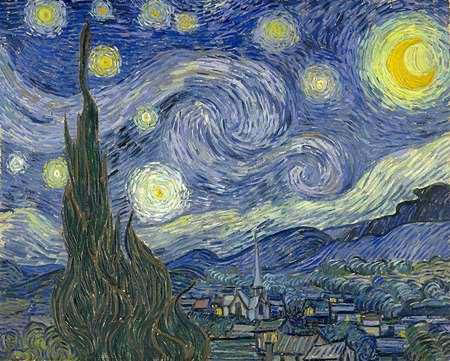 |
| Vincent van Gogh. The Starry Night. 1889. Oil on canvas, 29 x 36 1/4" (73.7 x 92.1 cm). |
| Example of Post-Impressionism - Violent energy - Using swirling brushstrokes - Intense colors - Intended antidotes to the alienation of modern life - More emotive than Impressionism �subjective response of night Historical Context - Cyprus trees were usually a symbol of death in Van Gogh�s time - Usually found in cemeteries - What is the relationship between the tree, the sky and the night? - What does the motion of the sky suggest? - To what is the tree reaching? - What is he saying here? - Given Van Gogh�s history, how might this painting be related to how he lived his life, died? - Reflective of his private world � looking for consolation and enchantment |
| My Two Cents I think Van Gogh is being very deliberate here and is trying to make a very specific statement. Look at the light in the sky and some of the homes as compared to the darkness of the church. The church does not reflect any light and the doors and windows all appeared to be darkened and shut (closed to visitors). This is in opposition to the lively energy and light in the sky. One cannot understand this work without Van Gogh's story. He was a defrocked minister and did not paint until later in life. Most of his works in which churches are featured show the doors and windows all closed (representing his view of the church). I think he adopted an essentially hopeless worldview since it was built on the idea of a "natural spirituality", etc. I think the outcome of his worldview fueled his depression, self-mutilation and suicide attempts. A brilliant artist who adopted a fatal worldview which led to hopelessness. |
 |
 |
| Back |
| Forward |
| Presentation |