

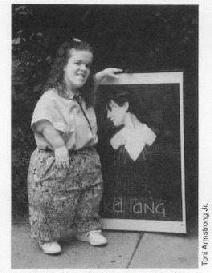
 Tekki and I have several things in common: we're both late products of the baby boom generation; we were raised with many Eurocentric Catholic "family values" (Tekki is Polish and I'm mostly Irish,
  ) and urban/suburban influences; we're both college educated with some emphasis in the arts; and we were born with bone growth disorders that peaked our heights a bit before four feet tall.
We met and slowly became friends because of these commonalities. Still, we're very aware of our many differences: She's a straight feminist and I'm a lesbian feminist; she's friendlier, more outgoing and has a greater positive outlook in life, whereas I tend to be somewhat introverted/insecure socially & much more distrusting, pessimistic & cynical. I'm usually more mobile *(ie. until fairly recently, since I started using a walker for balance and profound weakness in my legs), so I'm somewhat more self-sufficient & physically faster than she is. Sometimes I think she's mentally quicker than I am in some areas, especially with short-term memory (ie. NO PUN INTENDED) or calculations. Conversely, I have a strong practical mind for some physical adaptations and more chutzpa when asking/insisting on what I want/need in public scenarios.
Very often I'm described as confrontational, willful and stubborn, while Tekki is considered creatively compromising and/or far less likely to vehemently oppose the majority when asked to vote or share an opinion. Tekki's definitely more devoted religiously, in both faith and practise, while I consider myself often distrusting of organized religious doctrine. Still, I would describe myself moderately spiritual, with an equally strong moral base in belief and practise. We're both politically liberal, though I think I'm slightly more conservative on some issues, (ie. without specific examples of that now). Finally, both of us think and do things independent of each other and/or as unique individuals within groups like our families, other LPs, circles of friends and/or society in general, while we both consciously and passively strive to be considerate/respectful of each other and absorb a greater level of the other's most appreciated traits!
We're also aware of all the differences that combine to form the membership of Little People of America, too. Working within it can be a challenge for us.
One of the big differences between people of short stature is diagnosis. As many as 200 or more types/sub-types of bone dysplasias and growth hormone disorders make up the medical classification of "dwarfism." While any adult under 4'10" could be considered/described as a dwarf (or "little person"/LP), many X-rays, blood tests, and other procedures must be done for an accurate diagnosis of the specific condition. This is also necessary to prescribe possible treatment for associated medical problems, suggest warnings of greater surgical risks and/or to provide more accurate genetic counseling.
[Some examples of non-medical short stature/dwarfism are those persons whose growth is lower than 5' because the combined parental height is less than the statistical average for that race and country of birth, (eg. african pygmies, some isolated asian or latin-american, aboriginal or even closed religious populations, etc.) and/or low birth-weight babies not catching up during normal growth spurts. This was the likely cause for my younger sister Sue, whose adult height is about 4'10, from our smoker/alcoholic parents ~5'1" & 5'6", and born 3 weeks late (in Nov. 1962), but was of lowered birth weight of ~4 lbs., and kept in an incubator for extra care, 2-3 weeks.]
Increasingly now, diagnosis can be made in early infancy, and even *prenatally (ie. *more often from the heavily researched discoveries of "dwarfing genes", from gene-mapping in prenatal DNA testing, especially used for parents at risk for the lethal forms of dwarfism or other inherited medical conditions.
Recent medical advances in synthetic growth hormone have almost eliminated the physiological growth disorders seen in people who are usually referred to by the antiquated term "midget"; i.e., those with "proportional" limb and body growth, who often have prepubescent features. Because of the derogatory and misunderstood ways that the term "midget" has been used, (eg. "Hey... Look at the/that midget!") we rarely refer to or use this word, even when it applies to that generalized form of short stature.
Most kinds of dwarfism have genetic origins and result from either a single mutated/inherited dominant gene from either parent, or the combined recessive genes from (invisible/unknowing carriers) both parents. Many times the birth of a dwarf child to an "average-size" family is a big surprise, because the affected genes were hidden and neither parent's history had any such occurrences for known generations. This was the case for both Tekki and me.
We both have fairly common types of dwarfism. Tekki's condition is Diastrophic Dysplasia, is recessively inherited, and is characterized by short limbs as well as hand, joint and foot problems (often requiring multiple orthopedic surgeries to facilitate walking and other independent physical activities). My condition is called Achondroplasia, and is the most commonly seen type of bone growth disorder. Sometimes uninformed doctors mistake other types of dwarfism for Achondroplasia. Even in today's medically sophisticated climate, misdiagnoses are not uncommon (i.e. especially when parents live far from modern urban areas and/or university teaching-hospitals).
The achon gene is dominantly inherited, though it was a new mutation in my case, (as it is in up to 85% of all achon births). The most common physical features of this type of dwarfism are short arms, trident hands, short and sometimes bowed legs, a pronounced lordosis or swayed lower lumbar spine, a larger head/forehead with depressed nasal bridge and an average-size torso. Many, though not most, achons require surgery to straighten legs (i.e. osteotomies).
A greater number of achon-LPs do eventually require surgery to relieve pressures (ie. stenosis) in the narrow cervical and/or *thoracic/lumbar/sacral spinal (i.e. neurological decompression/*laminectomy which I had in 1986) canal, which when diagnosed and left untreated in an infant could result in severe infantile sleep apnea, hydrocephalus and/or for the adolescent-adult onset, resulting in severe sciatic pain, lower leg numbness, bladder/bowel dysfunction and/or levels of paralysis.
While these conditions may be fairly common in their lesser forms, advances in medical science, both in diagnostics & treatment, have made the risks and outcomes of the most severe types much less common. Dwarf children born today to either average-size or dwarf parents have the many advantages from the earliest & most current experiences of other communicating families along with the doctors who have gained some greater expertise through their integration with LPA, (i.e. especially now with increasing development & availability of vast medical info. & email discussions via the internet). However, many of us LPs, born before these advances were refined, survived these physical obstacles regardless of those who forcasted the most negative prognoses to our parents.
Each type of dwarfism has many distinctive physical or physiological features of which an individual may experience all or just a few, as noted above. Space is somewhat limited here to describe these features within each dwarf type in any more detail, but the rarity of these conditions and some similarity of their features makes it frustratingly easy for many people to confuse our identities or group us as if we were born into one race or family -- as Tekki's "tribe" story attests to.
 :
:There are, in fact, many stories that illustrate the public's misconceptions about us as individuals and little people. Most of them are funny, after the fact, showing the ridiculous extremes of what some people still believe. The following story is one of my favorites:
One summer, while working as a lab assistant at a V.A. hospital between semesters in college, I was approached by a middle-aged woman just as I exited the elevator to go to the cafeteria. She abruptly stopped in front of me, pointed, and shook her finger at me.
"I knew your parents at the World's Fair!", she exclaimed.
Before I could respond, she continued, "Yes... they were in that village they had for you people!" I gave her a very cold look.
While my immediate feelings were that of surprise and extreme annoyance for the intrusion and assumptions, I realized her historical reference. "Lady, my parents aren't those people!" I replied, and quickly walked away. She was actually talking about the Chicago 1933 World's Fair Expo on Navy Pier, where they had a group of little people in a miniaturized town exhibit called "The Midget Village" . This woman assumed my parents were dwarfs, that they were part of this exhibit, and that she remembered the resemblance for more than forty-five years.
Stereotypes are our constant companions, which is true for people within most minority groups. As such, we find ourselves categorized as either jolly or bitter, precocious or immature, asexual or lascivious, mystical or sinister, passive or aggressive, super-talented or void of intellect and education, etc. We're usually not seen as average, pretty, or sensuous compared to the average-size person. While we rarely have any trouble being noticed (ie. except when someone steps ahead of us standing in line), the attention we receive is usually not proportionate to what we do or don't do as individuals.
More than ten years ago (ie. actually between 1975 & 1980), before I graduated from college and started driving a car, I was waiting for a bus on a suburban street, standing there quietly with one other older woman. Since I'm not likely to engage in conversation with strangers, I smiled only slightly as she continued to sneak stares at me (as many "polite" adults are prone to do). Finally, she interrupted the silence and her stares with a statement that went something like... she "knew from just looking at me" that I "must be very special and talented!"

I understood what she meant from that statement: since my size and shape were such terrible things for me and others to deal with, I must have been  born with attributes that couldn't be seen, or skills that were far above average, to help me cope.
I wanted to contradict her conclusive statement, but I couldn't deny it then or now. Yet I wonder if I would have been a good vocalist, songwriter, guitarist, photographer, painter, writer, poet, and pet care counselor today if I had been born average-size and normal. Would I have discovered and developed my skills if I hadn't had something to prove or overcome? I often question the recognition I am denied, or that I receive, because of my so-called handicap.
Tekki and I both grew up in fairly typical middle class surroundings where each of us was the only little person, and where just some (or much) of the treatment we received was designed for our "special circumstances". -- In my family there were only occasional or subtle, (though some not subtle at all), acknowledgements of my differentness early in life. My mother would smile proudly as she shared her stories about: "how she fought for me when, as a newborn, a close friend, she no longer associated with, suggested that I be placed into an institution, rather than bringing me home to the rest of the family!".
Later still, my mother also described how: As a preschooler, I was too small to walk to/from the local kindergarten (ie. associated with the public school several blocks away, since our grammar school didn't include pre-K or K), like the other kids, so my mom found a different preschool/kindergarten that "picked up & delivered" me to its location and back home again. Finally, I was often reminded about how my parents pressured the nuns into admitting me into the same Catholic elementary school as my six other siblings (three older and three younger), because the nuns too "thought I belonged in a special school or institution". My Godparents gave me a step-stool to use in the bathroom, for drinking fountains and the chalk-boards, etc. Visiting relatives would frequently use the clich�: "Good things come in small packages!" At home our chores were rarely delegated with special treatment for me; I just learned to climb a lot or make other adjustments for my size. [Later, I'll share some funny stories about those particular skills I used a lot then.] I enjoyed physical activity and competition with my brothers in baseball and wrestling, but as they grew past me I developed other interests.
Credit should be given to my parents for trying to avoid special equipment, schools, or activities for me then. I needed to learn independence in an average-size world. There were, however, periods of overprotection during some parts of my life and overexposure in others, though. Also in retrospect, there was an unfortunate lack of attention paid to the emotional aspect of my differences. They couldn't relate to my size-specific problems, and there wasn't much, if any, comfort given for my personal pains caused by social isolation, ridicule, and what I now know to be outright discrimination. �They had no real interest in getting me involved in the LPA organization at an early enough age where I wouldn't be afraid of this association. They expressed no necessity or desire to attend any LPA functions for themselves or me, such as parents' meetings, etc. Even after I became more emotionally or physically independent and became involved with LPA on my own, this -- as well as other parts of my personal life -- are of minor or irritating interest to them.

�[From all of the stereotyped portrayals of dwarfs in the media, I, myself (from age 10 to 19 yrs.), also believed that most members of LPA were in the entertainment business, and I didn't want anyone thinking I supported the reinforcement of those same stereotypes. Still, realistically, I needed to associate with at least some others whose experiences more closely paralleled my own, because of our similar physical conditions! Thus, I struggled with my own preconceptions & prejudices for a long time before I felt comfortable with other LPs, especially in public settings.
While I could easily forget about or disassociate myself from the awkward attention I received in public from merely walking down the street, using mass-transit and/or going shopping in a department store, etc., the feelings of annoyance and anger I felt being gawked & stared at when I was among one or more other LPs doing the same thing, was 10 fold plus! If ever I felt punished by being born this way and needing to deal with and overcome my different appearance or actual disability, I couldn't cope nearly as well when I was among my own kind. To this day I can't say for sure that I would have developed more emotional maturity with chronological age if I had been exposed to LPA during my childhood. Still, I feel just as cheated now since my parents and siblings didn't benefit from associating with other families with dwarf/disabled children, and we have all suffered from countless misunderstandings and enduring alienation because of this, even to this day! -- You can criticize me for my opinions that might reflect my motivations & behavior today, but I won't change my feelings or take on additional guilt for sharing them here for all of the "w.w.w." to read!]



...About Me, About Dwarfism & About LPA,
Et Cetera


� 2000-2004+
Please Email...