CFD Vocabulary
Explanation of commonly used expressions in Computational Fluid Dynamics
Jess A Michelsen, AFM/DTU, November 1995
Text in italics indicates crossreference.
- ADI method. (Alternating Direction Implicit). Solution algorithm,
in which the operator of
 is split in a part, including only x-derivatives, and a part including
only y-derivatives:
is split in a part, including only x-derivatives, and a part including
only y-derivatives: 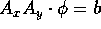 .
Eventual mixed derivative terms are transferred to the right-hand side.
Both
.
Eventual mixed derivative terms are transferred to the right-hand side.
Both  and
and  are tridiagonal matrices. Hence, the split-operator system can be solved
in a non-iterative, or implicit manner as a sequence of two simple systems
of equations. A pre-requisite for convergence is, that
are tridiagonal matrices. Hence, the split-operator system can be solved
in a non-iterative, or implicit manner as a sequence of two simple systems
of equations. A pre-requisite for convergence is, that  must be a good approximation to
 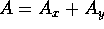 .
This is for example the case for transport equations, in which the time-step
is not too large. In 3D, A is split in three parts, stability
issues have been reported for 3D.
.
This is for example the case for transport equations, in which the time-step
is not too large. In 3D, A is split in three parts, stability
issues have been reported for 3D. - Block-structured mesh = Multiblock mesh, in which each mesh-block
is structured.
Meshes, consisting of a single, logically connected block of cells has
severe limitations in the modelling of the physical geometry. If the mesh
needs to be refined in boundary layers, etc., only extremely simple geometries
can be handled in a single mesh-block. In principle, there are two alternative
departures from the single-block structured mesh. Either, one composes
the mesh of a number of structured blocks, or one employs an unstructured
mesh most often consisting of triangular cells in 2D or tetrahedral
cells in 3D, connected in a more or less structured formation, which may
appear more natural for very complex geometries. In a block-structured
mesh, the computational domain is subdivided into a number of geometrical
blocks, each with a simpler shape than the entire domain. The computational
mesh in each block normally consists of
 computational cells in 3D. The method has much better geometrical flexibility
than single-block structured
methods.
computational cells in 3D. The method has much better geometrical flexibility
than single-block structured
methods. - Boundedness The solution is said to be bounded if the solution value in a computational point is bounded by the solution values in the surrounding points, or rather those of the surrounding points, which influence the point. Diagonal dominance is a pre-requisite for boundedness. For advective-diffusive problems, a centered difference discretization may, for cell Reynolds numbers or cell Peclet numbers exceeding 2, lead to locally non-limited solutions, typically of oscillatory character. For increasing advection domination, the solution will become increasingly non-physical and/or diverge. Boundedness is in these cases ensured by introducing upwind-discretization or by applying a non-linear higher-order filter, normally in the form of a fourth order dissipation term.
- Cell Centered. (CC) Methods, in which the flow variables are all allocated at the center of the computational cell. The CC variable arrangement is the most popular, since it leads to considerably simpler implementations than other arrangements. On the other hand, the CC arrangement is more susceptible to truncation errors, when the mesh departs from uniform rectangles. In the standard Finite Volume method, the CC arrangement is normally an ingredient.
- Cell Reynolds number Reynolds number, in which the global scales are substituted by local velocity and cell dimension. In practice, each mesh cell has one cell Reynolds number for each of its directions, defined by the cell dimension and the flow speed in that direction. By analogy, one may speak of a cell Peclet number for advection-diffusion problems in general. The cell Reynolds number becomes relevant when judging the quality of a computed result. If e.g. the flowfield displays oscillations of some kind, it is important to find their source. In this process, one needs to known if the upwind scheme is unconditionally bounded, which is always the case for the Donor cell scheme, but only the case for higher order schemes provided the cell Reynolds number does not exceed a certain limit.
- Cell Vertex methods (CV) In the Cell Vertex methods, the flow variables are stored at the vertices of the cell. The flux imbalance, fluctuation, or rate of change, is integrated for the cell, either as the surface flux integral or as the volume integral of the derivative terms. Hence, the fluctuation is now cell centered. The fluctuation is then distributed among the vertices. Several schemes for this distribution exist, most promising perhaps the multi-dimensional upwind schemes. It is noted, that the CV schemes by nature are totally different from the Vertex Centered (VC) schemes.
- CFL number (Courant-Friedrich-Levy). For discretized transport problems, the CFL number determines how many mesh cells, a fluid element passes during a timestep. Or rather, the fraction of a timestep to pass one cell. For compressible flow, the definition is different. Here, the CFL number determines how many cells are passed by a propagating pertubation. Hence, the wave-speed, i.e. fluid speed plus the sound speed, is employed. For explicit timestepping schemes, such as Runge-Kutta, the CFL number must be less than the stability limit for the actual scheme to converge. For implicit and semi-implicit schemes, the CFL limit does not constitute a stability limit. On the other hand, the range of parameters in which these schemes converge may often be characterized by the CFL number.
- Characteristic variables. Set of variables employed for compressible and pseudo-compressible flow. If the governing equations are hyperbolic, eigenvalue analysis may upon a choice of a characteristic direction lead to a splitting of the primitive variables into a set of wave-like variables. In 2D, there are two acoustic variables, one shear variable, and the entropy. For this set of variables, it is possible to compose upwind methods with very low or vanishing levels of numerical diffusion.
- Coefficients of influence If
 represents the discretized equation for a single point in the computational
domain and NB denotes all the neighbours of the point, the coefficients
represents the discretized equation for a single point in the computational
domain and NB denotes all the neighbours of the point, the coefficients
 are termed
the coefficients of influence. A large coefficient of influence (relative
to the remaining ones) is reflected by a pertubation in the associated
neighbour point greatly influencing the solution in the actual point P.
are termed
the coefficients of influence. A large coefficient of influence (relative
to the remaining ones) is reflected by a pertubation in the associated
neighbour point greatly influencing the solution in the actual point P. - Conjugate gradient methods A class of non-stationary iterative methods for the solution of (linear) systems of equations. May be brought to work efficiently if appropriate preconditioning is provided. For highly structured problems, such as those resulting from the use of block structured meshes, the multigrid methods are normally much faster than the conjugate gradient methods. Very small problems is an exception. On the other hand, conjugate gradient methods may be preferred due to their more straightforward implementation in existing codes.
- Conservation Law forms The governing equations may, for a given
set of flow variables, be written in at least five different conservation
law forms. Under specific conditions, e.g. Cartesian mesh, some of these
are equivalent. The strong conservation form is the most widely used. The
convective terms (in Cartesian frame) are written as
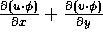 .
When transformed to general frames of reference, i.e. when used on general
non-orthogonal meshes, this form is retained except for the appearance
of metric factors. The non-conservative form is employed in certain situations
for incompressible flow. The convective terms are written as
.
When transformed to general frames of reference, i.e. when used on general
non-orthogonal meshes, this form is retained except for the appearance
of metric factors. The non-conservative form is employed in certain situations
for incompressible flow. The convective terms are written as 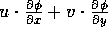 .
When transformed to general frames of reference, the advective speed must
be transformed into the composants in each of the local directions. Furthermore,
since the definition of the transformed velocity vector now differs in
space, fictive forces appear. Apart from the two already mentioned forms,
the semi-conservative, the weak conservation, and the chain-rule conservation
forms exist. These have only very specialized purposes.
.
When transformed to general frames of reference, the advective speed must
be transformed into the composants in each of the local directions. Furthermore,
since the definition of the transformed velocity vector now differs in
space, fictive forces appear. Apart from the two already mentioned forms,
the semi-conservative, the weak conservation, and the chain-rule conservation
forms exist. These have only very specialized purposes. - Convergent Term used in two different contexts. In the first
defines convergence for an algorithm, as
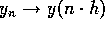 for
for  , where
 represents
the approximate solution,
represents
the approximate solution,  the theoretically correct solution, and h the length of the integration
step.
the theoretically correct solution, and h the length of the integration
step.The second sense of the term is used about algorithms, that converge even for very large integration steps (relative to other algorithms employed for the same problem). Hence, if only the steady-state is of interest an, in this sense, convergent algorithm is preferred. The pressure-velocity couplings, such as PISO and SIMPLE are normally viewed as convergent, while the ADI methods such as Peaceman-Rachford, Briley-McDonald, and Beam-Warming are not convergent, according to this definition. Convergence in this sense may not be proved for the Navier-Stokes equations. Experience, however, shows that each algorithm has a certain range of parameters, for example the CFL number, within which they perform near-optimally.
- Diagonal dominance The linear system of equations
 ,
where
,
where  denotes
the diagonal coefficients and
denotes
the diagonal coefficients and  the coefficients
of influence, is said to be diagonally dominant if, for all equations,
i.e. for all points P, the inequality
the coefficients
of influence, is said to be diagonally dominant if, for all equations,
i.e. for all points P, the inequality 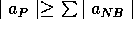 is fulfilled. Diagonal dominance is a necessary, but not sufficient, condition
in the convergence proof for a range of relaxation
methods.
is fulfilled. Diagonal dominance is a necessary, but not sufficient, condition
in the convergence proof for a range of relaxation
methods. - Domain Decomposition (DD) Iteration strategy used in conjunction with block structured methods. A single-block problem may also be decomposed with the intention of exploiting parallel potential. DD is often an element of multigrid methods. The basic relaxation technique is performed on the individual blocks. The task of the DD technique is then to ensure appropriate coupling between the blocks during relaxation, and thus retain global convergence. Usually, with DD the relaxation is performed on a block plus parts of the neighbouring block. In other words, the relaxations are performed on overlapping sub-domains (Schwarz alternating method). With certain multigrid methods, the optimal overlap becomes very small, i.e. one cell wide.
- Donor cell upwind The simplest upwind scheme for finite volume
discretized advection-diffusion problems. In a finite difference context,
the derivative in
 has to be approximated. Centered differences implies, that the derivative
is determined using the upstream and the downstream point. This leads to
non- bounded
solutions. In the donor cell scheme, the derivative is determined using
the present point the upstream point. Local truncation error analysis shows
first order accuracy. Hence, the solution becomes bounded at the expence
of large amounts of numerical
diffusion.
has to be approximated. Centered differences implies, that the derivative
is determined using the upstream and the downstream point. This leads to
non- bounded
solutions. In the donor cell scheme, the derivative is determined using
the present point the upstream point. Local truncation error analysis shows
first order accuracy. Hence, the solution becomes bounded at the expence
of large amounts of numerical
diffusion. - Fourth order dissipation In order to obtain bounded solutions to advection dominated problems, an extra term is artificially introduced. This term involves a fourth order filter, i.e. the term is proportional to the fourth derivative of the solution. The inclusion of the term reduces the fourth order derivative and smooth the solution. As sofar only the fourth order derivative is involved, the formal order of the method is not compromized (of course provided that the method itself is not a fourth order method). Unfortunately, the fourth order derivative may be very large due to physical phenomena such as shocks or other discontinuous phenomena. In such situations, the fourth order dissipation must be switched off and, to retain boundedness, substituted by a second order term. Fourth order dissipation was originally proposed by Jameson in a Runge-Kutta scheme for the compressible Euler equations, as an alternative to upwinding. Despite its elegance, the fourth order dissipation is currently being superseeded by more modern upwind techniques, which are both more physically relevant and easier to control during computations.
- Full Multigrid (FMG) For multigrid
methods, as for all other iterative methods, the number of iterations to
reach convergence depends on the quality of the starting guess. For multigrid
methods, it is only natural to use the solution from the next coarser mesh
as the starting guess on the fine mesh. Recursively, the efficiency of
finding this coarse solution depends on the starting guess on the coarser
mesh. The solution on the next coarser grid is again a good candidate.
Hence, in the FMG method, one initially computes the solution on the coarsest
mesh. The coarse grid solution is interpolated to the next finer grid,
and the solution on the next finer grid is computed. The process is continued
until the solution on the finest mesh is determined. In many cases it may
be shown that only one or two multigrid cycles are needed for each added
finer grid. The FMG process has can be shown to cost
 operations, an efficiency which is unsurpassed.
 - Limiting Normally in the form of flux limiting. It may be proved, that higher order upwind schemes can not be unconditionally bounded. Instead of reverting to low order upwinding and accepting high levels of numerical diffusion, one may apply the higher order upwind scheme as a correction to a lower order scheme. Whenever the higher order scheme leads to locally unbounded solutions, the higher order correction may be limited. Hence, the corrective flux is multiplied by a limiter. The limiter is normally computed as the ratio between two solution differences, taken at two stations in the upwind direction. When this ratio becomes negative, a local extremum has been encountered, and the limiter vanishes. Example of popular limiters are the MinMod limiter which is always a safe choice and the SuperBee limiter which is said to be overcompressive, i.e. it tends to sharpen gradients, even for smooth solutions.
- Multi-block methods See Block Structured
- Multigrid (MG). A large - and growing - class of strategies mainly intended for accelleration of basic relaxation methods. MG may in some cases have other purposes. Most relaxation methods are by nature local, they tend to smooth the residuals in space, rather than reduce them. The rapidly varying residuals are quickly annihilated, while the residuals of longer wavelength are left relatively unaffected. If the residual norm is monitored a typical relaxation method will, perhaps after one or two iterations with increasing residual norms, reduce the residual norm considerably for a small number of iterations, whereupon the residual reduction tends to stall. At this point, it is appropriate to discretize the equation for the deviation from the correct solution on a coarser mesh, the restriction process. On this mesh, the residuals have a shorter wavelength relative to the mesh, hence the basic relaxation method is able to smooth the residuals. One can now continue to discretize equations for the deviation from the exact coarsegrid corrections on recursively coarser meshes, until the coarsest mesh consisting of only 1 or 2 cells in each dimension is reached. Upon solution on the coarsest mesh one recursively prolongates the correction back on finer grids. For each finer grid one may perform relaxation sweeps. The process, beginning with recursive restrictions and smoothings, continuing with the coarse grid solution, and ending with recursive prolongations and smoothings back to the finest mesh is termed a multigrid cycle. MG methods in both linear and non-linear versions exist. Some basic schemes do not smooth, instead they propagate the residuals as a moving front. For these methods, the application of MG is intended to more rapidly convey the residual front to the outer boundaries. Most explicit compressible flow schemes are of this category. MG methods typically have linear convergence. See also Full Multigrid.
- Numerical diffusion. (ND) Often termed false diffusion. Diffusive side-effect from truncation errors resulting from the discretization. Most prominent is false diffusion due to the use of upwind schemes for the advection terms. ND from upwind discretization is not always controllable. ND is proportional to the cell Reynolds number, hence the ratio between advection and effective diffusion is limited for a given mesh, i.e. the effective Reynolds number is limited to a certain level, no matter how much the physical Reynolds number is increased. A number of skew-upwind and high-order upwind methods have been proposed to minimize the effect of ND. Most widely used is the QUICK scheme of Leonard.
- Odd-even decoupling. The physical solution is superimposed by one or more oscillatory spurious solutions, which might under idealized conditions be extracted. The problem appears typically for variables that enter the equations only in the form of first derivatives. The problem is best known from pressure-velocity coouplings, and is resolved either by the use of staggered mesh or by introduction of a fourth order dissipation term, as it is implicitly the case in the method of Rhie and Chow. The latter form is employed on non-staggered meshes, which yields simpler implementation on non-orthogonal meshes.
- Poisson equation The equation
 is called the Poisson equation. Its solution is an important ingredient
in numerous applications within the field of computational fluid dynamics,
in the form shown here aswell as a number of derived non-linear forms.
The latter are mainly employed in mesh generation. For incompressible Navier-Stokes
calculations, the solution of Poissons equation often consumes the majority
of the computational time. Currently, with the application of increasingly
advanced multigrid
methods, this is becoming less and less true.
is called the Poisson equation. Its solution is an important ingredient
in numerous applications within the field of computational fluid dynamics,
in the form shown here aswell as a number of derived non-linear forms.
The latter are mainly employed in mesh generation. For incompressible Navier-Stokes
calculations, the solution of Poissons equation often consumes the majority
of the computational time. Currently, with the application of increasingly
advanced multigrid
methods, this is becoming less and less true. - Prolongation The interpolation-like procedure in multigrid methods, that adds a coarsegrid correction to the solution on a finer grid. Variants of different orders exist. For systems of second order equations, linear prolongation suffices, higher order prolongation yields only marginally better convergence. Higher order interpolation may, on the other hand, improve behaviour of the Full Multigrid method.
- Preconditioning. An approximation to the inverse of the matrix
A in the system
 is employed in most relaxation
methods, including conjugate
gradient and multigrid
methods. There are several demands on this approximation, or preconditioner.
First of all, it should be good approximation to A. Secondly, it
should be sparse. Finally, the use of the preconditioner should preferrably
vectorize. Gauss-Seidel is a simple preconditioner, which does not vectorize.
However, the mesh-points may be split in a two-color system associating
all points of odd index-sum to one color and all points of even index-sum
to the other color. If the two colors are now swept separately, the scheme
may be vectorized very effectively.
is employed in most relaxation
methods, including conjugate
gradient and multigrid
methods. There are several demands on this approximation, or preconditioner.
First of all, it should be good approximation to A. Secondly, it
should be sparse. Finally, the use of the preconditioner should preferrably
vectorize. Gauss-Seidel is a simple preconditioner, which does not vectorize.
However, the mesh-points may be split in a two-color system associating
all points of odd index-sum to one color and all points of even index-sum
to the other color. If the two colors are now swept separately, the scheme
may be vectorized very effectively. - Primitive variables In the description of momentum transport,
in the form of Euler or Navier Stokes equations, the set of variables consisting
of velocity components and pressure is termed the set of primitive variables.
Another set of variables is the conservative
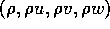 often used in compressible flow. The pressure is here determined from a
constitutive relation. The primitive variables may further be split into
a set of characteristic
variables. For incompressible flow, combinations as stream function/vorticity
or velocity/vorticity may be employed.
often used in compressible flow. The pressure is here determined from a
constitutive relation. The primitive variables may further be split into
a set of characteristic
variables. For incompressible flow, combinations as stream function/vorticity
or velocity/vorticity may be employed. - QUICK upwind The simple Donor
cell upwind scheme succesfully solves the problem of boundedness,
while on the other hand introducing excessive amounts of numerical
diffusion. In a finite difference context, the derivative in
 has to be approximated. In the donor cell scheme, the derivative is determined
using the present point and one upstream point. In the QUICK scheme, one
adds one point in each direction and calculates the derivative using the
cubic polynomial drawn through the four involved points. Local truncation
error analysis shows third order accuracy. In multi-dimensional problems,
the QUICK scheme is applied separately in each of the spatial directions.
The third order accuracy can not be retained, it is difficult to determine
an order. However, measurements reveal a limited amount of numerical diffusion.
The QUICK scheme is unconditionally bounded up to cell Peclet numbers of
5. Beyond this limit, it may become unbounded. The QUICK scheme is normally
applied as a correction to the donor cell scheme. In situations with unboundedness,
the correction may locally be limited,
thus reverting to the donor cell scheme. The QUICK scheme has a somewhat
different form in finite volume contexts, since here the differences rather
than the derivatives are of interest.
has to be approximated. In the donor cell scheme, the derivative is determined
using the present point and one upstream point. In the QUICK scheme, one
adds one point in each direction and calculates the derivative using the
cubic polynomial drawn through the four involved points. Local truncation
error analysis shows third order accuracy. In multi-dimensional problems,
the QUICK scheme is applied separately in each of the spatial directions.
The third order accuracy can not be retained, it is difficult to determine
an order. However, measurements reveal a limited amount of numerical diffusion.
The QUICK scheme is unconditionally bounded up to cell Peclet numbers of
5. Beyond this limit, it may become unbounded. The QUICK scheme is normally
applied as a correction to the donor cell scheme. In situations with unboundedness,
the correction may locally be limited,
thus reverting to the donor cell scheme. The QUICK scheme has a somewhat
different form in finite volume contexts, since here the differences rather
than the derivatives are of interest. - Relaxation method. Designation of a class of iterative methods for the solution of e.g. discretized partial differential equations. Relaxation methods often reduce short-waved residuals faster than long-waved residuals. Relaxation methods are an ingredient in many equation solvers. Gauss-Seidel and succesive over-relaxation (SOR) er examples of relaxation methods. Taking a geometrical viewpoint, relaxation methods typically scan the computational domain in a block-wise manner. The block may as in Gauss-Seidel be a single point. A lineblock is employed in line Gauss-Seidel, where the sweep direction is perpendicular to the line-block. Using approximate factorizations such as ILLU (incomplete line lower-upper), the block may effectively be extended to a complete plane. Considerable amounts of computations may be saved by a judicious choice of block, which may be based on the coefficients of influence. Whenever possible, points with great (mutual) influence are handled collectively.
- Residual norm A global measure of the residual. For any iterative
method, a means to decide when to terminate iteration due to convergence
must be provided to retain any degree of generality. The best would of
course be to measure the error norm. Since the exact solution, or even
an estimate is mostly not available, one may in practical computations
choose to monitor the residual norm or the increment norm, or both. In
most relevant cases, the increment norm is the cheapest one to compute,
while the residual norm is the safest. One normally decides to terminate
iteration when the norm has dropped a predefined number of orders. There
are three commonly used norms, the 1-norm, the 2-norm, and the max-norm
(
 -norm). The
most appropriate choice depends on the type of iterative method. Most methods
for elliptic systems are fairly indifferent to the actual choice. The 1-norm
has the advantage of an easier physical interpretation for finite volume
methods, e.g. the 1-norm of the mass residuals may be directly compared
to the net-inflow etc.
-norm). The
most appropriate choice depends on the type of iterative method. Most methods
for elliptic systems are fairly indifferent to the actual choice. The 1-norm
has the advantage of an easier physical interpretation for finite volume
methods, e.g. the 1-norm of the mass residuals may be directly compared
to the net-inflow etc. - Restriction. Designation for the process in multigrid methods, that transfers residuals from a finer mesh to a coarser mesh. The term is also in some cases used for the transfer of approximate solutions from finer to coarser meshes. Normally, the simplest possible method (depending on discretization etc.) is employed for solutions, while a higher order weighting for the residuals may improve performance. For Vertex centered computations, where the coarse mesh is found by removing every other fine mesh-point, the simplest restriction is the injection, where the residual is transferred directly between the coinciding fine and coarse points. Full weighting restriction implies that residuals in the neighbouring fine points are weighted in. For Cell centered systems, where one coarse cell covers 2 fine cells in each coarsened direction, the residuals in those fine cells covered by a coarse cell are accumulated and transferred to the coarse cell.
- Solution adaptive mesh Computational mesh, in which the mesh division is adapted to the solution, for instance such that greater gradients of the flow variable(s) results in denser mesh lines. Can be performed either dynamically, i.e. the mesh is moved during the computation to reflect changes of solution when they happen. Or the adaptation can be performed stepwise, where the mesh is adapted to the near-converged solution a limited number of times, each time followed by a number of iterations on the solution.
- Stability. In many contexts, the term refers to a system being tolerant to pertubations. Often, a stable system is characterized by its ability to damp out pertubations exponentially in time, while for an unstable system on the other hand a small pertubation may result in radical changes in the course of time. Many systems tend to behave oscillatory in unstable situations, while others just exponentially race away in a certain direction. In the time dimension, lack of convergence is often misinterpreted as instability. The Crank-Nicholson method, which is unconditionally stable for any timestep, is a classical example. For timesteps exceeding a certain range, the method delivers oscillatory results with almost exponentially growing amplitude. Nevertheless, the symptom is not caused by instability. In the spatial dimensions, non-boundedness may also resemble instability.
- Staggered mesh. Staggered = zig-zag order. Staggered mesh may be employed with pressure-velocity couplings to prevent odd-even decoupling of the pressure. The pressure is allocated to the cell center, while the horizontal velocity component is allocated to the vertical sides of the cells and the vertical velocity component is allocated to the horizontal faces of the cell. When e.g. horizontal momentum is evaluated, the involved pressure gradient may simply be found as the pressure difference between the two neighbouring cell centers, thus preventing odd-even decoupling. Employed on non-orthogonal meshes, the use of staggered mesh technique becomes considerably more complex. The velocity at all cell faces must be split into components perpendicular and parallel to the face. All components need to be stored at all faces, thus doubling storage in 2D (tripling in 3D). Further, as the definition of the components differ in space for curved meshes, fictive forces appear. Currently, the method of Rhie, using non-staggered mesh technique, attracts increasing popularity.
- Structured mesh. Computational mesh of type, where the neighbours
of an actual point are found using a simple, globally valid index variation.
If e.g. a computational point has indices
 ,
the neighbour on the right hand has indices
,
the neighbour on the right hand has indices  ,
independent of the actual position within the computational domain or mesh-block.
Structured meshes normally require more points than the more geometrically
flexible unstructured
meshes, but result in simpler and more efficient codes. Currently,
the ratio of efficiency for unstructured and structured implicit codes
is around one order of magnitude.
,
independent of the actual position within the computational domain or mesh-block.
Structured meshes normally require more points than the more geometrically
flexible unstructured
meshes, but result in simpler and more efficient codes. Currently,
the ratio of efficiency for unstructured and structured implicit codes
is around one order of magnitude. - Transportivity. Means that the physical influence on a macro-scale is directly expressed in the coefficients of influence, or in the flux evaluation. Hence, for advection dominated situations, the upstream coefficients are greater than the downstream ones, reflecting that an upstream pertubation is felt more strongly than a downstream pertubation. Transportivity expresses nothing about accuracy of the discretization.
- Pressure-velocity coupling. Algorithm for the solution of the Navier-Stokes equations expressed in primitive variables. The momentum equations are first solved as a predictor, tentatively using the pressure field found in the preceeding iteration or timestep. The continuity equation, rewritten as the divergence of the momentum equations, is then employed as a corrector. This results in a Poisson equation for the pressure. Names as SIMPLE, PISO, and SIMPLEC designate different versions of pressure-velocty couplings. SIMPLE and SIMPLEC are iterative algorithms for the solution of steady state problems, while PISO may be employed for both steady and unsteady calculations. All three versions may easily be comprized in a single implementation.
- Underrelaxation. Most algorithms will, employed for transport
equations, not converge for infinitely long timesteps. If one in order
to solve steady state problems merely removed the time derivative term,
one would be attempting to persuade the algorithm to do exactly this. Both
explicit, implicit, and semi-implicit algorithms will, again for transport
equations, be characterized by an optimal timestep length, for which they
converge most expediently. This value is normally given as a CFL
number or a Fourier number based on local values of velocities
etc. Instead of applying this optimal timestep, the time derivative term
may be substituted by an underrelaxation. Hence, The optimal underrelaxation
factor
 may
be computed from
may
be computed from  .
Thus, instead of using a global size of the timestep one may use a constant
CFL number throughout the domain. For this reason, underrelaxation is in
some cases termed local timestepping.
.
Thus, instead of using a global size of the timestep one may use a constant
CFL number throughout the domain. For this reason, underrelaxation is in
some cases termed local timestepping. - Upwind differences. (UW) If discretizing advective-diffusive problems by centered differences, one will for cell Peclet numbers exceeding 2 experience negative coefficients of influence on the downstream side. Hence, a pertubation of the solution in the downstream points will result in a change in the opposite direction in the present point. Thus, the solution becomes non-bounded. This behaviour may for example be prevented by the use of UW. Coefficients of influence resulting from UW are transportive in the sense that they reflect the fact that for progressively advection dominated flows upstream influences become more prominent. The tradeoff when employing UW is normally an added numerical diffusion. For the Donor cell scheme, the numerical diffusion is unacceptably high, while for the QUICK scheme it is low to moderate, mostly on an acceptable level. For compressible flows, UW is viewed in a different light. Here, instead of the primitive variables, a set of characteristic variables are often used. The governing equations for the characteristic variables are locally hyperbolic. Hence, their solutions are wavelike and upwind differences is the correct treatment. UW here appears under designations such as flux splitting, flux difference splitting, fluctuation splitting etc.
- Unstructured mesh. Often a mesh in which the computational cells are triangles in 2D and tetrahedra in 3D. Employed, if very high demands are placed on geometrical flexibility. A growing family of algorithms for the generation of these meshes are under development. Unstructured meshes require the use of pointer structures in the computational code, as geometrical relation is generally not reflected in storage relation. For flows involving shear layers, the unstructured meshes currently have problems with excessive numerical diffusion. Hence, some researchers use combinations of structured mesh in shear regions and unstructured mesh elsewhere.
- Vertex Centered (VC) In a vertex centered scheme, the flow variables are stored at the cell vertex. In contrast to the Cell Vertex schemes, the fluxes are integrated along the perimeter of the dual cell. The dual cell surrounds the vertex and is composed by dividing each cell between its vertices, normally the division takes place along lines connecting the mid-face and the cell center. On unstructured meshes it is noted that there are less vertices than cells. For triangular 2D meshes, the ratio between vertices and cells is approximately 1:2, while on tetrahedral 3D meshes, the ratio is often 1:6. Hence, for unstructured meshes the VC arrangement provides better discretization than CC for the same number of cells and vertices.
man 20 nov 13:44:47 1995
