|
Links
What's New
Warp
Speed?
What's
"IT"?
Disposable Cell Phones?
Stopping
Light!
Hi-Tech Cars:
Overload?
Best of What's New
The
God Particle
Info Sites
NASA
Homepage
ScienceDaily
exn.ca @discovery
CNN.com
Slashdot
Interactive
Encounter 2001
Inside the Space
Station
Life
in Space
Asteroids!!
Global Idea Bank
* Use the 'Back' button on your browser to return here.
|
|
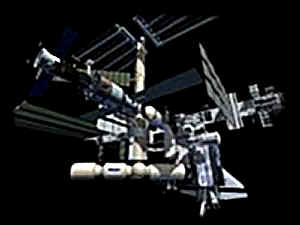
International Space Station
"To boldly go where no one has gone
before". STAR TREK is quickly becoming a reality for us (minus the aliens of course-lol-and 'yes' I'm a 'trekkie') as scientists uncover the mysteries of deep space and the technologies needed to get there.
It's been 40 years since man was first placed in space and since then we have launched hundreds of satellites and probes.
Some have entered our everyday language, like Voyager that traveled through our solar system past Pluto (now it's out of contact), the Global Positioning System satellites that can pinpoint anywhere on Earth, and the Hubble telescope with it's powerful lens that can see light years away.
All of these are sending us visions and data beyond our imagination.
We are now building a permanent 'home' in space, planning to land on an asteroid and anticipate walking on Mars.
The idea of terra forming Mars (or a similar planet) is not an impossibility, it is only an
impracticality.
The whole purpose of the various space programs is to 'expand our knowledge
of our Universe and our place in it'. In order to pursue this noble goal, massive resources are plowed into space exploration, and the returns are not only pretty pictures of nebulae, but significant advances in the technologies that we use every day.
I would guess that without John F. Kennedy tasking his nation to "Land a man on the Moon and return him safely to
Earth", the computer you're using and the network it's connected to wouldn't exist, or wouldn't be nearly as advanced as it is.
Advancement begets bigger advancement - which sets up a cycle of discovery that proceeds at a geometric rate.
With the exploration of space as the catalyst, all sorts of discoveries (intentional and otherwise) are being made in the scientific realm at a rapid fire rate.
Space programs have given us new energy sources, data collection and communication abilities, building techniques and materials, travel capabilities, educational resources, medical equipment, recreation devices, and the list goes on and on.
You name it, there's something "new and improved" coming out all the time,
it's replace or up-grade! By the time you get around to learning about or using a new technology or discovery, it's usually already on it's way to being - or already is - redundant.
Scientists, companies and manufacturers get caught up in the excitement of making their dreams a reality and race to be first in line.
New technology is rushed into the world with little regard to the consequences, practicality, proper functioning or true benefit to society and mankind as a whole.
They forge on, at breakneck speed, leaving the rest of us bewitched, panicked, perplexed or just plain stunned.
It is almost impossible to keep up with the amount and complexity of some of the new technologies, so we ascribe it as 'magic', and trustingly buy, use, consume and generally believe the discoverers.
We trust what they say - that this new method or product is or will be for our betterment, not because we understand it, but because we are so overloaded with new and better things we couldn't possibly digest it all and make an informed
decision.
I'm not a Luddite - this isn't an anti-technology or anti-space exploration rant, no, not at all!
We have, in this 'golden age' of discovery and technology, the opportunity to accomplish many great things for humanity's
sake... but is it really humanity's sake we're thinking of?
Back
to Index |