 |
|
|
|
|
|
|
|
|
|
|
|
|
|
|
|
|
|
|
|
|
|
|
|
|
|
�VII LRRP CO (ABN) History |
|
|
|
 |
|
|
|
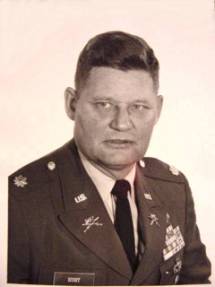
���� Edward M. Hunt |
|
|
|
Arrived early 1961 as Captain, appointed XO. |
|
|
|
1962 promoted to Major and became CO. |
|
|
|
June 1963 transferred from LRRP to Arkadelphia, AR |
|
|
|
BEATING THE ODDS |
|
|
| Edward M. Hunt was born in Carthage, MO on 14 September 1923, but spent most of his youth in rural Dane County WI, near Madison.� His father had been a doughboy in WWI and, by chance, influenced Hunt's future one day by saying, "If I had stayed in the Army, I could have retired by now." |
|
|
| After high school graduation in 1942, Ed Hunt joined the Army and completed his basic training as a member of the 252 Field Artillery at Camp McCoy, WI.� The 252 was an outfit of "school troops" at Fort Benning, GA, who would run exercises for other outfits, but would never do much else.� Hunt was told that it would be impossible to transfer out of the unit, which was unacceptable to him, so he found a creative way to beat the system by writing his own transfer to jump school.� Upon completion, he was assigned to the 407 Airborne Artillery at camp Mackall, NC.� "They didn't do much but sit around on their asses and go on three-day passes", recalls Hunt, who had been pressing for an infantry assignment.� He pestered the CO until he was finally transferred to the 541 Parachute Infantry for a crash course in infantry tactics.� Thirty days later he was sent to Fort Meade MD for out-processing, then to Camp Shanks, NY for the boat ride to Northern Ireland, the destination for replacement troops.� On 1 April 1944, Pvt. Hunt was assigned as a parachute artilleryman to E Company, 502 PIR, 101st Airborne Division.� The 'deuce", as it was known, was camped near Newberry, England. |
|
|
| On 5 June 1944 Pvt. Ed Hunt and the rest of Easy Co departed for Normandy on an aircraft with chalk number 19, the nineteenth aircraft to go.� The history of the deuce at Normandy from 6 to 13 June is well documented, and is nothing short of heroic.� Hunt's memories of the four bridges at Carentan are especially vivid. |
|
|
| With a population of about 4,000 people, Carentan was the second largest city in the Cherbourg Peninsula, located about eight miles from the sea on the Douver River. A canal running into the city made it possible for small boats to enter from the sea. A set of locks built into the canal controls the flow of the ocean's tide. North of the city is marshland, mostly below sea level. It would be easy to flood the entire area. The worst thing for us was the fact that there wasn't any cover. |
|
|
| The Allies needed to capture the city of Carentan so that we could link up all the beaches. Only then could we think of breaking out. To the Germans, Carentan had great strategic importance. To Field Marshall Rommel and General Dollmann, the Commanding Officer of the 7th Army, losing Carentan would mean the loss of the main road, and only a short time until the whole peninsula would be cut in two at its base. The loss of the main seaport city of Cherbourg would then be inevitable. Helping the German officer s decide on the importance of Carentan was their discovery the day before of an Allied operational order revealing our intentions ... 1. |
|
|
| In fact, the Germans had flooded the area before Easy Company got there.� Hunt recalls, "The Germans had blown one of the bridges, and we were crossing one of the fields.� I was up to my neck in water, the bullets were zinging and splashing around everywhere and it sounded like they were bouncing off my helmet." Nonetheless, he made it across, wet but unscathed.� For the next week, Hunt was heavily involved in the fighting.� "I had a 'detail face', and all I heard was 'Hunt, front and center?!'"� But he survived Normandy, and in late June, the deuce was pulled back to England to heal, reflect and train for the next mission. |
|
|
| On 17 September 1944 the 101st participated in an operation code named Market Garden, the largest airborne operation of all time, with over thirty-five thousand paratroopers.� After an uneventful drop behind German lines in Holland, the 502 had to clear and control a twenty-five mile stretch of road between Arnhem and the Belgian border.� The 82nd and the British also had similar twenty-five mile objectives.� The deuce engaged the Germans in the battles of Zon, Best and Wilhemena Canal, taking many casualties.� |
|
|
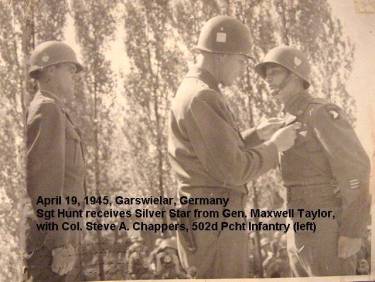
| In early December, they were pulled back to France for a short rest.� But on 16 December, the Germans launched a major offensive in the Ardennes forest, which would become known as the Battle of the Bulge.� The 101st was again called upon to stop the Germans, reaching Bastogne before the Germans got there, but the Germans subsequently surrounded them.� It was there that General McAuliffe replied to the German commander's demand to surrender, "Aw Nuts."� Although the 502 took many officer and enlisted casualties, they fought well and successfully repelled German attempts to break through at Hemroulle and at Champs.� The Germans were finally stopped when the Allies took the town of Bourcy, Belgium.� It was during this campaign near Champs that squad leader Pfc. Hunt earned the Silver Star, for single-handedly defending the unit against the attacking German footsoldiers, "stacking them up like cordwood," he says, "as they crossed a barbed wire fence."� He then left himself defenseless as he assumed a position in an open field for a clear shot with a bazooka, which took out an approaching German tank and initiated the German retreat.� His valor is described in the book Rendezvous with Destiny, which is the history of the 101st.� The award was pinned on him later in Germany, by General Maxwell Taylor. |
|
|
|
 |
|
|
| After Bastogne, the 502 held positions along the Moder River for a month, and then were recalled to France for a rest.� In April 1945 they defended along the Rhine near Dusseldorf, and in May were sent to Berchtesgarden.��� They remained in Austria during the summer of 1945, and were sent back to France in September, to await transportation stateside.�� While there, the 101st Airborne was deactivated, and along with it, the 502. There were only two members of the original 502 PIR, which jumped into Normandy and Holland and fought through Belgium and Germany, who were not either killed or wounded. Hunt was one of them.� Staff Sargent Hunt left the Army in late 1945. |
|
|
| In 1948, with the rank of Sargent, Hunt reenlisted in the Army for an airborne position.� He was sent to Bordentown, NJ for assignment to the 508 PIR, but when he got there he learned that the 508 had been disbanded.� He was then "assigned to a leg outfit, but I goofed off in the barracks until I found the 82nd Airborne recruiter," who got him assigned to the 504 PIR, 82nd Airborne.�� |
|
|
| By 1951, Hunt had risen to 1Sgt, and having been recognized as one of the top five percent of enlisted soldiers, was eligible for a direct commission to 2LT.� He passed the educational and psychological requirements, and was assigned to V Co, 503 PIR, and 11th Airborne Division at Ft. Campbell, KY. |
|
|
| In 1953-4, 1LT Hunt served in Korea as CO of C Co, 31st Infantry, 7th Division.� He tried desperately, but unsuccessfully, to get assigned back to the 11th Airborne Division, which was then also in Korea.� But it would not be until 1958 that he returned to jump status, this time back at Ft. Campbell, with his old outfit, Easy Company, 502 PIR, 101st Airborne, as its CO. |
|
|
| Later in 1958, Lt. Hunt left Ft. Campbell for the Advanced Infantry Course and Ranger School at Ft. Benning.� While at Ranger School, among his classmates were Charlie Beckwith, who later became the first commander of Delta Force, and Sgt Charles L. Jenkins, who would later become Hunt's Operations Sgt in Nellingen. |
|
|
| Also while at Ft. Benning, Hunt's eye was caught by an Army nurse, who was heading for an assignment in Frankfurt, Germany.� Although he petitioned for a European assignment, Hunt was sent to Ft. Riley, KS, and "was told to settle down.� You're not going anywhere for at least two years."�� Resigned to the idea of a long stay in Kansas, he made a couple of "investments," as he calls them, two trotters that he trained and raced, mostly in county fairs.� This hobby evolved from his youth in Wisconsin, where the sport had caught his interest.� Not a physically large man, the challenge of training and racing a rapidly trotting horse suited him well.� "And that's when I learned that you can't unpack for long In the Army," he recalls, "because just as I had become established there at Ft. Riley and with the horses, the Army decided to send me to Germany!" |
|
|
|
So in 1961, now Captain Hunt, airborne veteran of two wars, AIT and RANGER, was assigned to, of all places, the Fourth Armored Division in Goeppingen, Germany.� At least it was closer to Joan, and they were married in Basel, Switzerland later that year. |
|
|
| In early July 1961, Captain Hunt caught word of a new hotshot all-volunteer airborne outfit that was being formed nearby in Nellingen, under VII Corps.� He immediately arranged for an interview with the CO, Major Edward V. Maltese, another D-Day Airborne veteran (506 PIR).� After checking his references and his reputation, Maltese accepted Capt. Hunt as XO of the new company.� When Maltese was promoted to Lt. Colonel and transferred to 8th Division, Captain Hunt was promoted to Major in May 1962, and assumed command of the JayHawk Lurps. |
|
|
| Under Major Hunt the company matured, especially in LRRP tactics.� Although its personnel had been continuously trained and had become well qualified in airborne activities, radio operations, weaponry, cross-country skiing, mountain training, hand-to-hand combat and other military disciplines, Hunt knew that LRRP tactics were fruitless if the patrols could gather intelligence but not get it back to HQ promptly.� Through his own combat experience, he knew only too well the importance of prompt and accurate information.� While the Base Station concept was not new, its effectiveness was limited with the short transmission range of the old 3-piece AN/GRC 9 radios the patrols carried.� However, with the arrival of the new Sylvania AN/TRC-74, and later the AN/TRC-77, an even sturdier crystal frequency controlled CW radio with a longwire antenna and a much greater transmitting range, the concept was greatly improved.� The Base Station "commo vans", truck-mounted generator-powered radio huts with good receivers, 500-watt transmitters and RTT capabilities, were manned around the clock by the best of the company's radio operators.� They could be positioned strategically to receive coded messages from deeply inserted patrols and retransmit them to higher command.�� Hunt insisted that every patrol member, not just the RTOs, be CW qualified.� "What good is information if half the patrol is shot up and the other half can't send CW?" says he. |
|
|
| In June 1963, Major Edward M. Hunt, six months short of a twenty-year retirement, was reassigned from VII LRRP CO (ABN) to Arkadelphia, Arkansas, to act as a military advisor to a basic training command, supposedly his terminal assignment.� One of Hunt's proudest moments while there came when he and Captain Ellis Bingham, his former Commo Officer with the LRRP Company, were called to the Pentagon to comment on the new LRRP Manual, "which had been written by some 2LT at Leavenworth."� While the staffers quietly dismissed their opinions, Hunt asked if he might be allowed to make some suggestions on the content.� General Bondsteel, despite the advice of his lower-ranking aides, said OK.� "Bingham and I tore into every paragraph," Hunt recalls, "and what we gave back did not resemble what they gave us. General Bondsteel asked what we were doing different, and we explained our use of the base stations.� The staffers were not happy with us, but they kept every suggestion," and they stand yet today as the official LRRP Manual. |
|
|
| Rather than the twenty-year retirement his father had told him about, the Army offered Hunt an extension.� Thoughts about retiring to a life of rural tranquility with his horses were quickly put on hold, and he accepted it.� Before fully informing Joan about it, he had volunteered for Vietnam, although she presumed that he would.� He pressed for a G-3 jump slot, but was unsuccessful, as was he in trying for a combat role with the 1st Air Cav.�� He was assigned as a G-2 in Saigon, where he served for a year with distinction. |
|
|
| Retirement was still not in the cards for Hunt.� From 1966 through 1969 he served with the garrison at Fort Indiantown Gap, PA, which had grown once again to an important Army training post, still active today.� From there he was transferred to Fort Greeley, Alaska, once again on jump status.� As Infantry Test Officer, he led training and equipment testing for cold weather operations, and in the summer of 1972, 30-years after jump school, he made his last military jump. |
|
|
| By now a Lt. Colonel, Hunt returned to Fort Indiantown Gap that fall, and retired on 1 October.� He remained in Central Pennsylvania, just east of Harrisburg, and immediately resumed his passion for owning, training and racing trotters, mostly for purses at local county fairs and such.� Among his memorable successes, however, was a win in a pari-mutuel race at Dover Downs, Delaware, with a horse named Social History, at 51-1 odds! |
|
|
| Those of us who served under Major hunt will not forget him.� To us, mostly a fun-loving bunch of peacetime products, he was an awesome figure whose stature was far greater than his physical being.� He had a short cigar permanently implanted in the side of his mouth, a stocky figure and a serious demeanor.� He looked as though he could be gruff, but his bright blue eyes softened his appearance.� We all knew that he had once been an EM, and his wings proved that he had had combat experience.� But most of us never knew much else about him, or took the time to, because we were always busy training for something we did not really expect to happen, although it did for some.� Most of us served and went home, others went on to less friendly places to do things for which they were well trained, and many of them were decorated for their achievements and valor, including one who received the Medal of Honor, posthumously. |
|
|
| When asked which, of the many outfits he served with during his distinguished career, he thought was his favorite, he responds without hesitation, "The LRRP Company.� They were all volunteers, and that's what set us apart.� Those guys were the best."� Well, we agree with you, Sir, and you were one of us.�� AIRBORNE! |
|
|
| In April 2002, Kirk Gibson and Theo Knaak, former Lurps for Major Hunt, visited him and his wife Joan in their pleasant home in a peaceful neighborhood in Palmyra, PA.� He still owns and trains horses, leaving the driving to others, and still strives to be the best, and always trying to beat the odds.� |
|
|
| Note:� Kirk Gibson made another visit to Ed Hunt on 6 June, 58 years after D-Day.� It is still difficult for him to describe the events of Normandy, Holland and Bastogne.� Nor will he watch them on television or at the movies. "I guess my kidneys are a little too close to my eyes," he admits without shame.� |
|
|
| Those of us who were not there can not imagine the horrors he survived, against all odds. |
|
|
|
 |
|