Hi!Welcome to Our
Site.
In this page you'll find lots of interesting
informations.
Enjoy Yourselves
The Ocarina is an Andean
wind instrument. Its sound is depressing, sad and might even be described as
painful.
Ocarinas are made by a variety of mud, stone, wood and large seeds.
In addition to being used for musical tuning, ocarinas were made to imitate
animal sounds, especially bird voices.
The ocarina is a spherical flute,
with or without a mouthpiece (to channel air inflow), such that sound is
extremely easy to produce.
In the Andean world, this instrument can be found
in many varieties and with a large range of decorations. Some have eight finger
holes in the upper part (four for the fingers of each hand) and two in the lower
part (one for each thumb).
The European ocarina (known as the sweet potato)
was developed in the nineteenth century in Italy and Austria. It became quite
popular in many countries, including the United States.
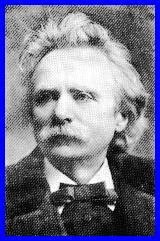
Grieg, Edvard Hagerup
(1843-1907), the most distinguished Norwegian composer of the 19th century. Born
in Bergen on June 15, 1843, Norwegian composer Edvard Grieg wrote the incidental
music for Henrik Ibsen�s poetic drama Peer Gynt in 1875. He arranged the music
for full orchestra in 1888, and it has become one of his best-known works.
.
This excerpt is taken from the section titled �In the Hall of the
Mountain King.� It is set in the mountains of Norway, the land of Trolls,
where Peer Gynt is driven from the troll king�s court.
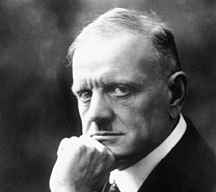
Sibelius was a Finnish composer whose music showed his love for his country and its people. Finland's greatest ever composer, he is still greatly admired by his existing local fans. Jean Sibelius was born in December 8th 1865 in Hameenlinna, a small group of people living in north of Helsinki. His daddy died in a cholera when he was two years old and was heavily in debt. The family (mother and three children) went to live in the house of his mummy�s mummy. At the age of five, "Janne", as he was called,sat at the piano and played little tunes and a number of musical notes on it.Soon after that he learnt the violin, and together with his sister Linda, who played the piano and Christian who played the cello (a musical instrument that looks like a large violin), the little Sibelius' soon made a piano trio. Janne came from a Swedish-speaking family, but he went to a Finnish speaking school. This way, he became familiar with the qualities, traditions, features,ideas and custom of the Finnish language. At school he was often dreaming,but by 1885 he took the examination which was necessary to satisfy his needs so as to get a degree for work and leave school.
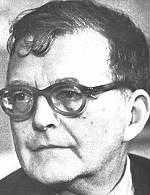
Shostakovich, Dimitri
Born: St. Petersburg, 25 September 1906
Died: Moscow, 9 August
1975,
Shostakovich would certainly lay claim to the Greatest of the 20th
century crown. All of his music is full of feeling, though the feeling expressed
is often bitterness, sadness, or sardonic "humour". Stravinsky apparently said
of Shostakovich that he was one of the most frightened men he had ever met , and
this feeling of fear (terror, even) is something one can often hear in
Shostakovich's music. This is not to imply that all of his work is irredeemably
grim. The second movement of the second string quartet is beautifully sad and
sweet, for example, the eighth quartet, the two cello concerti and the 24
preludes and fugues. Shostakovich had a strong musical education. He entered the
St. Petersburg Conservatory at a young age and was taught there by Glazunov,
among others. His first symphony was his graduation piece (in 1920), and was
well received. He supported himself and his mother in this period by playing the
piano at silent movie screenings. In later works, Shostakovich made frequent use
of a D-Eflat-C-B theme.
Written using the German notation this reads
D-S-C-H, his ``initials''