|
|
||||||||||||||||||||||||||||||||||||||
|
History
Jesuit missionaries started their missions in 1629, in Dapitan but progress was hindered by continuous warfare between the Spaniards and the Moros. For much of the Spanish period, Zamboanga del Norte was administered as part of two provinces. Dapitan was made part of the corregimiento of Misamis, while the western part was part of the corregimiento of Zamboanga. In the 19th century, when Misamis became a province, Dapitan formed one of its partidos or divisions. In 1837, the corregimiento of Zamboanga became a military government. In 1843, the Spaniards gained title to the area between Zamboanga and Dapitan through a cession by the Sultan of Maguindanao. Beginning in the
later half of the 19th century, many Visayans settled in Zamboanga
due to population In 1914, when the Americans established the Department of Mindanao and Sulu, Zamboanga was made one of its regular provinces. Zamboanga province was divided into two in September 1952 by virtue of Republic Act No. 711. The town of Dipolog became the capital of the province of Zamboanga del Norte.
People, Culture and the Arts At present, Zamboanga del Norte is populated largely by Dipolognons and Dapitanons, said to be the descendants of migrants from the province of Bohol, who were attacked in 1563 by Ternate raiders, and forced to resettle elsewhere. Thus the principal dialect of the province is Cebuano, but with a Boholano accent. Zamboanga del Norte is also the home of the Subanun, or 'people of the upstream' (also Subanen, Suban-on). They are upland and swidden cultivators, who prefer to build their houses on top of ridges near potable water sources near their fields. They prefer to locations near springs rather than streams. Through the years, land problems and degraded environment have forced some of the people to adopt wet rice agriculture. Metal craft and weaving are also practiced. The Subanons have maintained trade with coastal peoples through the centuries. Present day Subanons are non-aggressive, although there are indications that in the past the people were required to provide a "soul companion" for an important deceased relative. ‘Buklog’ is a Subanon set of unique rituals that utilizes a huge dancing platform to which a log is attached that hits a hollowed sounding board on the ground. Sinulog and Kinabayo are celebrated every July 24-25 in Dapitan City in honor of the city’s patron, Saint James. The Sinulog is a dance procession and Kinabayo is an exotic and colorful pageant re-enacting the Spanish-Moorish wars, particularly the Battle of Covadonga. In that battle the Spanish forces under General Pelagio took their last stand against the Saracens. They were able to reverse the tide of the war with the miraculous apparition of Saint James, the Apostle. The addition of local color and innovations has made this annual festivity a popular attraction to visitors of Dapitan. The shrine to Dapitan’s most famous sojourner, national hero Jose Rizal, still stands and gives testimony to Rizal’s exile in the town in the late 19th century. His house and part of the innovations he instituted in his small estate still stand and draw hundreds of tourists.
Trade and Investments A province on the move, Zamboanga del Norte boldly stakes its claim for the opportunities of growth in the next millennium. The province has a land area of 7,316 square kilometers and a population of 770,697. The agricultural resource base rests upon an expanse of 2,651 square kilometers and produces cash crops as well as agro-forestry products. Zamboanga del Norte has eight major fishing grounds along a 400-kilometer coastline and fishponds covering an area of 1,755 hectares. The province also has rich deposits of both metallic and non-metallic minerals. Zamboanga del Norte is approximately an hour and 15 minutes flight from Manila and 45 minutes flight from Cebu City or Zamboanga City. The land, sea and air transport services throughout the province are available and convenient. The roads and highways, stretching a total of 1,090 kilometers, are considered the best in the region. The airport in Dipolog City offers regular flights to Manila, Cebu and Zamboanga City while feeder airports in Liloy and Siocon provide landing strips for aircrafts of general aviation. The only seaport in the province is located in Pulauan and five major shipping companies operate transport services for passengers and cargoes to major cities and neighboring provinces. Zamboanga del Norte has domestic and direct distance dialing services as well as cellular phone services. Banking services are offered by 22 banks, eight of which are commercial, 2 are government-owned, and 12 are rural. Zamboanga del Norte has 47 water systems managed by six waterworks district and two electric cooperatives servicing the electric needs of the entire province. Zamboanga del Norte’s "growth with equity" strategy is not just slogan but a realistic move to match new investments with support infrastructure, incentives and strong political will. This is manifested by the local government unit’s efforts to create mechanisms that will assist investors and entrepreneurs establish their businesses in the province. To date, the LGU has created the Zamboanga Investments and Promotions Board, developed industrial sites in different municipalities and arranged for additional incentives aside from those already mandated by the national government. Added to this, the province has strategic access to domestic, as well as regional, markets like the Brunei-Indonesia-Malaysia-Philippines East Asian Growth Area. Among the preferred areas for investments are the processing and packaging of sardines, banana chips, coco-coir, mangoes; production of animal feeds, coco-charcoal, garments, plastic and plastic mouldings, ceramics, organic fertilizer; and manufacture of rattan furniture, farm implements, and marble processing.
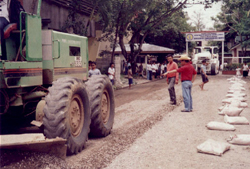
Partnership Initiatives More than half of Zamboanga del Norte's territory is classified as forest land and this wide expanse of wilderness is home to many endemic, and often times vanishing species of plants and animals. Surrounding the coast of the province are stretches of coral reefs that are home to many fish species. The increasing depletion of forest resources as well as the destruction of the surrounding marine environment was an impetus in initiating a provincial environment protection program. The Provincial Task Force Sagip Kalikasan (PTFSK) is a multi-sectoral initiative aimed at safeguarding the province's natural resources. The province established its local environment division, which spearheaded the creation of this task force. It coordinated the Armed Forces of the Philippines, the Philippine National Police, the Marina, Coast Guard, Parishes, fisherfolk organizations, the Department of Environment and Natural Resources, and other agencies whose primary concern is to deter illegal activities that destroys forest and marine resources. A component of the environmental program of the province is providing protection to the forests, while at the same time ensuring the viability of these protected areas by providing livelihood opportunities for affected communities. The Provincial Parks were established in an effort to halt the degradation of the forest cover and similar resources as well as preserve wildlife. The province established mountain parks in Mount Timolan and Lake Maragang that protects the area from kaingineros, illegal occupants, and the loss of endangered species such as the Philippine Eagle. While forest guards were posted, access roads constructed and an on-going reforestation activity were programmed in these area, an important component of the program was the close coordination of the provincial government with the local folk that ensures that they too have a stake in this undertaking.
Development Initiative Highlights:
|
||||||||||||||||||||||||||||||||||||||


 pressure in Cebu and Bohol. Many petty criminals and political
dissidents were likewise sent to settle in the sparsely populated Zamboanga
coast. Dapitan is most famous as the place of exile of Philippine national hero
Dr. Jose Rizal. For more than three years, he lived in the town, before he was
executed for allegedly instigating the Philippine Revolution. His house still
stands and is now a museum.
pressure in Cebu and Bohol. Many petty criminals and political
dissidents were likewise sent to settle in the sparsely populated Zamboanga
coast. Dapitan is most famous as the place of exile of Philippine national hero
Dr. Jose Rizal. For more than three years, he lived in the town, before he was
executed for allegedly instigating the Philippine Revolution. His house still
stands and is now a museum.