|
|
||||||||||||||||||||||||||||||||||||||||||
|
History
The Spaniards visited the coast of Mindoro in 1570 and established a settlement in Puerto Galera. The port became an important way station for galleons proceeding to or returning from Mexico. The island of Mindoro was placed under the jurisdiction of the province of Bombon (Batangas) until the early 17th century. A separate corregimiento was established and the corregidor took residence in Puerto Galera. For much of the
Spanish period, the coastal areas of Mindoro were under constant threat from
Moro Mindoro was made part of Marinduque in June 1902 but was established as a special province in November. It became a regular province through Act No. 2964 on February 20, 1921. On June 13, 1950, the island was divided into two provinces through the passage of Republic Act No. 505.
People, Culture and the Arts
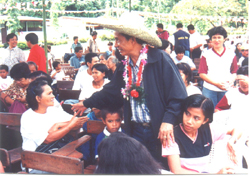
There are about seven major groups into which the Mangyans are divided, and there are further sub-groups among them. The Mangyans are basically subsistence farmers living in small family-based communities at the head of rivers and streams. They are shifting agriculturists who move out of an exhausted patch of forest to clear a new patch of land. The Mangyans, in general, are docile and are predisposed to move on rather than come into conflict with lowlanders. Although simple in manner of dressing and in their material culture, the Mangyans reserve the distinction of retaining the use of pre-colonial script of Indic origin. This syllabary uses 48 characters. This is true among the Hanunoo and the Buhids. They write their poetry in this script, on bamboo slivers, carabao horns and wood using knives and stylus to make shallow grooves. The poetry written using the script are known as ambahan and urukay. The ambahan are rhyming love songs in riddle form that are used in courtship. Urukay are words of wisdom and folkloric records sung by elders. The singing and chanting are accompanied by guitars, fiddles, flutes or jew’s harps. Calapan celebrates the Sanduguan to commemorate the earliest contact between the people of Mindoro and Chinese merchants. The festival is a reenactment of the historical encounter and participants dress as 12th century Chinese merchants or as ancient Filipinos and form into camps. The camps meet at the beach and reaffirm the ties, which bind them in peace. Sanduguan comes from the word "sandugo" which literally means 'of one blood' or brother.
Trade and Investments Oriental Mindoro
is a strategic neighbor to the burgeoning industries of CALABARZON. It is set to
Oriental Mindoro is 140 kilometers south of Manila and only 45 minutes away from the Batangas City International Port. Calapan City port provides the main link with Batangas and other points of the archipelago. Three airports allow light aircraft to land within the province. The Oriental Mindoro Electric Cooperative distributes power while three telecommunications firms provide domestic and international direct dial services. Two mobile phone companies complement the province's communications capabilities. There are 39 commercial and rural banks providing financial services in the province. Oriental Mindoro is focusing on developing its agricultural potentials by encouraging investors to improve productivity and increase agro-industrial capacities. Fruit and vegetable production, tree farming, aquaculture and feed milling are viable activities that can be readily absorbed by markets in CALABARZON. At the same time, the province is increasing its own capabilities to process these products by establishing agro-industrial zones within the province. Light industries such as marble works, metal works, ceramics, and handicrafts and houseware manufacture can thrive with the availability of raw materials within the province. Investments in mineral development will enable Oriental Mindoro to make use of its coal and marble deposits to fuel further development. Tourism is a bright prospect and there are opportunities in developing national parks like Lake Naujan and Mount Halcon into eco-tourism resort areas.
Development Initiative Highlights:
|
||||||||||||||||||||||||||||||||||||||||||
 mountain of gold. Oriental Mindoro shares the eastern half
of the large island of Mindoro Island. On the north the narrow Verde
Island Passage lies between it and the Batangas coast of the island of
Luzon. To the east, Tablas Strait separates Mindoro from the islands of
Romblon. Semirara and Panay islands lie southwards. A mountainous
interior cordillera separates the province from Occidental Mindoro. The
climate is divided into two seasons. The province experiences dry
weather from November to May and rainy weather the rest of the year.
mountain of gold. Oriental Mindoro shares the eastern half
of the large island of Mindoro Island. On the north the narrow Verde
Island Passage lies between it and the Batangas coast of the island of
Luzon. To the east, Tablas Strait separates Mindoro from the islands of
Romblon. Semirara and Panay islands lie southwards. A mountainous
interior cordillera separates the province from Occidental Mindoro. The
climate is divided into two seasons. The province experiences dry
weather from November to May and rainy weather the rest of the year.
 raiders. The constant and incessant raiding depopulated the communities of
Bulalacao and Pinamalayan. The only thriving communities were the towns of
Naujan and Calapan in the north. It was not until the 19th century
when the threat to settlements diminished that population steadily increased.
raiders. The constant and incessant raiding depopulated the communities of
Bulalacao and Pinamalayan. The only thriving communities were the towns of
Naujan and Calapan in the north. It was not until the 19th century
when the threat to settlements diminished that population steadily increased.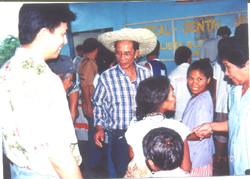 The Tagalogs
comprise the majority of the people living in Oriental Mindoro. Many are
descendants of migrants and most of the people can trace their lineage from the
provinces of Batangas and Quezon. In the interior of the island live the
cultural communities known collectively as the Mangyans.
The Tagalogs
comprise the majority of the people living in Oriental Mindoro. Many are
descendants of migrants and most of the people can trace their lineage from the
provinces of Batangas and Quezon. In the interior of the island live the
cultural communities known collectively as the Mangyans. make use of this opportunity to propel its own agro-industrial potential. The
province is an agricutural powerhouse. It is one of the Southern Tagalog
Region's top rice producers and also yields coconut, corn, citrus and banana.
Important commercial fish species, like tuna, mackerel, snapper, anchovy and
round scad are found in the waters around the province. About half of the land
area is considered forestland and is a source of rattan, vines and buri.
The province is known to have quantities of gold, silver, nickel, iron, copper,
chromite, gypsum, coal, barite and marble. A population of 608,000 supports the
labor needs of the province.
make use of this opportunity to propel its own agro-industrial potential. The
province is an agricutural powerhouse. It is one of the Southern Tagalog
Region's top rice producers and also yields coconut, corn, citrus and banana.
Important commercial fish species, like tuna, mackerel, snapper, anchovy and
round scad are found in the waters around the province. About half of the land
area is considered forestland and is a source of rattan, vines and buri.
The province is known to have quantities of gold, silver, nickel, iron, copper,
chromite, gypsum, coal, barite and marble. A population of 608,000 supports the
labor needs of the province.