|
|
||||||||||||||||||||||||||||||||||||||
|
History
The Spanish missionaries who penetrated the interior of the Cagayan Valley organized the area into mission settlements. The mission of Ituy was established in 1609 followed by the mission of Paniqui. Missionary work in the area was hampered by the continued belligerence of the native Gaddangs and Isinais and the attacks of the neighboring Ifugaos, and Ilongots. Several military expeditions were sent to pacify the region but the mountains continued to be frontier country. In 1839, Governor Luis Lardizabal, upon the recommendation of the Alcalde Mayor of Cagayan, divided the province into two provinces. As created in 1839, Nueva Vizcaya comprised an extensive territory, which covered the old missions of Ituy and Paniqui and reached up to Ilagan in present day Isabela. The division was approved by a Royal Decree, issued in 1841 and the new province was administered from Camarag (present day Echague). When the province of Isabela was created in 1856, Nueva Vizcaya lost a major portion of its northern and northeastern territories and its capital was transferred to Bayombong. The province of
Nueva Vizcaya surrendered to the Filipino Republican forces in September 1898
and Nueva Vizcaya was the scene of one of the most important battles between advancing American and Filipino forces and the remnant Japanese forces under General Tomoyuki Yamashita. The Japanese forces decided to fortify the mountainous Balete Pass linking Nueva Vizcaya and Nueva Ecija. For three months, the contending forces fought bitterly for control of the passes. After the Americans won control of Balete Pass, it was renamed Dalton Pass after an American general who died in the attempt to capture it.
People, Culture and the Arts Ilocano immigration into Nueva Vizcaya during the last fifty years has significantly altered the ethnolinguistic makeup of the province. More than 60% of the people are Ilocanos, while Ifugaos, Ibalois, Gaddangs, Isinais, Ikalahans and Ilongots comprise the greater part of the remaining population. Most of the population is concentrated in the narrow Magat River Valley region, along the main highway that runs through the province. Ilocano is the lingua franca, although English and Filipino are widely spoken. The Isinais and the Gaddangs used to predominate in the province of Nueva Vizcaya. Both groups have been acculturated into the main body of lowland Christian culture and are thoroughly bilingual in Ilocano. The Isinais are found in the municipalities of Bambang, Aritao and Dupax Sur. The Gaddangs are found in the towns of Bagabag, Solano and Bayombong. Both groups are lowland agriculturists. The Ikalahans are an Igorot people inhabiting the highlands of Imugan and Kayapa in the southwestern part of the province. The Ikalahans plant taro and sweet potato in low terraced fields along the river valley plains. Their traditional belief system involves ritual sacrifices and prestige feasts, although many members of this community have been converted to Christianity. Baskets and brooms are made by the Ikalahans in the vicinity of Imugan and are sold in the markets of Santa Fe. The mission churches of Nueva Vizcaya are hidden jewels of the centuries of painstaking evangelical work of Spanish friars. The churches of Bayombong and Dupax are rustic yet durable reminders of this difficult mission work. During the first week of August, Bayombong celebrates its town fiesta, which culminates in the sumbali, a street dance where participants blacken themselves to resemble Negritos.
Trade and Investments This gateway to the Cagayan Valley is envisioned to be the regional center for fruit and vegetable production and spice-based industries. Nueva Vizcaya is blessed with favorable semi-temperate climate and rich soil suitable for high-value crop production. The province possesses large stands of primary growth forests. The province’s adequate manpower resource is capable of meeting the demands of high-value agricultural ventures. Nueva Vizcaya is linked to the Maharlika Highway system, which facilitates access from lowland Cagayan and from Manila and Central Luzon. Chartered flights can make use of the Lantap feeder airstrip in Bagabag. Water and power needs are currently adequate to meet the needs of the province. The primary agricultural products of Nueva Vizcaya are still rice and corn, but the province is shifting into rootcrop, vegetable and fruit farming. The town of Kayapa produces high quality cauliflowers, cabbages, carrots and bell peppers for the vegetable markets of Baguio and Manila, making it the salad bowl of the Cagayan Valley. Pineapples and mangoes are being grown in lowland areas around Bagabag, while the upland barangays of Belance, Dupax, Villaverde and Aritao produce the finest yields of ginger, sweet peas, coffee beans, onions and tomatoes and bananas. There are more opportunities in the province to expand high-value crop production. Cutflower production is particularly attractive because Nueva Vizcaya enjoys a cool climate and has easy access to roads. Processing the great variety of foodstuff offered by the province is another potential activity that deserves attention. Gifts, toys and houseware production can make use of indigenous artistry and available raw materials. The relative ease in accessing the major markets of Luzon give Nueva Vizcaya incomparable advantages. The province also has excellent tourism potentials. Its cool climate and breathtaking beauty rivals established tourist attractions in Benguet. It is also surrounded by three major mountain ranges, the Sierra Madres, Caraballos and Cordilleras and makes an interesting jump off to explore the region. The province also boasts of some magnificent natural cave systems that have only recently been explored. Tourism related investments are very much welcome.
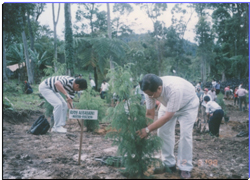
Partnership Initiatives A portion of the Magat River watershed area lies within the province of Nueva Vizcaya. This is an important source of water that supplies the gigantic Magat Dam in neighboring Isabela province. Over the past two decades, the wanton abuse of the watershed's forest resources threatened to reduce the lifespan of the dam, which supplies not only power, but also provides irrigation water for Region II. The provincial government, aware of the consequences of continued forest resource abuse, initiated a campaign to co-manage the Lower Magat Forest Reserve. The Department of Environment and Natural Resources, the main agency tasked with protecting the watershed, was reluctant to devolve the functions of forest protection because of the perceived lack of LGU capabilities in handling natural resources. The LGU managed to overcome the reluctance of the DENR by proving it was capable of co-management. The provincial government has largely promoted innovative programs that have overcome the traditional reluctance of communities to reforest. These programs give the communities a measure of ownership over the trees that are planted, provide tenurial arrangements with upland dwellers, build the capabilities of upland farmers to shift to less destructive farming and forestry methods and offer alternative economic opportunities such as eco-tourism to facilitate the protection of the wilderness. As a result of these measures, the DENR and the provincial government came into a partnership to manage the watershed. The structures and the master plans have been put in place and a multi-sectoral committee has been formed to steer the policy directions of the reserve. The co-management scheme is still in the development stage, but it shows that with a committed LGU leadership, partnerships with national government agencies, LGUs, NGOs and other stakeholders can address critical problems like environmental degradation.
Development Initiative Highlights:
|
||||||||||||||||||||||||||||||||||||||


 the Filipinos proceeded to hold it until President Emilio Aguinaldo was
captured in 1901. American civil government was established in 1902. In 1908,
the boundaries of Nueva Vizcaya were set.
the Filipinos proceeded to hold it until President Emilio Aguinaldo was
captured in 1901. American civil government was established in 1902. In 1908,
the boundaries of Nueva Vizcaya were set.