|
|
||||||||||||||||||||||||||||||||||||||||
|
History
Spanish explorers visited the coast of Davao del Sur as early as the 16th century. The island of Sarangani was visited by Alvaro de Saavedra in 1528, while Ruy Lopez de Villalobos also passed by the coast in 1543 on his way to the Moluccas. However, settlement and colonization was never attempted. The area was considered part of the realm of the Sultan of Maguindanao. After the area around the Davao Gulf was ceded by treaty to the Spanish Crown, the Spaniards began attempts to bring the people of Davao under their sway. In 1848, Don Jose Oyanguren established the province of Nueva Guipuzcoa. In 1860, Davao was created as one of the districts of Mindanao. In 1903, Davao became a district of the Moro Province. In September 1914, the Moro Province was abolished and in its stead, several provinces were created. Davao was among the provinces created from out of the Moro Province.
Davao del Sur was created through Republic Act No. 4867, which split Davao into three provinces on July 1, 1967.
People, Culture and the Arts Majority of Davao del Sur’s inhabitants are migrants from the Visayas and Luzon. Thus, the Cebuano dialect in Davao is heavily infused with Tagalog words. There are also a small group of Davaoeño speakers. The language is similar to the pidgin Spanish spoken in Zamboanga City and harks to the time when Davao was a penal colony of the Spaniards. The province is also the home to various cultural minorities like the Bagobo. Bagobos have one of the most colorful traditional dresses and are very conscious of ornamentation. Their clothing are woven from abaca fiber, decorated with beads, shells, metal disks, embroidery, and other colorful geometric patterns, such that they have been called the most colorful of the ethnic peoples of the Philippines. Both men and women file and blacken their teeth and shave their eyebrows to a thin line. Datus rule over the tribes, and are the interpreters of the law. The Bagobos, and other indigenous peoples, like the B'laans, Tagacaolos and Manobos have learned to cohabit with the lowlanders, and have focused on preserving their heritage thru their arts and crafts. They have a rich tradition of music and dance, and their baskets and ornate weapons are one of the best in the region. Metal craft is also well developed, producing brass, bronze and iron objects. The Kadayawan Festival of Davao, celebrated every third week of August, is a mirror of the province's rich indigenous cultural heritage. Kadayawan comes from the root word dayaw or madayaw, which means 'nice' or 'good'. It is a thanksgiving for the bountiful harvest, and fertile soil that this province has been blessed with. A main attraction of the festival is when highland tribes come down to perform their songs, dances, and rituals and participate in indigenous sports like horse-fighting.
Trade and Investments Located in the midst of vibrant growth areas, Davao del Sur is in a strategic position to take part in the region's development. The province is mainly agricultural and coconuts, bananas, palay and corn are major crops. The farms also produce cocoa, coffee, fruits and vegetables. The long coastline allows communities to fish both for home consumption and for commercial operations. The province also supports a wood processing industry that makes use of timber taken from the forests of the province. The population of 1,478,723 is a source of highly trainable and literate labor for the industries and services sectors of the province. Davao del Sur is accessible from the international airport in Davao City. Digos, is about forty kilometers from Davao City. The province is linked via a system of good roads with the provinces of Davao, Cotabato and South Cotabato. Cargo ships can make use of port facilities in Davao City and General Santos City, in South Cotabato, as well as the port of Malalag. Telephone service is available in most municipalities, while the province taps into the Mindanao power grid for its electricity requirements. There are 143 banking and financial institutions providing financing services to the people of Davao del Sur. Davao City, in the north, and General Santos City, in the south, are important growth centers that hem in the province of Davao del Sur. The province is strategically placed to provide resources to meet the needs of the rapidly industrializing and urbanizing centers. Agriculture is still the province's most promising industry. Investments in high-value crops, such as vegetables, fruits and cutflowers are very profitable because of the accessibility of the province to the axis of development. Livestock, poultry and cultured fisheries are also promising investment opportunities. Handicrafts, toys and gift items can be manufactured in the province and take advantage of the huge pool of indigenous craftsmen. Tourism also poses a veritably untapped opportunity. The province possesses pristine beaches, forest covered mountains, caves, isolated islands and unspoilt coral reefs. Developing the tourism capabilities of the province would require investments in hotels, resorts, transportation and other tourist services.
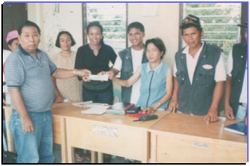
Partnership Initiatives Malita, Davao del Sur was once rich and fertile land in the 1930s. Davao del Sur used to produce high quality manila hemp as well as other agricultural products. However, due to massive clearing of forested areas to give way to new farmlands, the local ecosystem has been disrupted. The absence of a coherent plan for the upland areas, compounded by poverty, and the lack of awareness concerning proper technologies to utilize local resources, led the forests to destruction. These conditions now threaten to destroy the remaining 7,375 hectares of mixed old growth and residual forests in the province. Fortunately enough, an administrative order was issued which stated the innovative approach to conserving resources and preserving ancestral land and heritage. In 1993, the DENR issued an administrative order giving indigenous people right and the responsibility over their ancestral land. This started the partnership between the local government, a provincial task force and the two local indigenous groups to manage and conserve whatever forest resources remained within their areas. The partnership had to surmount cultural differences among the stakeholders, ensure equitable sharing of responsibilities and benefits, and enable the cultural groups to work with their traditions and customs in setting and carrying out practical targets and priorities. As a result of these efforts, nine barangays with 5,157 households composed of B’laans and Tagakaolos received more than just a Certificate of Ancestral Domain Claim. They paved the path towards a united approach in addressing poverty and environmental issues in this area of Davao del Sur.
Development Initiative Highlights:
|
||||||||||||||||||||||||||||||||||||||||
 of
Davao Gulf. From the heights of Apo, legend has it that a fair and just
datu dispensed justice to the Bagobos. It is his justice or daba-daba
that lends its name to the land below the Apo's heights. The province of
Davao lies north of Davao del Sur. To the west are the provinces of
Cotabato, Sultan Kudarat, South Cotabato and Sarangani. The province's
western coast is lapped by the waters of the Davao Gulf. A range of
mountains run along the western boundary, which makes Davao del Sur
largely mountainous. Rain falls evenly throughout the year.
of
Davao Gulf. From the heights of Apo, legend has it that a fair and just
datu dispensed justice to the Bagobos. It is his justice or daba-daba
that lends its name to the land below the Apo's heights. The province of
Davao lies north of Davao del Sur. To the west are the provinces of
Cotabato, Sultan Kudarat, South Cotabato and Sarangani. The province's
western coast is lapped by the waters of the Davao Gulf. A range of
mountains run along the western boundary, which makes Davao del Sur
largely mountainous. Rain falls evenly throughout the year.
 During the
American period, migrations from the northern islands were encouraged to extract
timber from the wilderness and turn the land into productive farmland. Thousands
of Visayans, Tagalogs, and Ilocanos settled in what is now Davao del Sur. A
colony of Japanese settlers established plantations in what is now the City of
Davao. Before the outbreak of the war in 1941, there were approximately 25,000
Japanese settlers living in "Davao Kuo." Most of the Japanese settlers
were repatriated to Japan after the Second World War.
During the
American period, migrations from the northern islands were encouraged to extract
timber from the wilderness and turn the land into productive farmland. Thousands
of Visayans, Tagalogs, and Ilocanos settled in what is now Davao del Sur. A
colony of Japanese settlers established plantations in what is now the City of
Davao. Before the outbreak of the war in 1941, there were approximately 25,000
Japanese settlers living in "Davao Kuo." Most of the Japanese settlers
were repatriated to Japan after the Second World War.