|
|
||||||||||||||||||||||||||||||||||||||||
|
History
In the 19th century, Spaniards began sending expeditions into Benguet to subjugate the Igorots. The first expedition, under Colonel Guillermo Galvey, succeeded in establishing Spanish presence in the La Trinidad Valley. In 1846, the area of Benguet became a district of the newly organized province of La Union. In 1854, the district became a separate comandancia politico-militar. Parts of the present province were also established as component territory of other comandancias like Lepanto, and Amburayan. The American established civil government by 1900. On August 13, 1908, Benguet became a sub-province of the Mountain Province together with Amburayan, Apayao, Bontoc, Ifugao, Kalinga and Lepanto. During the 1930s, mining companies began massive operations to work the gold mines in the area. This attracted many lowlanders to work and settle in the area, especially in towns surrounding the mines. During World War
II, Benguet was the site of fierce battles fought by Igorot guerrillas and
American On June 18, 1966, the Mountain Province was divided into four provinces by virtue of Republic Act. No. 4695. Benguet, along with the Mountain Province, Kalinga-Apayao and Ifugao, became a distinct province. People, Culture and the Arts Benguet is home to three highland peoples—the Ibalois, Kankanaeys and Kalanguyas. The Ibalois occupy the southeast, the Kankanaeys live in the northwest and the Kalanguyas are found in eastern Benguet as well as the western portions of the adjacent provinces of Ifugao and Nueva Vizcaya. The three tribes are culturally similar and are collectively referred as Igorot peoples. There is also a sizeable lowlander population, mostly Ilocano speakers, who have made a home in the province. English, Ilocano and Filipino are widely spoken and understood. The three highland groups differ mainly in language but are similar in their traditional beliefs and rituals. They all believe that spirits and supernatural beings exist who are responsible for bestowing blessings and bounties when they are pleased and honored, as well as inflicting pain and suffering when they are displeased and not heeded.
Traditional culture is fast transforming in the face of greater contacts with lowland Christian culture. Practices like headhunting, mummification and body tattooing have all but disappeared. Traditional costumes have also given way to western apparel. Most Benguet residents belong to one of the many Christian churches that have actively proselytized among the Igorots. Yet the culture of the Benguet peoples lives on. Traditional Igorot crafts continue to be made by highland craftsmen. Igorot weavers are renowned for their distinctive motifs. They also continue to make ethnic jewelry, which may be simple or complex, each bearing specific names. Igorot woodcraft is also very popular. Living cultural traditions and important relics can also be found in museums in the city of Baguio as well as in the town of Kabayan, the cultural heartland of the Ibalois. In Kabayan, the mummified remains of important men have been left in burial caves that dot the mountains surrounding the town. These mummies are considered very important national treasures and some can be seen on display at the local museum.
Trade and Investments Benguet has traditionally been a source of gold and vegetables but current efforts are geared towards making the province a regional industrial center. The province is mostly mountainous and lies over 2,000 meters above sea level on the average, giving it a temperate climate. About 77% of the land is considered forest land and the remaining 23% is cultivated to crops such as vegetables, fruits, coffee, palay, banana and rootcrops. The province is a major source of metallic ore and is home to some of the largest mining concessions that extract gold, copper and silver. A highly literate and trainable population of 485,546 answers the labor necessities of the province's industries. Five national roads allow access into the province. The Marcos Highway, Naguilian Road, and Kennon Road are the main avenues that link it with Manila, while the Benguet-Nueva Vizcaya Road and Halsema Highway provide access to the provinces of Nueva Vizcaya and Mountain Province. The province can be reached by air through Loakan or Mankayan airports. It has ample power supplies generated from Binga, Ambuklao, Bikun and Bineng to support the requirements of existing and new industries. The traditional industries of Benguet continue to beckon as very good investment priorities. Agriculture, primarily cold weather vegetable farming, continues to enjoy an expanding and readily accessible market. Agricultural pursuits, such as cutflower and fruit production, and food processing ventures, like fruit preservation and jam making, are also very attractive investment possibilities. Mining also remains the province's premier industry because of the wealth of metal ore reserves. The cold climate, scenic countryside and the unique culture of Benguet draws tourists from the lowlands. Investments in tourism related activities are still attractive options especially since the province is also veering towards eco-tourism promotion. The province also forms part of the North Luzon Quadrangle growth area, an initiative to draw industries into the north by complementing the economies of six provinces. Baguio City has been identified as a major industrial cog of this initiative. Several Benguet municipalities have been earmarked to decongest the city of industries and new industrial estates are being developed. Investments in power generation, private estate development, agro-industries, garments manufacture, handicrafts and novelty making and light manufacturing are being encouraged.
Development Initiative Highlights:
|
||||||||||||||||||||||||||||||||||||||||
 The major
source of cold-weather vegetables in the Philippines, Benguet is located
in the Central Cordillera Range of northern Philippines. Pangasinan lies
south of the province, while Ifugao and Nueva Vizcaya lie to the east,
the Mountain Province in the north, Ilocos Sur in the northwest and La
Union in the west. The land is mountainous and is cut by deep river
valleys. The elevation keeps temperatures cool and invigorating, and
when the Siberian winds blow in from the north in December and January,
the weather may be chilly. The province of Benguet has a wet season from
June to October and dry season from November to May.
The major
source of cold-weather vegetables in the Philippines, Benguet is located
in the Central Cordillera Range of northern Philippines. Pangasinan lies
south of the province, while Ifugao and Nueva Vizcaya lie to the east,
the Mountain Province in the north, Ilocos Sur in the northwest and La
Union in the west. The land is mountainous and is cut by deep river
valleys. The elevation keeps temperatures cool and invigorating, and
when the Siberian winds blow in from the north in December and January,
the weather may be chilly. The province of Benguet has a wet season from
June to October and dry season from November to May.
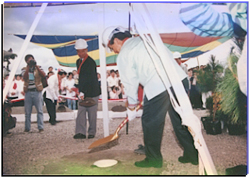 forces to open up the western flank of the Japanese defenders during
the final days of liberation in 1945.
forces to open up the western flank of the Japanese defenders during
the final days of liberation in 1945.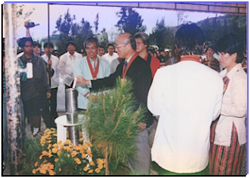 The people of
Benguet have certain noted traditional feasts and rituals, such as the kosdey,
a rite for the fertility of the earth that is observed held when the rice blooms
in the fields during the rising of the May moon. The tchungas is a
purification rite, with a ceremony held to avenge the ghosts of the enemies who
killed their people in the past and whose heads were cut off and brought home as
trophies. This ritual also signifies the purification of those whom they have
avenged. The most popular feast is the Cañao, which is held to ensure a
good harvest and good health.
The people of
Benguet have certain noted traditional feasts and rituals, such as the kosdey,
a rite for the fertility of the earth that is observed held when the rice blooms
in the fields during the rising of the May moon. The tchungas is a
purification rite, with a ceremony held to avenge the ghosts of the enemies who
killed their people in the past and whose heads were cut off and brought home as
trophies. This ritual also signifies the purification of those whom they have
avenged. The most popular feast is the Cañao, which is held to ensure a
good harvest and good health.