INTERNATIONAL SCHOOL
Member of the International Education
Agency
PROSPECTUS
2001
INTERNATIONAL SCHOOL
Member of the International Education
Agency
PROSPECTUS
2001
LIHIR INTERNATIONAL SCHOOL
c/- LIHIR MANAGEMENT COMPANY
P O Box 789
Port Moresby Phone : (675) 986 4233
Papua New Guinea Fax : (675) 986 4234 Email : [email protected]
PRINCIPAL/ TEACHER – grades 4>6 : Ms Pauline Rosenblum
TEACHER – grades 2 and 3 : Ms Louise Hunt
TEACHER – grades Prep and 1 : Ms Georgia White
TEACHER – shared resource : Ms Scholastica Pagiran
TEACHER (PRESCHOOL) : Ms Ida Kenneth
ASSISTANT TEACHER : Ms Ruth Moning
ASSISTANT TEACHER : Ms Jenny Pesas
ADMINISTRATIVE OFFICER : Ms Irene Rae
SCHOOL COLOURS : Maroon and Gold
SCHOOL MOTTO : "Knowledge Knows No Bounds"
"Kapaie na nivet sina ninanse"
ESTABLISHED : 22nd July, 1997
LIHIR INTERNATIONAL SCHOOL BACKGROUND
On Tuesday the 22nd of July 1997 Lihir International School opened its doors for the first time.
Lihir International is situated on Lihir Island in the New Ireland Province of Papua New Guinea. The school itself is located at ‘Maraun’ in the heart of the Lihir Management Company (LMC) townsite.
On the first day 27 students were enrolled in Grades Prep to 6 inclusive. The students came to Lihir from other centres in Papua New Guinea and across Australia and for most it was their first time in Papua New Guinea.
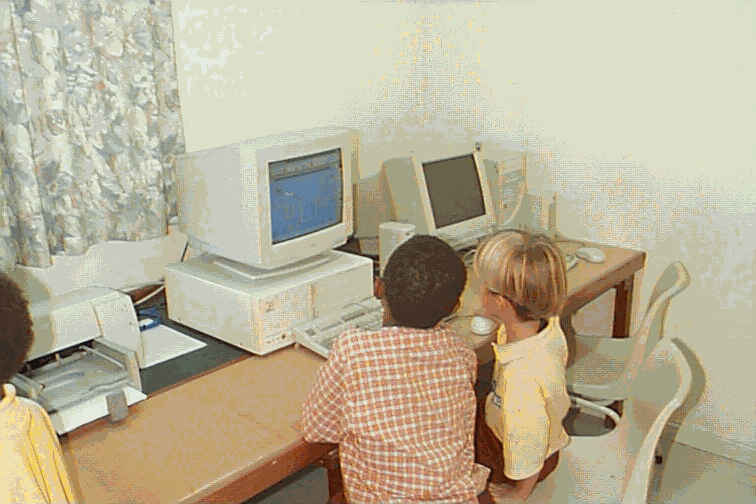
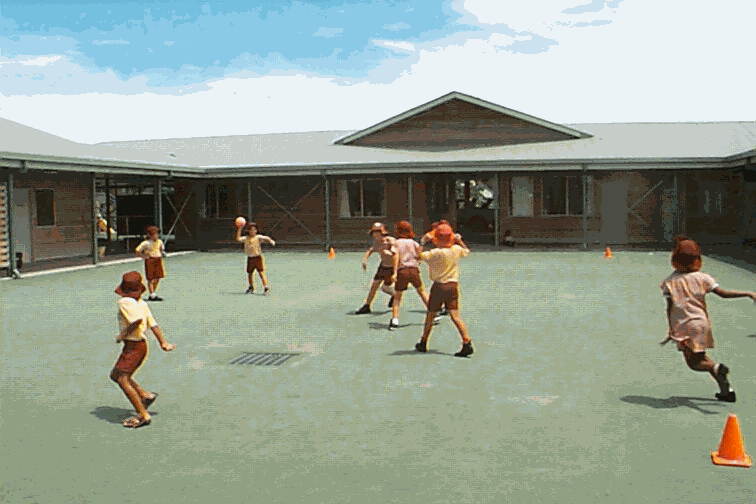
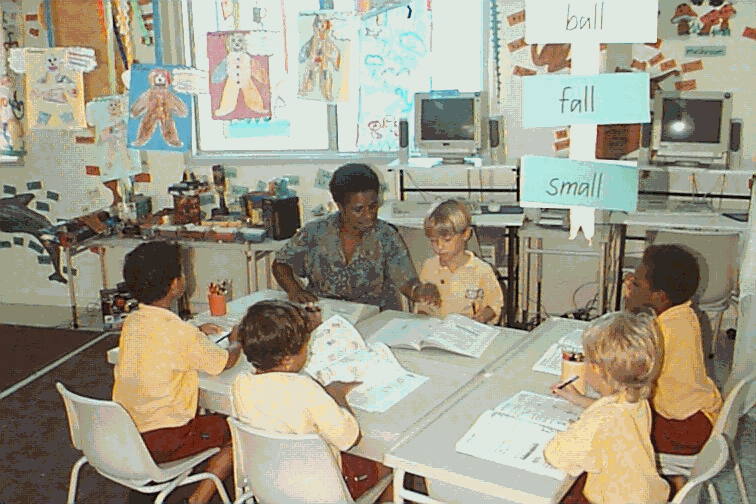
The school is a low set building centred around a court yard which is covered with artificial grass. The school was constructed by Lihir Management Company at a cost of K1.3 million. There are 4 large classrooms, a library, computer room, office, staffroom and canteen, all fully air-conditioned. Enrolments steadily climbed over the first 18 months with the completion of the Lihir Management Company and Government accommodation. They have fluctuated, but stayed around the 70 students mark since then.
Late in 1996, the contract for the management of the school was taken up by the International Education Agency of Papua New Guinea (IEA). The International
School system in Papua New Guinea operates independently from the country’s Government School system. Each International School operates as a non-profit organisation, under the auspices of a parent company, the International Education Agency (IEA). The IEA is a non-government body, which is responsible to the Department of Education through a government body, the National Education Board.

MISSION STATEMENT
The mission of Lihir International School, is to provide
a high quality international education in a multicultural and caring environment,
that fosters the intellectual, physical, social and emotional development
of the child through the co-operative effort of the school, home and general
community.
SCHOOL PHILOSOPHY
Self and Others
The community of Lihir International School value
The community of Lihir International School value
The community of Lihir International School value
beliefs and values of other cultural groups and take advantage of the learning opportunities provided by the fascinating and diverse culture at Papua New Guinea".
GOVERNANCE
THE BOARD OF GOVERNORS
The School’s Board of Governors is made up of parent representatives, the principal, a teacher’s representative and an LMC representative. The governors are the management body of the school and work closely with the principal who is responsible for the daily running of the school. The elected members of the School Board of Governors generally meet twice per term. Extra meeting are also convened by the chairman when necessary.
The Annual General Meeting is held during March each year. Copies of the constitution of the School Board of Governors may be viewed at the school office.
The 2000 School Board is:
Mr Colin Vale - Chairman
Mrs. Susan Hohnke - Secretary
Mr Rod Williams - Board Member
Mr Brian Archer - Board Member
Mr John Kopana - Board Member
Mr Felix Holi - Board member
Mr Gabriel Kondiak - Board Member
Ms Pauline Rosenblum - Principal
Ms Louise Hunt - Teachers’ Representative
EDUCATIONAL ORGANISATION - 2001
Lihir International School is operated by the International Education Agency (IEA) of Papua New Guinea and follows the IEA Core Curriculum and Administration Procedures.
The Principal directs the educational operation of the school, involving the staff and School Board of Governors in discussions before making major policy decisions. Staff meeting are held every Monday and school Board of Governor meetings are twice a term.
The school, in 2001, will be organised into 4 teaching units.
Volunteer parents are encouraged to assist teachers at each year level. Swimming and reading are areas where help is particularly welcome.
Students are placed in grade levels in accordance with the following criteria:-
Preschool
In 2001 the Kindergarten / Preschool will consist of a split program.
If there are vacancies in the kindergarten group, it may be possible for children who turn 3 later in the year to attend kindergarten after they have had their third birthday. This is entirely at the discretion of the kindergarten teacher and principal. Students will then stay at preschool for the following two years before entering prep.
CURRICULUM
The International Education Agency of Papua New Guinea, through its statement and philosophy, has affirmed its intention to ensure that its schools provide a high quality of education equal to that found in developed countries throughout the world.
Towards this goal the IEA declares a mandatory curriculum framework for IEA schools.
The curriculum is divided up into eight Key Learning Areas:
In order to achieve the overall goals of the IEA, Outcomes Based Education (OBE) has been adopted.
Outcomes Based Education, in one form or another, has been introduced in the major English speaking countries with which the IEA is concerned. In Australia new curriculum documents have been developed over the past few years which identify specific learning outcomes divided into levels of achievement.
OBE allows for a clear statement of the curriculum, presented in a way that ensures that students move along a path to achieve the level of learning they are capable of in a particular period. Its underlying philosophy is that all children can learn, and it challenges schools to reconsider the ways in which they present education so that all children are given the time to learn.
OBE is divided into three main areas:
SCHOOL HOURS
Primary
Prep-grade 6 - 8.30 am START
Morning Tea - 10.30 am to 11am
Lunch Time - 12.45 pm to 1.30 pm
School finishes - 2.45 pm
Preschool
Kindergarten / Preschool commences - 8:30am
Kindergarten / Preschool finishes - 1.30pm
TERM DATES 2001
Term 1: Monday 5th February > Thursday 12th April
Term 2: Monday 23rd April > Thursday 29th June
Term 3: Tuesday 24th July ->Friday 28th September
Term 4: Monday 8th October >Wednesday 12th December
Note:
- Independence Day – Monday 17th September
SCHOOL FEE POLICY
Parents, your signature on the enrolment form indicates that you have read and accepted this school fee policy. We are funded almost completely by school fees. You will appreciate the need to adhere strictly to this policy to enable us to meet our finiancial and budgeting commitments.
SCHOOL FEES 2001
Preschool children (3 days per week) - K3,000 full year
Non-company sponsored primary students
- K5,500 full year
STUDENT BEHAVIOUR
Shared Responsibility
At Lihir International School, we aim to provide a supportive school environment where behaviour of all members of the school community is socially responsible. The school’s Behaviour Management Plan teaches students that there are standards of behaviour throughout the school and that they are expected to behave under the supervision of adults, not only their classroom teachers. We aim for consistency between the values espoused in the home and those we are encouraging within the environment of the school. Behaviour management is more effective when there is
correlation between the behaviour seen
as acceptable in the home and those which are seen as acceptable within
the school environment.
Classroom
Classroom behaviour management plans are devised after negotiations between the classroom teacher and the students. After the plan in formulated a letter is sent home to parents explaining the rules and the positive and negative consequences. This letter includes a tear off section which invites parents to comment on the plan.
Playground
A School Behaviour Management Plan governs students behaviour in the common areas of the school - the playground the lunch areas, or wherever the students are present without their classroom teacher. Participation by the school community in developing an agreed school wide Behaviour Management Plan, increases shared understanding of and commitment to implementing the plan.
This plan has been developed throughout 1998 in cooperation with the staff and school board. The "Managing Behaviour in a Supportive School Environment" document was implemented at the start of the 1999 school year.
GENERAL INFORMATION
Absenteeism/ Mid Term Holidays
It would benefit your child if you could ensure regular attendance, as each day’s work is built upon the previous day’s work. However, a child when ill does not do his/her best work and should be kept home to receive the care that will help him/her recover as quickly as possible.
When children are absent from school, we request that a telephone message (contact 986 4233). Should this be impractical, a written note could be sent when the child returns to school.
The staff are fully aware that a number of families need to take holidays or annual leave through the school terms. We encourage as many parents as possible to try and coincide their holidays with the breaks in the school terms as this will cause minimal disruption to your child’s learning. It is very difficult for a student to grasp new concepts if the continuity of learning is broken.
If families are leaving the island mid term please inform your classroom teachers as early as possible.
Accidents, Illness
Whilst the care and protection of your child at school is important, sometimes accidents may still occur. In the case of an accident or illness, only basic first aid can be administered. Parents will be contacted as soon as possible and advised of the circumstances, usually with the recommendation that the child be collected and taken home, or dropped home in the school vehicle. If there is a serious accident, the ambulance or hospital will be called. Costs associated with the above will be borne by the parents concerned.
Admission to Prep (first official year of school)
Children who have turned 5 by the 1st of April, (of that school year) may be enrolled in Prep.
Parents should consider the general maturity of their children before enrolling them in Prep. Children may be chronologically eligible but not socially, emotionally or intellectually mature enough to commence formal schooling.
Sighting of proof of age will be required for all children being enrolled in Prep for the first time. Birth Certificate, Passport, or a statutory declaration witnessed by a Justice of the Peace will be acceptable.
Assessment and Reporting
Written reports on pupils progress are made at the end of each Semester ie. at the end of June and the beginning of December.
Parents are invited to discuss with teachers, any concerns they have, at a mutually convenient time.
Appointments
Parents seeking interviews with the Principal or teaching staff, should contact the Administrative Officer for an appointment. This practice allows us to plan a time suitable to both parties. Teaching staff should not be approached by parents during teaching sessions, unless the matter is of an urgent nature, as parents can understand the importance of uninterrupted class lessons.
Bicycles
Parents of children riding bicycles to school are asked to encourage their children to wear bicycle helmets (correctly) and to observe the rules of road safety. Bicycles are not to be ridden into the school grounds at any time.
Books and Stationery
All books and stationery are provided by the school. These items are incorporated within school fees. At the end of a school year all non consumables eg. scissors will be collected and reissued the following year. Students who loose or damage books and stationery items will have to replace them at their own expense.
Dogs not permitted in school grounds
For the health and safety of all, parents
are asked not to bring their dogs to school when collecting or dropping
off children.
Emergency Evacuation Drill
Procedures have been adopted which promote speedy evacuations of the buildings in cases of emergency. Practise in these procedures occurs regularly. Continuous rings of the bell is the warning.
Excursions
From time to time, classes will be involved in excursions, which enhance the learning activities of the classroom.
No student is permitted to participate without the written consent of parents. Detailed information is forwarded home at appropriate times throughout the year.
Homework
It is a policy of our school to set homework on some or every day of the school week. Homework is either a reinforcement of classroom learning activities or some form of project work. Your child’s teacher will discuss homework expectations at their Parent Information Session at the beginning of the school year. All children are encouraged to read for at least 10 minutes every night.
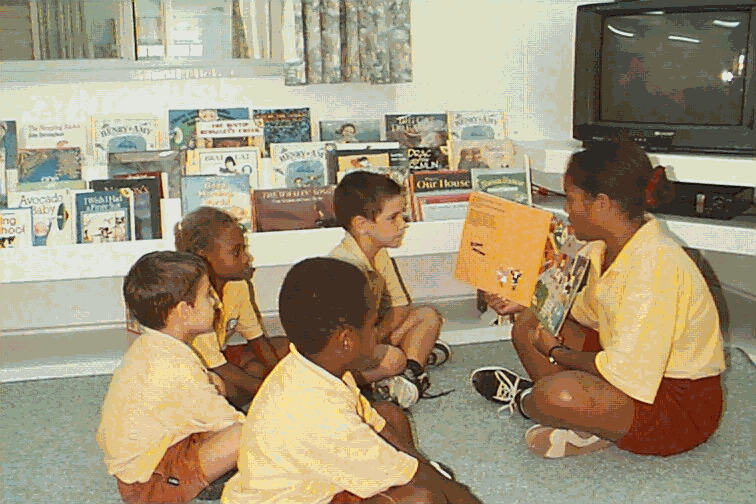
Library
The library provides a relaxed, non threatening
environment where students, staff and community members can read, borrow
resources or study quietly. A computerised borrowing system will be in
operation in early 1999 whereby children may borrow or exchange resources
at both lunch breaks as well as before and after school.
Lost Property
Please ensure that all children’s property is marked clearly with the child’s name. It is not a good idea to mark names on tags as they are easily ripped off. A lost property box is keep in the office.
Medication
Only medication prescribed by a medial practitioner may be adminisisted at the school. An authorised adult may give oral medication if requested in writing by a parent/guardian. The instructions for dosage and administration times must be written on the container by the pharmacist or doctor.
If your child requires medication, a form has to be completed at the office before the medication can be administered.
Newsletter
A weekly newsletter, "It’s Thursday", is published each Thursday and distributed to all townsite residents. The newsletter is a major vehicle whereby information from the
school and associated committees is disseminated to parents and community members. You are urged to read all newsletters carefully and note any items that may be of interest to you. The newsletter is also a tool for community members to claim dates or advertise up coming events. Contact our administrative assistant for more information.
Parents Helpers in the Classroom
Teachers require helpers from time to time and usually request this help at the beginning of the year or term. It is necessary for all volunteers to sign the Volunteer Register held at the school office, before performing any tasks.
P + W Association
The Parents and Wantoks association was established in late 1997. This committee oversees the major fundraising events, school uniforms, canteen and social functions. The president reports to the school board on a monthly basis. Meeting times are advertised in the weekly newsletter and generally occur on the first Monday of each month.
Sick Students
If a child becomes ill at school, parents/guardians or other contact persons are informed and requested to pick up the child. If no contact can be made, children are kept in the sick room under observation. PLEASE DO NOT SEND SICK CHILDREN TO SCHOOL.
Appendix 1 in the Prospectus is a copy of the General Diseases Policy. This includes recommended time for exclusion from school.
Smoking
Smoking is prohibited within school buildings. Please observe this regulations.
Swimming
For one term sometime throughout the year all students participate in formal swimming lessons on a weekly basis. Our Friday afternoon sports program also incorporates swimming from time to time. Parents will be informed of swimming times via the newsletter.
Sun Safe Policy
The school has a policy of "No Hat, No Play". A school hat is available from the uniform shop convenor and must be worn at all times in the sun.
A supply of suncream is available at the school for the children to apply, should they require it. If children are allergic to the particular type we have available, they are most welcome to bring their own.
Canteen/Tuckshop
The canteen began operation during term one 1998 and is open every Friday. Students order their lunch via a paper bag system. Canteen price lists are reviewed each term in line with price rises at the supermarket. The canteen is run by parent helpers. The menu caters for the need of the students and the limited range of food available on the island.
Undesirable items at school
Parents should ensure that their children do not bring to school undesirable items such as pen knives, toy guns, valuable toys and excessive amounts of jewellery. Dangerous items will be confiscated immediately.
UNIFORM INFORMATION
The school uniform consists of the Sports Uniform and Dress Uniform.
Dress uniform
Girls - Dress, school hat, black leather shoes or black sandshoe and black or white socks.
Or
Boys dress shirt, girls maroon shorts, school hat, black leather shoe
or black sandshoe and black or white socks.
Boys - Boys dress shirt, maroon shorts (ruggers), school hat, black leather
shoes or black sandshoe and black or white socks.
Sports Uniform
Girls - Yellow polo shirt, girls maroon shorts, school hat, sandshoes and
black or white socks.
Boys - Yellow polo shirt, maroon shorts (ruggers), school hat, sandshoes
and black or white socks.
Dress Uniforms are to be worn on Monday’s, Tuesday’s and Thursday’s and Sports Uniforms on Wednesday’s and Friday’s. Uniforms are compulsory and students are encouraged to take pride in themselves and their uniform. Shirts, for boys and girls are to be tucked in at all times and shoes kept neat and tidy. Excessive amounts of jewellery are not part of the school uniform.
Uniforms can be purchased in Australia or on Lihir Island. To purchase uniforms in Australia see appendix 2.
If you have any questions regarding uniforms please do not hesitate to contact the school or Mrs Kylie Antal (675) 986 4635.