Habitat
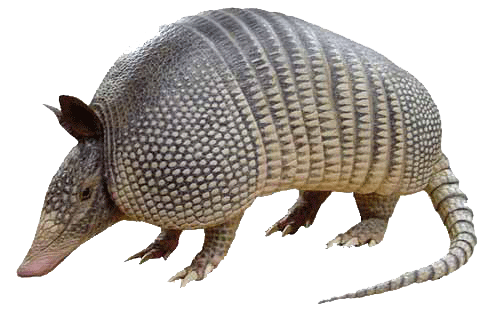
The Armadillos are natives to South and Central America and have been introduced several times to Florida during the 20th century, possibly earlier. They eat many insects that are dangerous to crops, however their tendency to dig for insect makes them a pest in grassy areas. They are a grayish brown color. They are also around as big as a cat, but they have very short legs. Nine-Banded armadillos usually have nine bands on their shell-like armor, but they could have from 8 to 11.
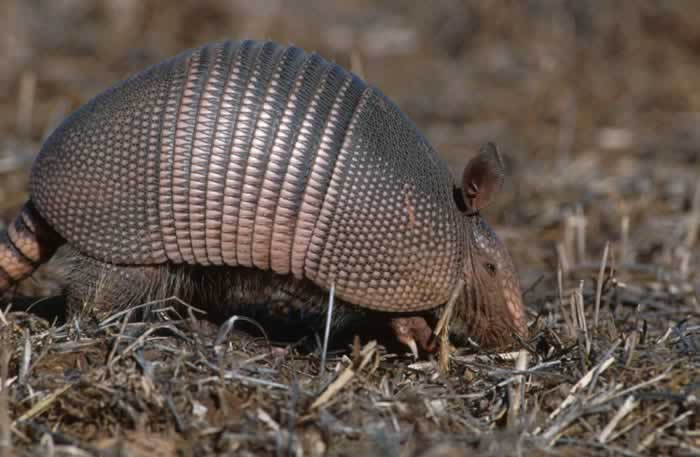
Armadillos are usually found in forest marshy areas. But they can live anywhere where it is warm enough and as long as there are enough bugs to eat. That could be our own backyard. They have small eyes and don't have color vision. They have long sharp claws, which they use for digging, and can be dangerous. They have a nearly perfect sense of smell, which they use to hunt for insects.

The major threats to armadillos are: Rivers, even though armadillos are faily good swimmers, the Rio Grande is a formidable barrier. Large rivers like the Mississippi continue to stop or delay the expansion in some areas of the U.S. It's not likely that many animals will attempt to cross such large rivers. In parts of South and Central America armadillos are a good food source. Some predators such as wolves and panthers also contribute to the delay in distribution. Last but not least, lack of a suitable habitat, nine-banded armadillos are usually found in warm brushy forest-like areas, but due to burnoffs, both natural fires and the ones started by people, they have been living in prarie areas.
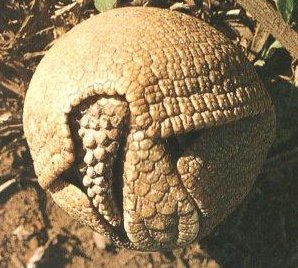
The nine-bands on an armadillo's shell are made of thick skin which make it very flexible and able to bend and roll up into a ball. Even though they have short legs they can run relatively quick, and with they long sharp claws they can dig a whole rather fast. They have teeth but they seldom bite, but their claws could be dangerous when we pick them up.
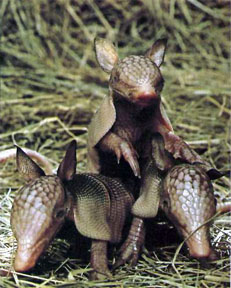
Although breeding happens in July, the embryo stays in a sleep mode until November. Four little babies are born four months after that. All four of them the same sex, and they are quadruplets, all four of them look the same, and they're all developed in the sme egg. Something interesting is that they even share the same placenta inside the womb.
Sources