|
|
|
|
CONCLUSION |
|
|
|
|
CONCLUSION |
|
|
|
|
In this project I have sought to answer the question ‘How did L.S. Lowry represent his environment?’ To do this, I observed many of Lowry’s works and researched information in books, on websites and on television programmes, as well as visiting art galleries. I have also studied Lowry’s influences, favoured mediums, colours and styles, before putting them into practice myself in recreations of some of Lowry’s works. However, I have not only studied Lowry, but also
a variety of other artists, including Monet and Delacroix, instigators
of the Impressionist movement in France. I have also taken a close look
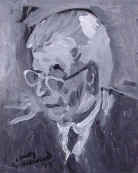
at Lawrence Isherwood, a one-time friend of Lowry and an artist of
similar background and style to him. |
|
|
LS Lowry, by Lawrence Isherwood |
|
|
To
help illustrate my project, I have produced a series of small sketches
in various mediums, including ballpoint pen, watercolour pencils and
Lowry’s most favoured medium, pencil on paper. I have also produced
some larger-scale works in order to help analyse some of Lowry’s more
famous works, including an A3 pastel on sugar paper representation of
‘St Simon’s Church, Peel Park’, and an acrylic on paper
representation of ‘Going to the Match’. I
feel that most Lowry outdoor scenes have a similar theme – one of
poverty, darkness and gloom – probably due to the environment in which
Lowry grew up. To help him create this atmosphere, Lowry used a limited
palette of five colours which, when placed alongside each other or
mixed, create a dull mood. Lowry also never painted the sky blue, but
usually a grey, a pale red colour or sometime just plain white. This was
probably due to the fact that industrial skylines were usually filled
with smoke from large chimney stacks. |
|
|
Though
each Lowry piece does deal with a similar theme of poverty, they all
have their own atmosphere – be it calm, hectic, happy or sad. It is
this ability to capture an ambience in his own slightly impressionistic
style that has attracted many people to Lowry’s works. Lowry
also had a geometric style of rendering perspective and buildings. He
always used a straight piece of wood as a ruler for drawing straight
lines, and painted buildings farther in the background a paler, lighter
colour to create a sense of perspective. Lowry’s scenes are always filled with people. Although he attracted many critics due to his ‘matchstalk’ representations of living beings, it must have taken Lowry a long time to insert the tens, even hundreds of people into some of his drawings, each captured in a millisecond of a separate action. |
|
|
So, after both visually and textually studying Lowry's works, I feel that I have improved my artistic skills as well as my appreciation of his works. |
|