| The Love Token began as a single coin, smoothed or sanded down on one side, or sometimes on both sides. It was then engraved with initials, names, sayings, quotations, special dates or something that was to be remembered. There are two basic requirements for a love token: |
| First: It must be a coin from circulation. Second: The engraving must be done by hand. |
| "JSG" intertwined on a <1874> dime. Note that it has a hole at the top and no border around the edge. Three initials are the most common love token engraving. |
 |
| Love Tokens were made on practically all denominations of coins. During the late 1800's a man earned about 10 cents a day. As a result, most love tokens on U.S. coins were engraved on smaller denomination coins, particularly the Liberty Seated Dime. These silver coins were softer, thus easier to engrave, than cents and nickels. Gold coins were also used but not as frequently, considering the value that a love token on a $1.00 gold coin represented. |
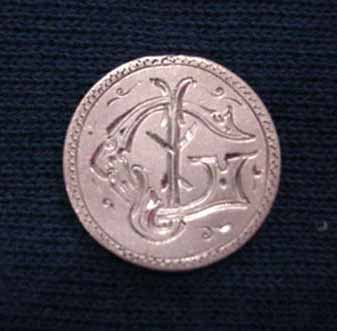 |
| Here are the letters "JG" or "GJ" depending on how you want to read them. It was engraved on the reverse of an 1857 dime. . Two initials are a little harder to find. This one also has a border engraved around the edge. The more elaborate engraving and the border would make more this love token more desirable than the plain one (JSG) above. |
| A young man desiring to get married in 1876 may have taken a dime from his pocket and engraved, or had an engraver engrave, his last initial (family name) and his girlfriends first initial on it. If she accepted and wore it they were consider engaged. Mothers during the late 1800's often had bracelets made with the names or initials of their children on them. The quality of each piece was dependent upon the capabilities of the engraver. There apparently was an abundance of skilled engravers available to make them. Sid Gale bought the "JG" love token above for his wife Judy. |
 |
| Love Token Society |