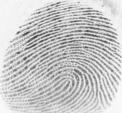
Fingerprinting is used in the law enforcement agencies and the courtroom to determine whether a suspect can be linked to a crime scene. Fingerprints are used to identify people whether or not they are a suspect, victim, or witness. Fingerprints have also been used to trace unidentifiable persons to other crime scences resulting in solved cases. They give forensic scientists, psychologists, psychistrists, attorneys, judges, and law enforcement agencies leads to the suspects sex, size, occupation, and other meaningful background.
The process of fingerprinting is very detailed but one must look at its background. Dactylography is the science of analyzing of fingerprints. William Herschel, in 1858, was a British magistrate working in Bengal, India. He concluded that no two fingerprints were alike and never changed. It was common for the Bengalis to use one fingerprint as a signature. Herschel was suspicious of a Bengali so he had all he fingers printed which would help in a contract dispute. In 1888, Juan Vucetich, Buenos Aries police officer, made it common to print all fingers. Francis Galton calculated mathematical equations to provide scientific basis for legal admissibility in the courtroom around 1890. By 1891, Edward Henry, took Herschel's idea and expanded it into an idea of classification. The Bertillion system was created by Alphonse Bertillion. This system required a measurement of the middle finger among other things and was later abandoned. The Henry-Galton system is what became the FBI-NCIC (National Criminal Information Center).The first fingerprint to be used in a criminal trial was in 1901. The system was also used to register aliens and ethnic groups.
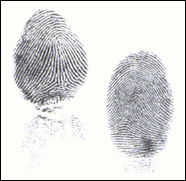
There are different types of fingerprints. The first is plastic which is left behind in a soft material. The next is latent which is invisible and must be developed before it can be processed. And the last is visible. Visible fingerprints can be caused by blood, dirt, ink, or grease. The fingerprint is photographed from regular exposure, overexposure, and underexposure to give every angle of the print to catch anything that might give a lead to the suspect.
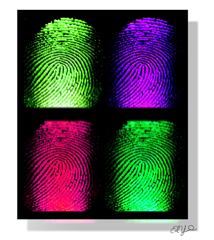
There are also different methods of fingerprinting which include dusting, fluroscent powder, magnetic powder, brushing, lifting, iodine fuming, ninhydrin spray, silver nitrate, superglue fuming, and a laser. Dusting, brushing, and lifting are some of the older methods. The two that I found interesting were iodine fuming and ninydrin spray. Iodine fuming works well on paper and unfinished wood. You can also tell if the prints are fresh or not. The one I thought was interesting was that it does not leave any traces of trying to search for prints. This technique involves placing a few iodine crystals in a fuming pipe, heating the pipe, and blowing fumes through the mouthpiece onto the surface. The iodine fumes are purple in color and prints are yellowish brown. This technique disappears fast so it must be photographed quickly. And ninhydrin spray is used for all surfaces even books and wall paper. It will develop prints over 30 years old! It produces a blue violet color on print. The area around the print may stay damp so keep it well ventilated.
I loved reading about fingerprinting! Everything that I read was helpful. I am going into forensic psychology and criminology so this helped me understand the background and some of the methods/science behind it all. I also understand that finderprinting is a vital key to my career because it helps solve may cases, saves lives, and gives leads to many other cases that can be solved!
Check out this link:
History of Fingerprinting
history.htm
This website offers history about fingerprinting all the way back to prehistoric times until the present!!!