
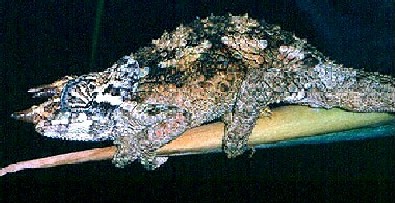
 Family: Chamaeleonidae
Common Name: Werner's Chameleon
Scientific Name: Trioceros werneri
Food: Insects
Distribution: Tanzania (Ufipa, Uluguru Mts., Uzungwe Mts.)
Habitat:
Color Discription: brown with cream markings. However, the interstitial skin is a red-pink, often giving the animal a decidedly reddish tint.
Physical Discription: Males have 2 preocular and 1 rostral horn. Females have only 1 large rostral horn or no horns at all. This difference becomes apparent at approximately 4 months of age. Very similar to fuelleborni, werneri. The fuelleborni can be distinguished partly on the basis of the occipital lobes. The occipital lobes of fuelleborni have a maximum of 15 large, plate-like scales covering each lobe. These are intermingled with smaller scales. The werneri has up 30 such plate-like scales, giving the impression that the lobes are larger and more elongated than in fuelleborni. Thus, the lobe scales on C. werneri appear to be finer than those on C. fuelleborni. Male werneri have 3 annulated horns (1 rostral and 2 preocular). Females have a 1 large annulated rostral horn. The parietal crest is anteriorly forked and the large occipital lobes are completely fused together. There is a well developed dorsal crest which has a scalloped appearance (compared to the spiked appearance of the dorsal crest in fuelleborni). Small gular and ventral crests are present. Squamation is roughly heterogeneous.
Size: 12"
Temperatures:
Breeding/Reproduction: 9 - 30 live young are born and only one clutch/year seems to be the rule. Sexual maturity occurs at 6 months of age.
Cage Setup:
Water:
Special Needs:
Special Note: Little is known about their husbandry and for this reason they should be kept only by those with extensive experience in chameleon husbandry.