
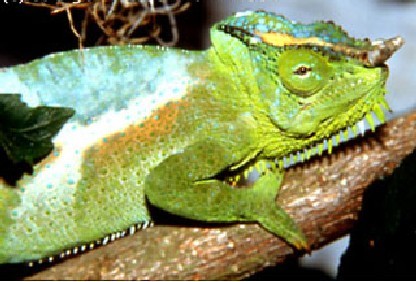
 Family: Chamaeleonidae
Common Name: Four-Horned Chameleon
Scientific Name: Trioceros quadricornis
Food: Small moths and butterflies seem to be the quads' food, but Zoophobas worms, woodlice and house flies are also usually consumed. Wax moth larvae may also be offered but wax-worms are very high in fat and should be offered only sparingly. The quantity of food needed varies by individual but particularly with female chameleons. DO NOT OVERFEED as this can lead to dangerously large clutches of eggs. Crickets make up the bulk of most captive chameleon's diet. It's important that you feed your crickets a good diet as it ultimately becomes the chameleon's food as well. Chopped carrots and mixed leafy vegetables as well as pototoes as the main diet (Pototes will be the main water source). Don't supply additional water, let the vegetables be the crickets water source. This will result in less smelly cricket containers and longer-lived crickets. Quads are sensitive to excessive vitamin A so do not use any commercial vitamin supplements but rely on using well-fed feeder insects instead.
Distribution: Cameroon (Manegouba Mts., Mt. Kupe, Bamboutos Mts., Mt. Lefo, Mt. Oku), Nigeria (Obudu Plateau).
Habitat: Trees, and bushes
Color Discription: bright green with brown, yellow, black, and/or red markings. Captive born Quads are sometimes blue or blue-green, but this coloration is rare. From neon to dark forest green to even teal and powder blue or mixtures. The typical display pattern is generally bright to medium green with wave-like washes of dilute bluish white or parchment along the upper sides. The casque usually sports distinct robin's egg blue or burnt orange spotting surrounding a tan to burnt orange oblong central core. Claws may be a rich red color.
Physical Discription: high casque but lacks occipital lobes. Despite its name, males actually exhibit 3 pairs of small rostral horns but the posterior pair may be undeveloped. A row of conical scales forms a ventral crest, most pronounced in the gular region and becoming progressively smaller toward the cloaca. On the back and proximal 1/3 of the tail there is a sail-fin. It is for this reason that some pet shops may mis-label quadricornis as a "sail-fin chameleon" thereby confusing them with C. montium. While males sport horns and a high tail fin, some females occasionally develop rudimentary horn buds and possess at least partial tail fins. Body scalation is heterogeneous.
Size: 10" - 15", with females running 2" - 3" shorter.
Temperatures/Humidity: The area of Cameroon where quadricornis originates experiences 400" of rain a year. The ideal daytime temperatures are 72ºF - 76ºF accompanied by a relative humidity of 75% - 100%. If you cannot provide such high humidity then it is very important to provide plenty of drinking water. As with most chameleons, they also prefer a distinct 5ºF - 10ºF night time temperature drop accompanied by an increase in the relative humidity. Thus the usual recommendation for chameleons, i.e., no nightlights or under-cage heating pads, is particularly important for this species. They tolerate regular lows into the high 50'sºF with no apparent difficulty. Consistent lows (in the low 50's F or less) or consistent highs (above 85º F) is risky and should be avoided.
Breeding/Reproduction: In captivity, females will lay between 8 - 15 eggs about 3 times a year. If you house your Quads separately, place the female in the male's cage and observe her reaction to the male’s advances. If the female is not receptive, separate the pair and try again in about a week. If they do mate, return the female to her own enclosure. If the mating was successful, she will show gravid colors about 2 days after copulation. Eggs should be incubated at 72° - 73° F and hatch in approximately 18 weeks.
Cage Setup: Most chameleons are solitary by nature and must be housed individually. Though they can sometimes live peacefully in groups, females will probably live longer and have more clutches, if kept singly. Use Screen cage. This ensures good ventilation, and the chameleon can climb if necessary (though watch their grip as they can hurt their feet if the mesh is sharp edged or of unsuitable size). An added benefit of a screen cage is that you can place all the lights and drip and misting systems on the outside and you can easily mist the plant leaves without opening the cage.
Water: The cage and its plants should be heavily misted several times daily, and more often in hot weather. This satisfies all drinking water needs and maintains a consistent high humidity. As the amount of water entering these cages exceeds evaporation rates, these cages should also be fitted with drains to prevent standing water from accumulating and becoming a health concern. Hand misting also works quite well and is a more practical option for most chameleon owners. The floor substrate is a matter of choice but capillary matting (from your local garden center) works well and is easily removed, rinsed and replaced regularly. If you hand spray it is recommend putting a simple drip system (available at most larger pet shops or you can just use a plastic or paper cup with a pinhole in the bottom) in or on top of the cage. If you arrange the water to drip onto and run over the leaves of a plant the water flow will attract their attention and they will drink when they are thirsty. They may not drink every time or they may not drink when you are looking but always provide this drinking water at least 1 - 2 times a day in addition to the regular mistings.
Special Needs: UVB-producing fluorescent tubes such as Repti-Sun 510 R (Zoo-Med) are probably the best choice for the primary lighting. Quads are not much for basking but if ill or stressed, they will sometimes seek out a sunlit spot. Thus, a small wattage incandescant bulb is all that is required for basking. The UV tube is a poor substitute for natural unfiltered sunlight so if you have the opportunity to place your chameleon cage outside on sunny days then this will be greatly benefitial to the chameleons health. In hot weather be sure that they have sufficient shade available to them in case they overheat. Sunlight coming through a window, is of little benefit because normal glass filters out the UV-B which they require.
Special Note: Males will grow 2 - 6 horns on the tip of their noses. Though popular, Quads are not recommended for beginners.
The most important factors in successfully maintaining quadricornis in captivity involve meeting their water and humidity requirements.
Dehydration is one of the most common problems and usually indicates that your housing or hydration practices are inadequate and immediate steps should be taken to rectify the situation.
If the eyes appear slightly sunken, place the individual on a large potted plant and place it in the shower.
Using a gentle, cool mist approx. 65ºF allow the the individual to be "rained on" for at least an hour.
If you do not have a fine mist setting on your shower head you can bounce the spray off of the shower wall to create a finer mist.
Sunken eyes may also indicate other problems and if they persist more than an hour or two after a shower, a vet's attention may be needed.
Don't let an animal go more than a day or two with sunken eyes before contacting a vet with experience working with reptiles.