
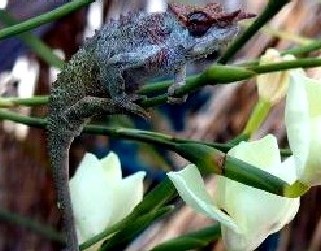
 Family: Chamaeleonidae
Common Name: Pfeffer's Chameleon
Scientific Name: Trioceros pfefferi
Food: flies and worms. Hatchlings willingly eat fruit flies, pinhead crickets, or tiny wax worms.
Distribution: Cameroon (Mt. Kupe, Mt. Manegouba)
Habitat:
Color Discription: The top of head is orange or orange with light blue to violet scales. The temporal, lateral, orbital, and canthal crests and rostral are orange. Body coloration can include red, blue, green, yellow, brown and orange and varies between individuals. A brownish-orange to faded black horizontal eye stripe is present in both sexes. Females lack the vivid coloration displayed by the male.
Physical Discription: There is a well developed casque. 25 plate-like scales adorn the body on each side. There is a prominent gular crest with 10 - 13 spiky conical scales spaced far apart on both sexes. The rostral process is well developed, rising diagonally upwards over the nostrils (bridging two short diverging horns) and are concave and somewhat flattened vertically. 0scalation is heterogeneous in both sexes. Tails are slightly longer than bodies. Females are slightly smaller than males. The dorsal crest is less developed in females. Rostral are well developed on males, but appear on females as a small ridge, fused at the base and separated apart in front.
Size: 6" - 8", females are slightly smaller.
Temperatures/Humidity: 8OºF days with a 20ºF drop at night. Humidity is ideal at 80%.
Breeding/Reproduction: Little is known about their reproduction. Breeding can occur at 6 months. 5 - 11 eggs are laid per clutch. Number of clutches per year is unknown. Gestation is 2 - 3 months. 6 clutches of eggs incubated at 68ºF - 72ºF hatched at approximately 17 weeks, with one clutch hatching at 18 weeks and one at 19 weeks. Sexual maturity occurs at 6 months.
Cage Setup:
Water: Drip system Only. They dont like being sprayed or "rained on".
Special Needs:
Special Note: