
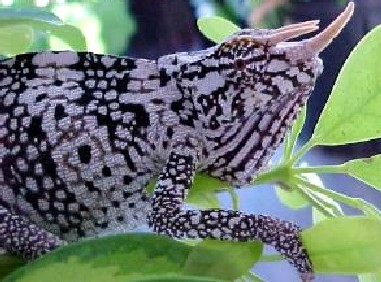
 Family: Chamaeleonidae
Common Name: Owen's Chameleon
Scientific Name: Trioceros oweni
Food: Insects
Distribution: Equatorial Guinea (Fernando Po, Mbini), Angola, Cameroon, W/C/N Democratic Republic of the Congo (Zaire), Gabon, Nigeria, Central African Republic
Habitat:
Color Discription: Green, black, brown, red, orange, yellow, and white with a basic color pattern. 3 broad transverse stripes, mostly light, adorn the sides and stripes also appear on the tail. Dark cross stripes on the legs and bodies are either uniformly colored or have light dots or markings. From the center of the eye, stretching over the jaws and under the mouth and continuing caudally, are dark narrow stripes. The male's head can be pink with bright red dots. Gravid females can be dark with bright orange or yellow dots.
Physical Discription: Three smooth, slightly annulated horns are present only in the males. The casque has small occipital lobes and is very low. There are large scales on the head crests and parts of the body. Scalation is smooth. There is no dorsal crest but there are two rows of standard scales along the back. Females are smaller than males and do not have horns.
Size: 12" - 15"
Temperatures/Humidity: Daytime temperatures should be approximately 75ºF with a basking area of around 85ºF, and as high as 90F with no more than a 20 degree drop at night. 100% humidity is required as well as constant daytime hydration by humidifier,
Breeding/Reproduction: Little is known about the reproduction of this species. One female bred and gestation was 3x months; no further eggs developed and she was not gravid at the time of her death 6 months later. Duration of incubation was between 8 - 9 months with temperatures of between 65ºF - 72ºF. Hatching took place within 4 days with the majority of the eggs hatching on day 3.
Cage Setup: Should be maintained, with cages densely planted and well lit.
Water: drip system, and misting is required.
Special Needs: Humidifier, UVB bulbs,
Special Note: oweni is extremely shy, and giving them privacy should be a foremost consideration.
They do very poorly in captivity and for this reason should be kept only by the expert chameleon keeper.