
 Family: Chamaeleonidae
Common Name: Cameroon Sailfin Chameleon
Scientific Name: Trioceros montium
Food: Insects
Distribution: Cameroon (Mamfe District, Maneguba Mts., Mt. Cameroon, Mt. Kupe, Rumpi Hills)
Habitat:
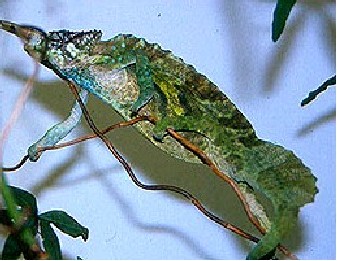
Color Discription: Body shading can vary from neon to dark forest green or blue with gravid females often showing red skin between the green scales. Males in display sport bright blue, lime green and yellow spots along the head and shoulders. Both sexes have large plate-like "disk" scales along the body which vary in color from orange, to pale green, to sky blue. Males often have a yellow stripe with blue edges running diagonally from the middle of the back to the abdomen.
Physical Discription: This species has long rostral horns projecting straight forward along the lower snout, a high, distinctly scalloped dorsal crest, and an even higher sailfin tail. Females possess conical "horn-bud" scales but no horns. Males possess the high scalloped dorsal crest and the high tail fin, as well as the bright "display" colors. Females are smaller in size.
Size: Males grow to 10". Females grow to 8".
Temperatures: 100% humidity is required for this species as well as constant daytime hydration by humidifier, drip, and/or spray/mist. Daytime temperatures should be approximately 75ºF with a basking area of around 85ºF, and as high as 90ºF, and no more than a 20 degree drop at night.
Breeding/Reproduction: Reproduction in captivity may be difficult as the males are sometimes reluctant to breed. By keeping the female physically and visually separate and then introducing her when she is receptive, and by cooling the cage and increasing hydration/humidity, the male be encouraged to court and copulate. Once gravid, the female assumes darker colors; gestation is 2 - 3 months. Females should be supplied with a proper laying site, as they are not particular about where they lay 5-25 eggs, and will lay them anywhere. 2 - 3 clutches may be laid in a single year. Incubation is approximately 21 weeks. Incubation temperatures have been reported as successful in a wide range, from 60ºF to 90ºF. The most commonly recommended temperature is around 75ºF with a few degrees drop at night. Babies often hatch "en mass' and with eager appetites. Sexual maturity is reached at approximately 6 months.
Cage Setup:
Water:
Special Needs:
Special Note: This species can be very shy, and if approached too quickly or closely, have a tendency to "drop and run", blackening, turning flips or hiding in corners on the ground.