
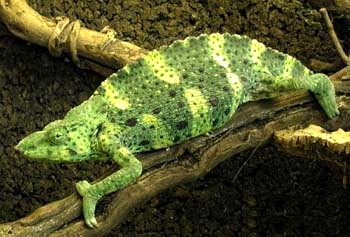
 Family: Chamaeleonidae
Common Name: Meller's Chameleon
Scientific Name: Trioceros melleri
Food: Insects
Distribution: Malawi, N Mozambique, Tanzania
Habitat:
Color Discription: Green with dots and broad vertical bands on the flanks that may be brown, dark green, yellow or even black.
Physical Discription: The head is relatively small compared to the rest of the body and is more elongated compared to others of the genus. A sharp medial ridge is apparent from the eyes to the tip of the snout. The relatively low casque bears greatly enlarged occipital lobes. The body is stout and the tail is relatively short, approximately 1/3 the size of the rest of the body. Ventral and gular crests are undeveloped but a low, scalloped crest extends from just behind the casque through the proximal half of the tail. Scalation is heterogeneous. In addition to being slightly smaller than males, the medial crest anterior to the eyes is smaller in females and the dorsal crest and occipital lobes are less well developed. One of the most notable features is the longitudinal rows of large, granular scales in the gular region. Other enlarged, granular scales are distributed homogeneously on the trunk and limbs.
Size: Males can reach 24" the females are smaller
Temperatures: day-time high temperatures 80º - 85º F although in their natural habitat temperatures may reach the high 80's. A night-time temperature drop into the low 60's is highly desirable.
Breeding/Reproduction: 15 - 70 eggs are laid with an average of 50 but 1 clutch is laid annually. Hatchlings feed well on fruit flies and two week old crickets for the first three weeks of life and then eagerly take house flies and larger crickets.
Cage Setup: 4' x 2 ' x 2' but larger the cage the better. The more space they have the happier they seem to be.
Water: Misting as well as a drip system
Special Needs:
Special Note: Until very recently there has been little information on the captive care of melleri due, in part, to the heavy parasite loads and high death rates of WC specimens.
Several reports suggest, however, that this species needs a great deal of room and does best in a free-ranging set up.
Hydration requirements are thought to be considerable. They have been reported to live for as long as 12 years.