
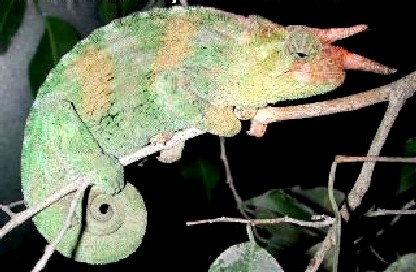
 Family: Chamaeleonidae
Common Name: Johnston's Three-Horned Chameleon
Scientific Name: Trioceros johnstoni
Food: Insects
Distribution: equatorial central Africa (Congo, Burundi, Rwanda, Ruwenzori and Virunga Ranges of Western Uganda, and Eastern Republic of Congo (Zaire).
Habitat: trees at heights of 12' - 18' and in the high, moist savannahs and montane forests
Color Discription: light green with 3 - 5 vertical bands of turquoise and/or yellow. When stressed, the animal turns to a darker brown pattern with lighter colored bands. Females often have yellow markings on the head.
Physical Discription: johnstoni is similar in appearance to jacksonii but with a deeper body. Males of the nominate form (johnstoni johnstoni) have annulated horns; 2 preocular and 1 rostral. Females lack horns. (In the subspecies johnstoni ituriensis both sexes lack horns). The horns may be up to 3 cm in length. There is a flattened casque which lacks occipital lobes and extends only slightly past the back of the skull. Large, lenticular scales adorn the body, throat and limbs. Gular and dorsal crests are absent. In addition to lacking horns, females also have more homogeneous scalation, are slightly smaller and lack the hemipenal bulge.
Size: 12" exceptional specimens reach 15".
Temperatures/Humidity: temperatures range from 55ºF - 85ºF. Average day time temperatures are between 72ºF - 83ºF with night time drops to 50ºF - 60ºF. Day time humidity ranges from 60% in the dry season to 80% in the rainy season. Night time humidity is considerably higher.
Breeding/Reproduction: 8 - 18 eggs (average 14) are typically laid in a single clutch. This number increases with age. Only 1 clutch is usually laid per year but 2 clutches in a year have been observed. Hatching rates of 80 - 100% have been reported. Sexual Maturity occurs at 10 - 12 months. Incubation is in Vermiculite or Perlite at either a permanent 68ºF - 69ºF or preferably at 69ºF day 64ºF night. The recommended incubation temp. of a consistent 72ºF is too high and produces weak hatchlings!!. Hatching time is approximately 120 days. When eggs start to turn dark transfer to 'hatching-tank' with moss etc on the ground and a few thin branches inside. Carefully cover the eggs with a layer of leaves, grass, etc., thus forcing hatchlings to dig themselves out and providing them with opportunity to climb up right away. This technique will also prevent an accident with Vermiculite and it also better mimics the natural surroundings. Never squeeze hatchlings out of eggs!! The hatching process can take up to two days.
Cage Setup: There has been some success maintaining johnstoni in groups of 1 male: 2 - 3 females in a large 3'x 3'x 6' densely planted enclosure. For more standard sized cages, individual housing is strongly recommended. Gravid females must always be kept individually. Males must never be housed in anything other than complete physical and visual isolation from each other.
Water: Misting as well as a drip system.
Special Needs: Lots of simulated rainfall with high humidity is critical, as is a sharp night time temperature drop of 15ºF - 20ºF
Special Note: