
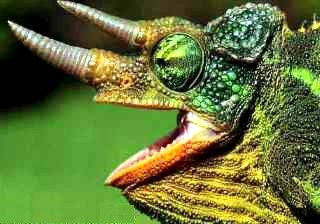
 Family: Chamaeleonidae
Common Name:
Scientific Name: Trioceros jacksonii xantholophus
Food: Insects
Distribution: Kenya, Tanzania and Hawaii
Habitat: Trees and bushes
Color Discription: A striking, lime green chameleon with some have attractive yellow highlights while others sport a bluish tinge to their green coloration. Stress coloration is dark brown, often with a pattern of lighter colored diamonds along the flanks. When cold or under severe stress, then it is a uniform dark brown.
Physical Discription: Males have three prominent horns. 2 originate in front of the eyes (i.e., preocular horns) and the third, rostral horn, from the snout. (The word rostral is derived from the Latin word for "beak.") Females of Trioceros xantholophus have only small, vestigial horns. The difference is quite obvious in adults and a small difference may be seen in juveniles as young as 8-12 weeks. The casque is low, lacks occipital lobes and projects a few millimeters behind the head. A prominent dorsal crest runs the length of the trunk. Gular striations may be apparent, particularly in juvenile animals
Size: 12" - 14"
Temperatures/Humidity: Basking temperatures should be 80º F - 85º F with a night time temperature drop of at least 10º F degrees. Night time temperatures should be into the lower 40º's F range or even lower is well tolerated as long as the animal has the ability to warm up to 70º F or higher during the day. Proper humidity should be between 50% - 75%.
Breeding/Reproduction: Females will give birth to 10 - 30 live young after a gestation of 5 - 10 months. Most chameleons, females of this species are reportedly able to store sperm, thus accounting for their reported ability to deliver several clutches from a single mating. Despite this common wisdom, there are surprisingly few documented cases of this phenomenon in captive specimens. 10 - 30 live young are born in a single clutch. 1 clutch a year seems to be the rule but 2 clutches per year may be possible. As with most live bearers the babies are quite delicate and should be sorted and housed by size frequently to minimize the social stress that may inhibit their growth and contribute to a high infant death. The young will feed eagerly on Drosophila hydeii and later on pinhead crickets. Adequate supplies of productive Drosophila hydeii cultures must be on hand when a clutch is expected. Babies are less tolerant to heat and low humidity than are the adults and slightly lower temperatures are recommended. When misting the babies, care should be taken to direct the spray at the plant leaves rather than the babies themselves as a droplet of water on its snout may soficate the babys. Sexual maturity is reached in 5 - 6 months although most breeders suggest wait on breed a female until she 9 - 12 months old.
Cage Setup: Glass enclosures should be avoided. In addition to making it difficult to provide the proper temperature gradient, glass enclosures do not permit the air flow needed to prevent respiratory infections. Males are highly aggressive toward each other, and must be housed separately. There have been reports of successful group housing of females but only in very large walk-in types of cages. Single housing is highly recommended for all members of this species.
Water: 2 - 3 mistings per day, each lasting a few minutes should be supplemented by a drip system.
Special Needs: An ultrasonic humidifier is useful in maintaining proper humidity and is highly recommended.
Special Note: