
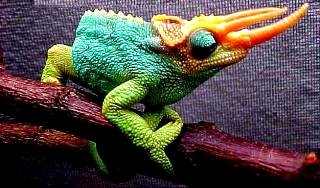
 Family: Chamaeleonidae
Common Name: Dwarf Jackson's Chameleon
Scientific Name: Trioceros jacksonii merumontanus
Food: Insects
Distribution: Tanzania (Mt. Meru)
Habitat:
Color Discription: Males are more colorful than females with a yellow head, blue–green flanks and eye turrets (which are sometimes a beautiful sky-blue), green legs and tail. Females range from brown at times to olive green, or a complete lime green. Stress coloration is dark brown, often with triangular patterns along the flanks. Scale pigmentation of the parietal crest is dark or dusky, similar to that of jacksonii, however, the scales are smooth like that of xantholophus. The dorsal crest can range from dark to yellow and runs the length of the trunk.
Physical Discription: Males are longer and more slender than females. Females are slightly smaller, yet appear to be "bulkier" than males. Males possess 3 prominent horns that are quite long in proportion to their body and are considered to be fairly fragile. Females possess a rostral horn and either rudimentary or no preocular horns. Many wild caught, imported females are lacking the rostral horn possibly due to the importation process or even natural causes, which results in a short wedge. Males exhibit a tail base swelling.
Size: 6" - 8"
Temperatures:
Breeding/Reproduction: Sexual maturity is reached at anywhere from 7 - 10 months but it is advised to wait until they are 12 months old for breeding. Gestation can take 5 to 7 months. Introduction of a female into a male's cage will result in the male's constant head jerking and brighter coloration. A receptive female will become light, olive-green, elevate her tail base, and allow male to mount. A non-receptive female's color will darken and she will gape and sway from side to side. A gravid female will have a very round appearance. It is rare for the mothers of this subspecies to do any harm to their babies but they still need to be removed from her cage and into their own. Separate the young by size to avoid stress and competition for food. Females will give birth to 3 - 10 young which feed eagerly on fruit flies within 24 hours of birth, and eventually, on pin head crickets. Prior to birth it is highly recommended to have many fruit fly cultures already producing flies. Babies are less tolerant of heat combined with low humidity so lower temperatures are recommended. Like adults, the babies are also avid baskers. In addition, plenty of light should be available, including a fluorescent UV light source. Care in misting is essential as asphyxiation is possible. A dripper is a must as the babies tend to be "water droplet shooters" rather than "leaf lappers". Babies will have an overall brown coloration with reddish triangular patterns along flanks. Sex can be determined by horn development at 2 months. Two clutches per year are possible. Despite the reported ability of females to store sperm, a female will rarely produce a viable clutch without a recent copulation.
Cage Setup: Males are highly aggressive toward each other and at times can be moderately aggressive towards keepers. Females are generally timid. All should be housed separately. Cohabitation is tolerated for a short time for mating purposes only. An all screen enclosure should be used to allow for proper airflow as well as temperature gradients. Glass enclosures should be avoided. Merumontanus is a very active chameleon so plenty of climbing areas should be provided to allow for natural behaviors like basking and hunting. The cage should be well planted to allow for privacy but keep the top clear; failing to do so will result in the chameleon constantly roaming the top of its cage, upside-down.
Water:
Special Needs: plenty of light should be available, including a fluorescent UV light source.
Special Note: