
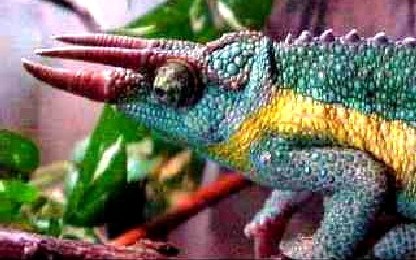
 Family: Chamaeleonidae
Common Name: Jackson's Chameleon
Scientific Name: Trioceros jacksonii
Food: Insects such as crickets, super worms, regular meal worms, butter worms, wax worms, roaches, grasshoppers, snails and the common house flies.
Distribution: Kenya (Kikuyu near Nairobi, highlands of central Kenya except of eastern slopes of Mt. Kenya), Tanzania (Mt. Meru), Kenya (eastern slopes of Mt. Kenya)
Habitat: They are arboreal chameleons, spending most of their time in trees
Color Discription: Light green with a yellow stripe along the flank. A splash of light blue can be seen on the head and tail base. Coloration of the form formerly know as "willegensis" is blue on the head and green on the top part of the body with a canary yellow band on the flank that can extend from the gular region to the tail base. There is blue on the belly, their tails are dark green with blue spots. Female coloration ranges from dark olive to light green.
Physical Discription: Masters of camouflaging themselves, the Jackson’s Chameleon possesses a sophisticated ability to vary their skin pigments to protect themselves from predators. They are able to change their colors to blend in with backgrounds found in the wild, they can also flatten their sides, which gives them the appearance of a leaf on a tree. The size of the jacksonii falls between that of the larger xantholophus and smaller merumontanus. Female jacksonii have a well developed rostral horn. The female's preocular horns vary from absent to well developed. Scale pigmentation on the parietal and dorsal crests are similar to merumontanus and darker than xantholophus. Jacksonii tends to have a "rougher" parietal crest, unlike that of merumontanus and xantholophus which tend to be somewhat smooth. Male horns, especially the rostral, appear to be darker in color and thicker than that of merumontanus and xantholophus. Males of all 3 subspecies (merumontanus, jacksonii and xantholophus) have well developed, annulated preocular and rostral horns. Males exhibit a tail base swelling.
Size: 10" females will be smaller
Temperatures/Humidity: 74° F - 80° F during the day and 57° F - 65° F during the night. Constant temperatures or slight temperature changes, will compromise the health of your chameleon. They will also require an area to bask in, in which the temperature should be 76° F - 80° F. Allowing the temperature to exceed 90° F for a long time will can prove to be fatal. Humidity level need to be between 50% and 75% in their cages,
Breeding/Reproduction: Unlike other chameleons the Jackson’s chameleon gives birth to live young. Females will birth between 6 - 40 live young. Most Jackson’s Chameleons will reach sexual maturity in between 6 - 10 months. For breeding, introduce the female into the male’s cage. Receptive females will usually remain all green or gray green and will not run from the male. Copulation can last about 15 - 20 minutes, and as long as the female shows no signs of stress (color change), they may be left to repeat breeding. The female’s gestation period is between 5 - 10 months, and the female's appetite will decrease because of the growing embryos, coming to a complete stop 1 - 2 days before birthing. Birth will usually occur in the early morning.
Cage Setup: screen aluminum, pre-coated wire or plastic structure netting to build their terrariums. The mesh should be a minimum of 20 x 20 microns, and preferably 1/16". This will allow the chameleon to climb within the cage and prevent insects from escaping. It is recommended to use a minimum enclosure which measures 24" x 24" x 18". Decorate with plants such as Ficus, Gardenia, Jade, Pothos, and Schefflera. As well as plenty of branches to climb on. The Jackson’s Chameleon is a solitary animal in the wild. They should be housed separately, and should not be over handled. It is best if either a male/female pair or trio (one male, two females) be kept together or a single male kept by himself.
Water: Misting as well as a drip system is recommended.
Special Needs: Fluorescent ultraviolet light should be provided for 12 hours each day. A 60 watt bulb should be the maximum wattage used for basking.
Special Note: Jackson’s Chameleons are the only old world chameleons found in the wild in the United States.
They can be most commonly found in Texas, California, and Florida, and many of them are imported from the Hawaiian Islands.
The Jackson’s Chameleons is susceptible to infections, parasites, metabolic bone disease (MBD) and stress, which can compromise their health.
To avoid illness it is recommended to have your chameleon examined regularly by qualified veterinarian who specializes in chameleons.
It is also important to maintain a clean sanitary environment for them to thrive in.
Constant monitoring for changes in behavior, stool and other physical changes is recommended.
If anything is seen that’s out of the ordinary contact your veterinarian.