
 Family: Chamaeleonidae
Common Name: Giant Usambara 3-horned Chameleon
Scientific Name: Trioceros deremensis
Food: Insects
Distribution: Tanzania (Uluguru Mts., Usambara Mts.)
Habitat:
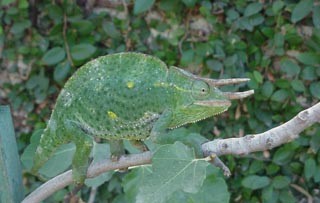
Color Discription: Adults is a medium to pale green with 3 - 4 pale yellow slashes that run in a broken line from behind the eye to midway down the body. A scattering of off- white, blue, red or brown patches and streaks are sometimes present. Excited/stress coloration sports a display of dark green or black spotting. The reverse of this pattern, light spots on a dark green pattern can also be displayed. Hatchlings and young juveniles display the same patterns as adults but on an aqua blue background.
Physical Discription: They are a stocky species and have a short tail relative to their length. The casque is unadorned; it is smooth, flattened and oblong and ends in a point bearing small, unfused occipital lobes. A short gular crest is present. Scalation is smooth. Males possess 3 large annulated (ringed) horns. Female Trioceros deremensis lack all traces of horns. Horn bud scales are not even present.
Size: 12" - 16"
Temperatures/Humidity: Daytime highs should be in the low to mid 70's, and night temperatures in the high 60's, accompanied by high humidity above 80%
Breeding/Reproduction: It is believed that this species does not produce viable, fertile eggs until the females second or third breeding season. Breeding season is thought to be in the fall, but may occur at any time of the year in captivity, perhaps due to environmental conditions (inconclusive). Breeding season, with numerous copulations, may last up to 3 months. Gestation is around four months. 20 - 60 eggs are laid in a single clutch. Incubation is approximately four months at a temperature of 72F. Age of sexual maturity is unknown but is thought to be from 9 - 12 months.
Cage Setup: heavily planted cages and should be maintained separately in screened enclosures.
Water: Drip system as well as misting
Special Needs: This species seems to do best with an ultrasonic humidifier aimed directly at the cage and a constant flow of water dripping (usually directly overhead) on or near them.
Special Note: Only expert keepers should attempt to work with this species.
One unusual trait of this species, particularly babies and juveniles, is their tendency to vibrate their entire bodies - a "shake and wiggle" just prior to shooting their tongue at a prey item.
Typically hearty eaters, males can somewhat decrease their food intake while greatly increasing their activity levels during the breeding season.